

Whether you work as a physician, nurse practitioner, or medical billing specialist, you probably deal with overactive bladder (OAB) on a regular basis. It affects roughly 33 million Americans, yet one of the most common headaches in clinical practice is getting the ICD-10 code for overactive bladder right so claims actually go through.
Get the code wrong, skip one documentation detail, or mix it up with a similar but distinct condition, and you face a denied claim, a compliance risk, or delayed reimbursement. So let’s break this down completely — no fluff, no confusion.
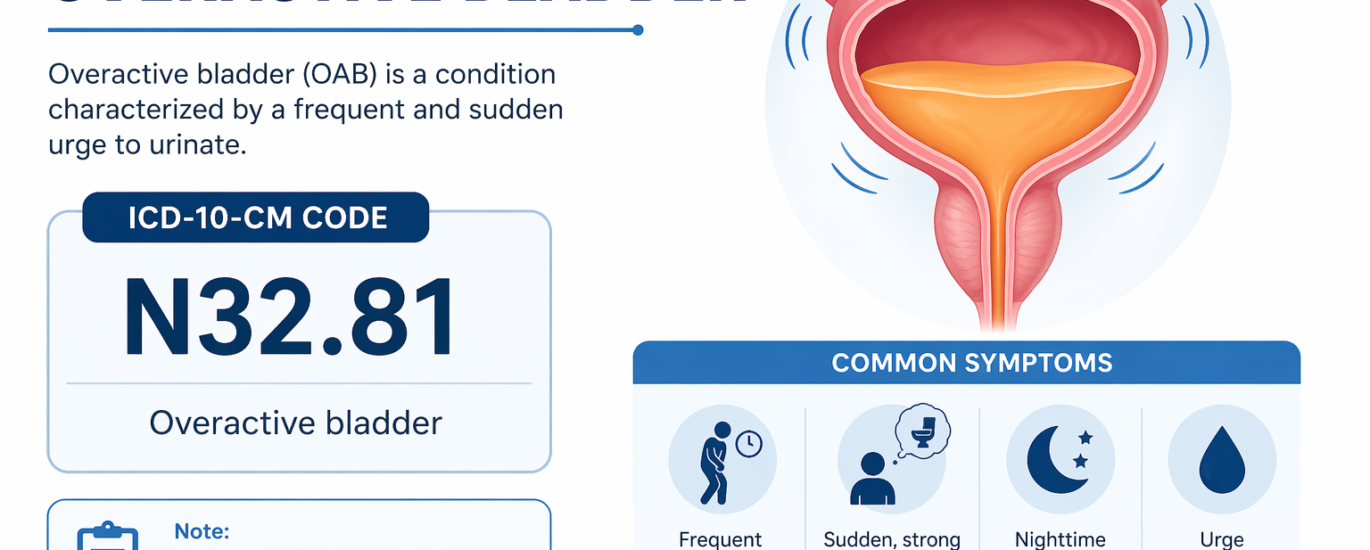
What is the ICD-10 code for overactive bladder?
Overactive bladder is a syndrome defined by a sudden, uncontrollable urge to urinate. It often pairs with increased urinary frequency (more than 8 times per day), nocturia (waking at night to urinate), and sometimes urge incontinence. The key word here is urgency. That’s what separates OAB from other bladder conditions in the ICD-10 system.
Why Does Accurate Coding Matter?
So why does accurate coding matter so much? Because insurance payers, CMS, and commercial carriers all review the medical record to confirm that the diagnosis code has clinical support. A correct code attached to weak or vague documentation still leads to a denial. On the flip side, strong documentation with a wrong code causes just as many problems.
The ICD-10 code for overactive bladder, N32.81, is only appropriate when the patient record clearly documents urgency. Without that documentation, this code becomes medically unsupported and may trigger an audit.
Breaking Down ICD-10 Code N32.81
What the Code Structure Means
Every ICD-10-CM code tells a story through its alphanumeric structure. Here’s how N32.81 breaks down:
- N → Genitourinary system diseases
- N32 → Other disorders of the bladder
- N32.8 → Other specified disorders of the bladder
- N32.81 → Overactive bladder (the specific, billable final-level code)
N32.81 is what coders call a “final-level” or “leaf” code. That means you cannot go any deeper in specificity, and you should not use a parent code like N32.8 for billing purposes. Always use N32.81 when OAB is the confirmed diagnosis.
Clinical Criteria Required for This Code
Before assigning N32.81, clinicians and coders should confirm that the patient’s chart documents the following:
- Urinary urgency – The hallmark symptom. The chart must explicitly state this, not imply it.
- Frequency patterns – How many times per day does the patient void? How often at night? Document the numbers.
- Duration of symptoms – How long has the patient experienced these issues? Weeks? Months?
- Exclusion of neurological causes – If a neurological condition causes the bladder problem, N32.81 is not the right code. Move toward the N31.x series instead.
- Exclusion of infection – Urinalysis results should confirm no active UTI drives the symptoms.
Coding Tip: Always document the ruling-out process. A clinical note like “urinalysis negative; post-void residual normal; no neurologic abnormalities identified” actively protects you in an audit by showing medical necessity behind the N32.81 selection.
Related ICD-10 Codes You Need to Know
OAB doesn’t always travel alone. Patients often present with overlapping conditions, and that’s where many coders run into trouble. Here’s a clear breakdown of the codes that frequently come up alongside or instead of N32.81:
| ICD-10 Code | Description | When to Use |
|---|---|---|
| N32.81 | Overactive bladder | OAB without neurological cause, urgency confirmed, incontinence may or may not be present |
| N39.41 | Urge incontinence | Patient involuntarily leaks urine immediately following urgency; add alongside N32.81 |
| N39.46 | Mixed incontinence | Patient has both stress and urge incontinence documented |
| N31.9 | Neuromuscular dysfunction of bladder, unspecified | Use when a neurological condition drives the bladder dysfunction |
| R32 | Unspecified urinary incontinence | Only when you cannot specify the incontinence type; avoid if OAB is confirmed |
| R35.0 | Frequency of micturition | Use as a supplemental code when frequency is a documented symptom |
| R39.15 | Urinary urgency | Symptom-only code; use only when OAB has not yet received a formal diagnosis |
Note that N39.41 and N32.81 often appear together. If a patient has OAB and also experiences urge incontinence, you bill both. They are not mutually exclusive. However, do not code R39.15 alongside N32.81 because urgency is already part of the N32.81 definition. Coding both would therefore be redundant.
OAB With or Without Incontinence: Does It Change the Code?
This question comes up constantly, so let’s set the record straight. N32.81 covers both presentations: OAB with incontinence and OAB without incontinence. The code itself does not distinguish between the two.
However, when urge incontinence is present and documented, best practice is to additionally code N39.41. This gives payers the full clinical picture and supports medical necessity for treatments like anticholinergics, Botox injections, or peripheral tibial nerve stimulation (PTNS).
Think of it this way: N32.81 describes the bladder condition itself. N39.41 describes the resulting complication. Together, both codes paint a more complete and defensible picture of the patient’s presentation.
Documentation Best Practices to Avoid Claim Denials
What Your Clinical Notes Should Include
Payers review the entire medical record, not just the superbill. So even if you code N32.81 correctly, a sparse or vague clinical note can still get you denied — especially for higher-cost treatments. Here’s what complete documentation looks like for an OAB patient:
- Specific symptom description (e.g., “patient reports 10–12 voids per day with 2–3 episodes of nocturia and strong urgency before each void”)
- Duration of symptoms (e.g., “symptoms present for approximately 6 months”)
- Urinalysis results (to rule out infection)
- Post-void residual volume (to rule out overflow problems)
- Neurological assessment (to rule out neurogenic causes and justify N32.81 over N31.x)
- Treatment history (for advanced therapies, show that conservative treatments came first)
Bladder Diary: A Documentation Tool Worth Using
Many clinicians underuse the bladder diary. When a patient tracks their voiding patterns over 3–7 days, that diary becomes valuable for your documentation. It provides objective data on urgency severity, frequency, and incontinence episodes. Furthermore, referencing the diary findings in your clinical note — and scanning a copy into the record — strengthens your medical necessity argument considerably.
Common Coding Mistakes That Trigger Audits
Even experienced coders make these errors. Being aware of them actively reduces your audit risk.
Using N32.81 for Neurogenic Bladder
If a patient’s OAB symptoms come from multiple sclerosis, Parkinson’s disease, spinal cord injury, or any other neurological condition, N32.81 is the wrong code. Instead, use the N31.x series, which covers neuromuscular dysfunction of the bladder. Assigning N32.81 here is a misclassification that payers will catch during medical review.
Coding R39.15 Alongside N32.81
As noted earlier, urinary urgency is already part of the N32.81 definition. Adding R39.15 on top creates redundant coding that can trigger a flag without adding any clinical value.
Using R32 Instead of N32.81
R32 is a generic, unspecified incontinence code. If you have confirmed OAB and documented it as such, R32 is too vague and it actually under-represents the patient’s condition. Specificity always wins in ICD-10-CM, and N32.81 is far more specific.
Audit Alert: Billing N32.81 for advanced OAB treatments like Botox injections (CPT 52287) or sacral neuromodulation (CPT 64561/64590) without documented conservative treatment failure is a common denial trigger. Always show the treatment escalation pathway in your notes.
N32.81 and Insurance Billing: What You Should Know
Pairing N32.81 With CPT Codes
The ICD-10 code for overactive bladder works alongside several CPT codes depending on what service you bill. Here are the most common pairings:
| Service | CPT Code | Used With |
|---|---|---|
| Office visit (new patient) | 99203–99205 | N32.81 |
| Urinalysis | 81003 | N32.81 (supportive) |
| Botox injection (bladder) | 52287 | N32.81 + N39.41 |
| Percutaneous tibial nerve stimulation | 64566 | N32.81 + N39.41 |
| Sacral neuromodulation lead placement | 64561 | N32.81 + N39.41 |
| Urodynamic testing | 51726 | N32.81 |
MS-DRG Grouping
For inpatient claims, N32.81 groups into MS-DRG 695 (Kidney and urinary tract signs and symptoms with MCC) or MS-DRG 696 (without MCC). This grouping determines your reimbursement tier, so accurate principal diagnosis selection matters just as much in the inpatient setting as it does in the outpatient world.
Excludes Notes: What N32.81 Specifically Excludes
The ICD-10-CM system uses two types of excludes notes, and both apply to N32.81. Understanding them prevents you from pairing codes that should never appear together.
Excludes2 conditions (codes that can appear alongside N32.81 when both are documented): calculus of bladder (N21.0), cystocele (N81.1), and female bladder prolapse or hernia (N81.1). These represent separate, coexisting conditions that happen to involve the bladder.
Key exclusion principle: When frequent urination has a specified bladder condition as its cause, code that condition directly instead of using N32.81. This is precisely why ruling out underlying causes before assigning the OAB code is such an important step in the clinical workflow. “Overactive bladder (N32.81) should not be confused with structural conditions like bladder prolapse (N81.1), which require different diagnosis and coding.”
A Quick Word on ICD-9 vs. ICD-10 for OAB
Older clinical records or crosswalk tools sometimes reference ICD-9 codes. For example, the historical ICD-9 code for OAB was 596.51 (Hypertonicity of bladder). However, since the U.S. fully moved to ICD-10-CM in October 2015, N32.81 is the only valid code for current claims. If you conduct retroactive research or review older records, keep this crosswalk in mind — but never use ICD-9 codes on current billing documents.
Frequently Asked Questions
What is the ICD-10 code for overactive bladder?
The ICD-10 code for overactive bladder is N32.81. It is a billable, final-level code under the genitourinary system chapter (Chapter 14) of ICD-10-CM, specifically within the N30–N39 range covering other diseases of the urinary system. This code is valid for all claims with dates of service on or after October 1, 2024.
Is N32.81 the same as the code for urge incontinence?
No. N32.81 covers overactive bladder as a condition, which may or may not include incontinence. If urge incontinence is specifically present and documented, you should also assign N39.41 (urge incontinence) alongside N32.81. The two codes work together and are not mutually exclusive.
Can I use N32.81 if the patient has a neurological condition causing bladder symptoms?
No. N32.81 is specifically for overactive bladder without a neurological cause. If a patient’s symptoms come from a condition like multiple sclerosis, Parkinson’s disease, or spinal cord injury, the appropriate codes fall within the N31.x series, which covers neuromuscular dysfunction of the bladder. Using N32.81 in this scenario is a misclassification.
What documentation do I need to support N32.81?
Your clinical note should clearly document urinary urgency, voiding frequency patterns (both daytime and nighttime), symptom duration, a negative urinalysis to rule out infection, a normal post-void residual to rule out overflow problems, and a neurological assessment. Additionally, for patients receiving advanced treatments like Botox or nerve stimulation, you should also document that conservative treatments came first.
What was the ICD-9 code for overactive bladder?
The previous ICD-9-CM code for overactive bladder was 596.51 (Hypertonicity of bladder). However, since the full U.S. move to ICD-10-CM in October 2015, N32.81 is the only valid code for current claims. ICD-9 codes should only appear in historical record reviews, not on any current billing documents.
Can N32.81 be used with CPT codes for Botox bladder injections?
Yes. N32.81 (along with N39.41 if urge incontinence is documented) is the appropriate ICD-10 diagnosis code to pair with CPT code 52287 for intradetrusor Botox injection. Payers typically require documentation of failed conservative management before approving this advanced therapy, so make sure your clinical notes reflect that treatment escalation pathway.
Summary: Quick Reference for N32.81
Chapter: 14 – GU System
Code: N32.81
Status: Billable & Valid