

If you work in medical billing, clinical documentation, or healthcare administration, you have probably typed the letters “N39” more times than you can count. But when it comes to the ICD-10 Code for Urge Incontinence, a lot of providers and coders still get confused about what exactly it covers, how it compares to related codes like stress incontinence ICD-10 or mixed incontinence ICD-10, and why getting it wrong can cost your practice real money. So let’s break it all down in plain English, right now.
What Is the ICD-10 Code for Urge Incontinence?
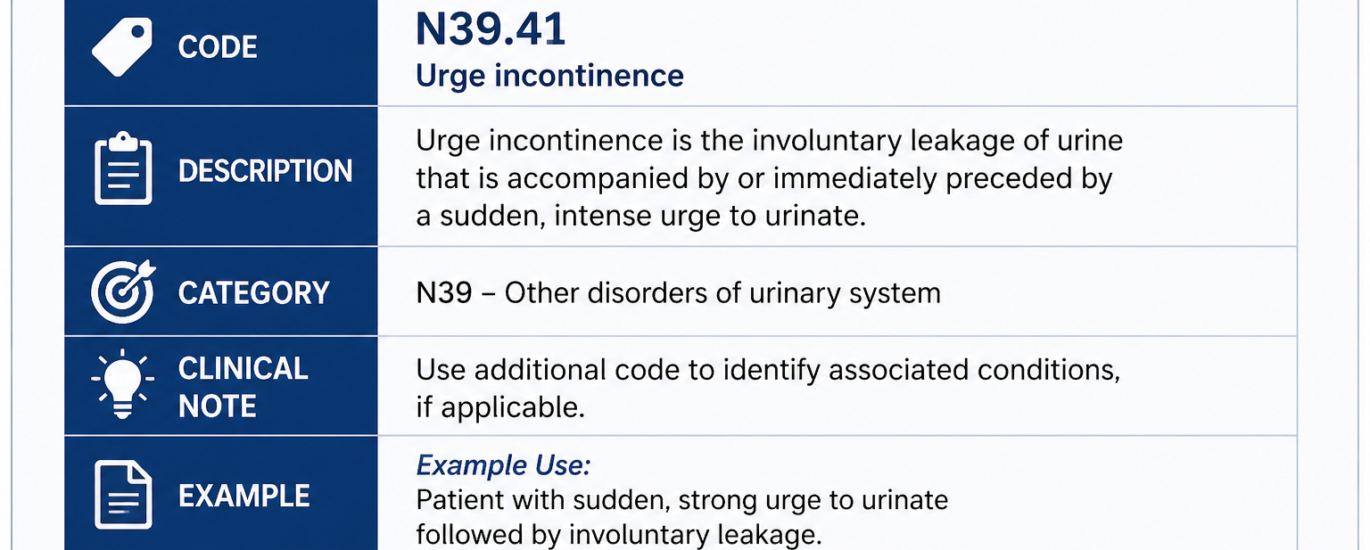
The ICD-10 code for urge incontinence is the ICD-10-CM billable code for urge incontinence. Specifically, it captures the involuntary loss of urine that happens right after a person feels a sudden, overwhelming urge to urinate but cannot hold it long enough to reach the toilet. Think of it as the “gotta go RIGHT NOW” problem — and then the leakage that follows when the bladder wins that race.
This code falls under Chapter 14 of the ICD-10-CM classification system, which covers diseases of the genitourinary system (N00-N99). More specifically, it sits within the N30-N39 subgroup: Other Disorders of the Urinary System. The N39.41 diagnosis code stays fully valid for the current fiscal year spanning October 1, 2025 through September 30, 2026, and it works for HIPAA-covered transactions across all care settings.
Here is the exact place it lives in the ICD-10 hierarchy:
- N39 — Other disorders of urinary system
- N39.4 — Other specified urinary incontinence
- N39.41 — Urge incontinence (billable)
ICD-10 Code for Urge Incontinence: The Full Picture
Before diving deeper into N39.41, it really helps to understand how urinary incontinence ICD-10 coding works as a whole. The ICD-10 system gives providers a specific code for nearly every type of bladder leakage. This matters because choosing a vague or unspecified code like R32 (urinary incontinence, unspecified) instead of a precise code like N39.41 triggers denied insurance claims, audit risks, and incomplete clinical records.
Here are the most commonly used incontinence ICD-10 codes you will run across:
N39.0 — Urinary Tract Infection, Site Not Specified Many people confuse N39.0 with an incontinence code, but it actually serves as the go-to code for a urinary tract infection (UTI) without a more specific location. However, UTIs can temporarily cause or worsen urgency symptoms, so you will sometimes see N39.0 coded alongside N39.41. When a coder asks whether to use N39.0 for a simple UTI, the answer is yes — as long as the documentation does not offer further specificity.
N39.3 — Stress Incontinence (Female) (Male) This is the stress incontinence ICD-10 code. Stress incontinence involves leakage that physical pressure on the bladder triggers — coughing, sneezing, laughing, or lifting something heavy. Weak pelvic floor muscles or a displaced bladder usually drive this condition, not an overactive detrusor muscle. Providers must clearly document that leakage occurs with exertion, not urgency, to justify this code.
N39.41 — Urge Incontinence This is the main code we focus on today. Coders apply it when the patient experiences leakage immediately preceded by a sudden, uncontrollable urge to void.
N39.46 — Mixed Incontinence The mixed incontinence ICD-10 code (N39.46) applies when a patient shows documented features of both urge incontinence and stress incontinence at the same time. This combination shows up more often than many providers realize, especially in older women. If you feel unsure whether to pick N39.41 or N39.46, go straight to the clinical documentation. Does the patient report both urgency-triggered leakage AND exertion-triggered leakage? If yes, N39.46 is the right call.
When Exactly Should You Use the N39.41 Diagnosis Code?
This is where a lot of coders and clinicians get tripped up. You should use the ICD-10 code for urge incontinence only when clinical documentation specifically shows that urgency precedes the leakage. That one detail is everything. If the note just says “incontinence” without specifying urgency, do not reach for N39.41 — default to the unspecified code R32 instead.
So, for accurate N39.41 coding, the provider’s documentation should ideally include language like:
- “Patient reports urine leakage immediately after a strong urge to void”
- “Leakage occurs 3 to 4 times daily, always preceded by urgency”
- “Urge incontinence confirmed; patient cannot reach the toilet in time after urge onset”
That level of specificity directly supports the ICD-10 code for urge incontinence and protects the claim during audits.
Furthermore, when the documentation also identifies an overactive bladder (N32.81), ICD-10 guidelines tell coders to report both N39.41 and N32.81 together. These two conditions frequently travel together, and accurate dual coding gives payers and clinical databases a much clearer picture of what the patient actually deals with.
Common Coding Mistakes With the N39.41 Diagnosis Code
Even experienced coders slip up on urge incontinence ICD-10 coding from time to time. Here are the most frequent pitfalls to watch out for:
Using R32 when urgency is documented. R32 covers incontinence NOS (not otherwise specified). Once a provider documents that the patient feels urgency before the leakage episode, you have enough specificity to reach for N39.41. Defaulting to the vague code creates a documentation error and throws off clinical data quality.
Mixing up N39.41 and N39.46. When your documentation only supports urgency-driven leakage, stick with N39.41. When it clearly supports both urgency AND stress components, move to the mixed incontinence ICD-10 code N39.46. Never guess — always code what the notes actually say.
Skipping the overactive bladder add-on. When the provider diagnoses overactive bladder alongside urge incontinence, you need both codes on the claim. Dropping N32.81 when the provider clearly documents it creates a coding error that can hit reimbursement and quality reporting metrics.
Applying N39.41 to functional or cognitive incontinence. When leakage happens because the patient cannot physically reach the bathroom (functional incontinence) or because of cognitive impairment, the right code is R39.81, not N39.41. The N39 category explicitly excludes functional urinary incontinence, so catching this early saves you from a compliance headache later.
N39.41 and the DRG Assignment
From a reimbursement standpoint, the N39.41 diagnosis code falls within the MS-DRG (Medicare Severity Diagnosis Related Group) system under two groupings:
- DRG 695 — Kidney and Urinary Tract Signs and Symptoms with MCC
- DRG 696 — Kidney and Urinary Tract Signs and Symptoms without MCC
Getting the DRG assignment right directly affects how much your facility collects for inpatient stays. When coders accurately apply the N39.41 diagnosis code and providers document any major complicating conditions (MCCs), the reimbursement correctly reflects the actual clinical complexity of the case — instead of leaving money on the table.
Documentation Best Practices for ICD-10 code for urge incontinence
Solid documentation forms the backbone of accurate ICD-10 coding. For urge incontinence, high-quality clinical notes should include all of the following to fully support the N39.41 diagnosis code:
- Frequency of leakage episodes per day or week
- Clear confirmation that urgency immediately precedes the leakage
- Presence or absence of stress triggers such as coughing or sneezing
- Voiding diary results when available (ideally showing more than 8 voids per 24 hours)
- Any associated diagnosis of overactive bladder
- Treatments the provider has tried or plans to try (bladder training, medications, pelvic floor therapy)
When providers consistently document these details, coders can assign N39.41 with full confidence, and claims move through payers without friction.
Excluded Conditions: What N39.41 Does NOT Cover
The ICD-10-CM Excludes1 note attached to N39.41 carries real weight. The following conditions sit outside its scope, and you should never code them as N39.41:
Knowing these exclusions keeps your coding compliant and prevents costly claim denials from popping up down the road.
Quick Reference: N39 Incontinence Code Comparison Table
- Enuresis NOS — use R32
- Functional urinary incontinence — use R39.81
- Urinary incontinence associated with cognitive impairment — use R39.81
- Urinary incontinence NOS — use R32
- Urinary incontinence of nonorganic origin — use F98.0
| ICD-10 Code | Type | Key Feature |
|---|---|---|
| N39.0 | UTI, site not specified | Infection-related, not incontinence |
| N39.3 | Stress incontinence | Physical exertion triggers leakage |
| N39.41 | Urge incontinence | Sudden urgency precedes leakage |
| N39.46 | Mixed incontinence | Both urgency and exertion trigger leakage |
| N39.490 | Overflow incontinence | Overfull bladder leaks |
| R32 | Unspecified incontinence | Use only when type goes undocumented |
Frequently Asked Questions
What does the ICD-10 code for urge incontinence represent?
The ICD-10 code for urge incontinence identifies urge incontinence in ICD-10-CM. Providers and coders apply it when a patient experiences involuntary urine leakage that a sudden, strong urge to urinate directly precedes. The code covers claims from October 2025 through September 2026.
What is the difference between N39.41 and N39.46?
N39.41 covers urge incontinence alone — leakage that urgency causes and nothing else. N39.46 is the mixed incontinence ICD-10 code, and coders use it when the patient shows both urgency-triggered and exertion-triggered leakage in the documentation at the same time. Do not reach for N39.46 unless the notes clearly support both types.
Can coders use N39.41 and N32.81 on the same claim?
Yes, absolutely. ICD-10 guidelines specifically tell coders to add N32.81 for overactive bladder whenever the provider documents that condition alongside urge incontinence. Reporting both codes paints a more complete clinical picture and supports accurate reimbursement.
Does N39.0 connect to incontinence?
No. N39.0 covers urinary tract infection (UTI) without a specified site — it does not describe any form of incontinence. That said, a UTI can cause or worsen urgency symptoms, so in those situations both N39.0 and N39.41 may appear on the same claim, depending on what the provider documents.
What risk does using R32 instead of N39.41 carry?
Reporting R32 (unspecified urinary incontinence) when the documentation clearly shows urge incontinence counts as a coding error. That mistake can generate lower-quality clinical data, trigger potential audit findings, and in some cases produce denied or downcoded claims. Always code to the highest level of specificity the documentation supports.
What is the stress incontinence ICD-10 code?
Providers and coders use N39.3 for stress incontinence. This code covers leakage that physical pressure or exertion triggers — things like coughing, sneezing, or lifting. It represents a completely different condition from urge incontinence, so coders should never swap it for N39.41.
Does N39.41 cover both men and women?
Yes. Urge incontinence gets more attention in female patients, but the N39.41 diagnosis code covers both male and female patients equally. The underlying cause may differ — neurological conditions, prostate issues in men, or overactive bladder in either sex — but the code itself carries no gender restriction.
This article targets medical coders, healthcare professionals, and clinical documentation specialists. Always consult the official ICD-10-CM coding guidelines and a certified coder or compliance officer for case-specific coding decisions.