

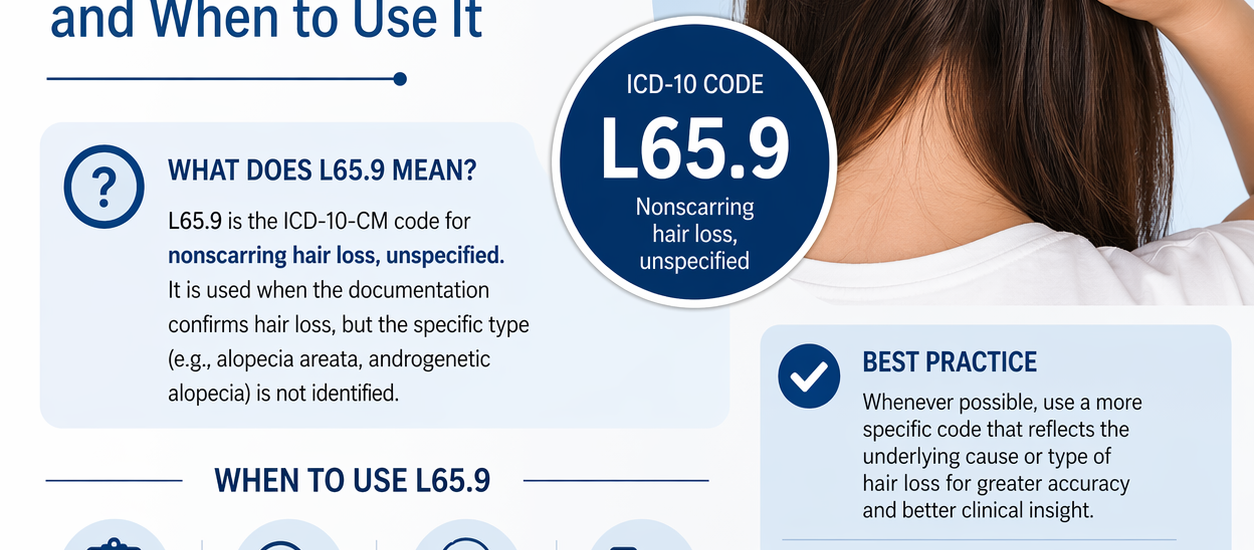
If you have ever sat in a doctor’s office wondering why they keep typing codes into their computer, here is the deal. Every medical condition carries a unique alphanumeric label under a system called ICD-10-CM — International Classification of Diseases, 10th Revision, Clinical Modification. Therefore, when a doctor diagnoses you with hair loss, they do not just write “hair loss” and call it a day. Instead, they assign a specific ICD-10 code for hair loss — such as L65.9 — that tells insurance companies, researchers, and billing teams exactly what type of hair loss you have.
The most widely used ICD-10 code for hair loss unspecified is L65.9, which stands for nonscarring hair loss, unspecified. However, that is just one code in a whole family of hair loss codes. Depending on your specific condition, the right code could be something entirely different.
Understanding these codes matters whether you are a patient trying to make sense of your paperwork, a medical coder working to avoid claim denials, or a healthcare provider who wants accurate documentation. So let’s break it all down in plain, easy-to-understand language.
The Main ICD-10 Codes for Hair Loss: A Full Breakdown
Hair loss codes primarily fall within the L60-L75 range of ICD-10-CM, which covers disorders of skin appendages. Below is a clear walkthrough of every major code you will encounter.
L65.9 — Nonscarring Hair Loss, Unspecified
This is the go-to ICD-10 code for hair loss unspecified, and it ranks among the most commonly used codes in dermatology. Specifically, L65.9 applies when a patient clearly has hair loss that is nonscarring in nature, but the exact type has not been confirmed yet.
The key phrase here is “nonscarring.” In nonscarring hair loss, the hair follicles stay intact, which means hair regrowth is still biologically possible. This is a huge distinction from scarring alopecia, where follicles face permanent destruction.
Doctors use L65.9 as a temporary or catch-all code while they run further tests to narrow things down. For medical coders, however, using this “unspecified” code too often acts as a red flag during audits. Therefore, always push for more specificity when clinical documentation allows it.
L65.0 — Telogen Effluvium
Telogen effluvium is that frustrating type of hair shedding that hits a few months after a major stressor, like childbirth, surgery, illness, or extreme emotional trauma. Essentially, a large chunk of hair follicles all shift into the resting phase at the same time, causing significant but usually temporary shedding.
This condition is one of the most common forms of nonscarring hair loss, and it gets its own specific code: L65.0. Moreover, because it frequently gets miscoded under the generic L65.9, it ends up distorting data and billing records. So if telogen effluvium is clinically confirmed, coders should always reach for L65.0 instead.
L65.8 — Other Specified Nonscarring Hair Loss
When a patient has a confirmed nonscarring hair loss condition that does not fit neatly into any other specific code in the L65 series, L65.8 is the right pick. Think of it as the “everything else that is still nonscarring” bucket. Conditions like alopecia mucinosa or other rare nonscarring subtypes typically land here.
Alopecia Areata ICD-10 Codes (L63 Series)
Alopecia areata ICD-10 codes live in their own dedicated range: L63.0 through L63.9. This condition is an autoimmune disorder where the immune system mistakenly attacks hair follicles, causing patchy, unpredictable hair loss. About 6.8 million Americans currently live with it, which makes it one of the most common autoimmune disorders in the country.
How the L63 Series Breaks Down
Here is exactly how each code in this series works:
L63.0 — Alopecia (Capitis) Totalis: This code applies when a patient has lost all hair on the scalp — total scalp baldness, not just patches.
L63.1 — Alopecia Universalis: This is the most severe form. The patient loses all hair everywhere on the body, including eyebrows, eyelashes, and body hair.
L63.2 — Ophiasis: This specific variant causes hair loss in a band-like pattern around the sides and back of the head.
L63.8 — Other Alopecia Areata: Variants that do not fit the subtypes above belong here.
L63.9 — Alopecia Areata, Unspecified: Providers use this when the alopecia areata ICD-10 documentation confirms the autoimmune condition but does not specify the subtype.
Why Specificity Matters in L63 Coding
Alopecia ICD-10 coding for the L63 series shows strong diagnostic accuracy. That said, providers should always document whether the loss is patchy, total, or universal so the clinical record supports the most specific code possible.
Androgenic Alopecia ICD-10 Codes (L64 Series)
Androgenic alopecia ICD-10 codes fall under the L64 category. Androgenetic alopecia is the medical term for what most people simply call male pattern baldness or female pattern hair loss. Genetics and the hormone dihydrotestosterone (DHT) drive this condition.
The Three Core L64 Codes
L64.0 — Drug-Induced Androgenic Alopecia: Providers use this specifically when a medication directly causes androgenic-type hair loss. Testosterone therapy is a classic trigger, and documentation must clearly link the drug to the hair loss pattern.
L64.8 — Other Androgenic Alopecia: This covers androgenetic alopecia that is not drug-induced. Notably, this code also handles female pattern hair loss associated with PCOS (polycystic ovary syndrome).
L64.9 — Androgenic Alopecia, Unspecified: When the diagnosis of androgenic alopecia is confirmed but the specific subtype is not yet identified, this code fills the gap.
How the Pattern Differs by Gender
In men, androgenic alopecia shows up as a receding hairline and crown thinning forming that classic “M” shape. In women, however, the pattern looks entirely different. The ICD-10 code for hair loss female related to androgenic alopecia typically presents as diffuse thinning at the top of the head with a widening middle part, and it rarely leads to full baldness.
ICD-10 Code for Female Pattern Hair Loss
Many people specifically search for the ICD-10 code for female pattern hair loss and the ICD-10 code for hair loss female. So here is a clear answer:
Which Codes Apply to Women
Female pattern hair loss (FPHL) is a form of androgenetic alopecia, and therefore it codes under the L64 series. Specifically, L64.8 covers other androgenetic alopecia, which includes FPHL. Additionally, if FPHL links to hormonal conditions like PCOS, providers may need extra coding alongside the alopecia code. Furthermore, if the pattern is confirmed but not further specified, L64.9 can apply.
What Coders Must Document
The critical thing for coders is to document both the gender of the patient and the confirmed pattern of loss in the clinical notes. Without that documentation, auditors can challenge the specificity of the code and trigger a denial.
Scarring Alopecia Codes (L66 Series)
Scarring alopecia operates in a completely different ballgame. In these conditions, inflammation permanently destroys the hair follicles. Because there is no coming back from it, accurate coding matters even more in this category.
Key L66 Codes to Know
L66.0 — Pseudopelade: A rare form of progressive scalp scarring that gradually erases the hairline.
L66.1 — Lichen Planopilaris: An inflammatory scarring alopecia that primarily affects the scalp.
L66.12 — Frontal Fibrosing Alopecia (FFA): A newer code added in October 2024. It describes progressive hairline recession typically seen in postmenopausal women.
L66.2 — Folliculitis Decalvans: Bacterial inflammation that scars the scalp over time.
L66.81 — Central Centrifugal Cicatricial Alopecia (CCCA): Also introduced in October 2024, this condition disproportionately affects women of African descent and involves inflammation spreading outward from the crown.
L66.9 — Cicatricial Alopecia, Unspecified: The catch-all for confirmed scarring alopecia without a specified subtype.
Quick Reference: ICD-10 Hair Loss Code Cheat Sheet
| Code | Condition | Key Feature |
|---|---|---|
| L65.9 | Nonscarring hair loss, unspecified | Follicles intact, type not confirmed |
| L65.0 | Telogen effluvium | Stress-triggered shedding |
| L65.8 | Other specified nonscarring hair loss | Confirmed but rare subtype |
| L63.9 | Alopecia areata, unspecified | Autoimmune, patchy loss |
| L63.0 | Alopecia totalis | Full scalp hair loss |
| L63.1 | Alopecia universalis | Full body hair loss |
| L64.9 | Androgenic alopecia, unspecified | Pattern baldness, cause unspecified |
| L64.0 | Drug-induced androgenic alopecia | Medication-related |
| L64.8 | Other androgenic alopecia | Includes female pattern hair loss |
| L66.9 | Scarring alopecia, unspecified | Permanent follicle destruction |
| L66.81 | CCCA | Primarily affects women of African descent |
| L66.12 | Frontal fibrosing alopecia | Progressive hairline recession |
Documentation Tips to Avoid Claim Denials
Whether you are a provider or a coder, strong documentation is the difference between smooth reimbursement and a nightmare audit. So here is exactly what to include.
For Nonscarring Hair Loss (L65 Series)
First, confirm the absence of scalp scarring directly in your clinical notes. Next, perform and record a trichogram or pull test when possible. Finally, specify whether the hair loss is diffuse, patchy, or follows a particular pattern.
For Alopecia Areata (L63 Series)
Start by documenting the presence of exclamation mark hairs if they are visible during examination. Additionally, note whether loss is limited to the scalp or has progressed to a universal pattern. Also, record SALT (Severity of Alopecia Tool) scores to track progression over time.
For Androgenic Alopecia (L64 Series)
Always clearly document the hair loss pattern in the chart. For drug-induced cases, include the specific medication and the timeline of hair loss onset. For female patients, specifically note any associated hormonal conditions like PCOS, since these directly support the code selection.
Common Coding Mistakes to Watch Out For
Even experienced coders slip up sometimes, so let’s cover the most frequent errors in hair loss coding.
Using L65.9 as a Permanent Code
First and most commonly, coders use L65.9 even after a more specific diagnosis has been confirmed. This is one of the top audit triggers in dermatology billing, and avoiding it is straightforward — simply update the code once the subtype is confirmed.
Mixing Up L63 and L65
Another frequent error involves confusing the L63 and L65 series. Alopecia areata is an autoimmune condition and belongs firmly in L63. It does not belong in L65, even though both cover nonscarring types.
Skipping Secondary Drug Codes
Similarly, coders often forget to add secondary codes when hair loss results from a medication. Always pair drug-induced cases with the appropriate adverse effect code from the T36-T50 range to stay compliant.
Ignoring the Scarring vs. Nonscarring Distinction
Finally, failing to distinguish between scarring and nonscarring types is a fundamental error that changes the entire code family. Providers must confirm this distinction through clinical examination before coding begins.
The Link Between Coding and Patient Care
Beyond billing, these codes directly shape the treatment plan. Because hair loss — clinically called alopecia — can stem from autoimmune diseases, hormonal imbalances, nutritional deficiencies, stress, genetics, or medications, the right code helps the entire care team stay on the same page. Consequently, a wrong code does not just hurt the bill; it can delay the right treatment.
So yes, getting this right genuinely does matter.
Frequently Asked Questions (FAQs)
What is the ICD-10 code for hair loss unspecified?
The ICD-10 code for hair loss unspecified is L65.9, which stands for nonscarring hair loss, unspecified. Providers use it when hair loss is confirmed but the exact subtype has not yet been determined through diagnostic testing.
What is the ICD-10 code for alopecia areata?
The primary alopecia areata ICD-10 code is L63.9, used when the autoimmune hair loss condition is diagnosed but the specific subtype is not identified. More specific options include L63.0 for total scalp hair loss and L63.1 for complete body hair loss.
What is the ICD-10 code for female pattern hair loss?
Female pattern hair loss typically codes under L64.8 (other androgenic alopecia) or L64.9 (androgenic alopecia, unspecified). Clinical notes should confirm the female pattern of diffuse thinning at the top of the scalp with a widening middle part.
What does L65.9 mean exactly?
L65.9 is the ICD-10-CM code for nonscarring hair loss, unspecified. The “nonscarring” part confirms that the hair follicles are still alive and regrowth is theoretically possible. The “unspecified” part simply means the exact subtype has not yet been narrowed down through diagnostic workup.
Is androgenic alopecia ICD-10 coded the same for men and women?
Not always. Male pattern baldness often falls under L64.9 or L64.0 if a drug causes it. Female pattern hair loss, on the other hand, typically falls under L64.8. The documented hair loss pattern and any associated conditions like PCOS determine the right pick.
Can hair loss qualify as both cosmetic and medical?
Absolutely yes. While many people view hair loss as purely cosmetic, it can medically signal thyroid disorders, autoimmune conditions, nutritional deficiencies, or hormonal imbalances. Accurate ICD coding helps insurance payers understand the clinical necessity of treatment and supports medical necessity documentation.
What new ICD-10 hair loss codes were recently added?
In October 2024, two important codes arrived: L66.81 for Central Centrifugal Cicatricial Alopecia (CCCA) and L66.12 for Frontal Fibrosing Alopecia (FFA). These additions allow providers to document these specific scarring conditions far more precisely than before.
What is the difference between L63 and L65 codes?
L63 codes cover alopecia areata, an autoimmune condition where the immune system attacks hair follicles. L65 codes, by contrast, cover nonscarring hair loss types that are not autoimmune in origin, such as telogen effluvium or other unspecified nonscarring loss.
Final Thoughts.
The ICD-10 code for hair loss you select truly matters — not just for billing, but for accurate patient care, research, and treatment planning. Whether you are looking at the catch-all L65.9, diving into alopecia areata ICD-10 codes in the L63 series, exploring androgenic alopecia ICD-10 options in L64, or navigating the newer codes for scarring conditions, each code tells a very specific clinical story.
Always aim for specificity over vagueness. The more precise your documentation, the better the outcome for everyone involved — from the patient sitting in the exam chair to the coder processing the claim.