

What Exactly Is Z12.31 and Why Does It Matter in 2026?
If you work in medical billing, radiology, or healthcare administration, you already know that one wrong code can tank a claim fast. So let us talk straight about Z12.31, the ICD-10-CM diagnosis code that carries the full weight of breast cancer screening documentation across the United States.
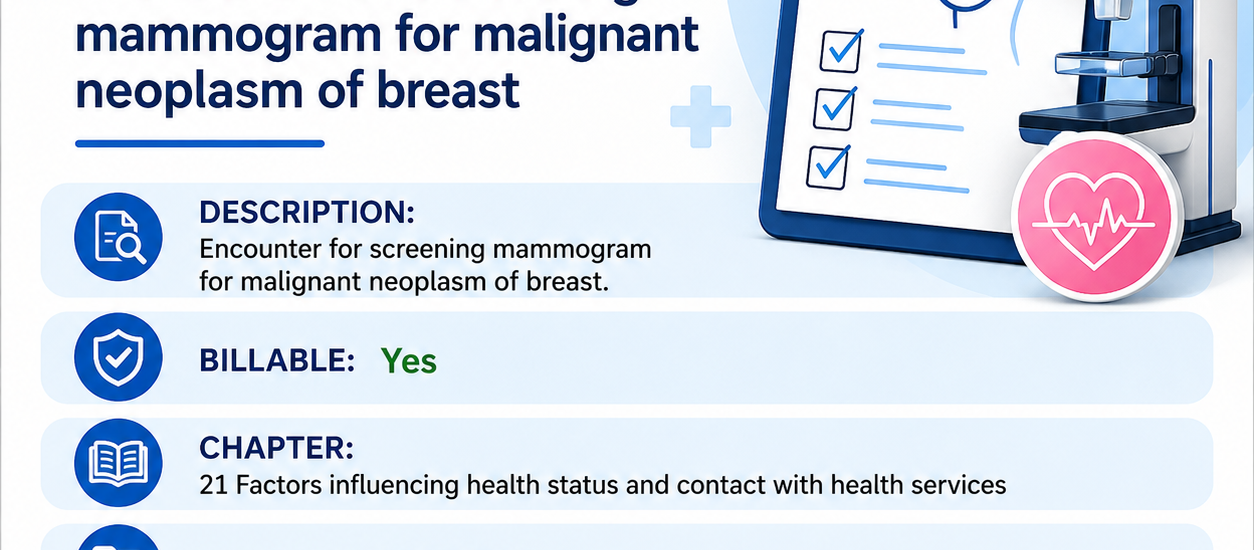
In simple terms, Z12.31 stands for Encounter for Screening Mammogram for Malignant Neoplasm of Breast. That sounds like a mouthful, but the concept is actually very easy to grasp. Basically, this code tells the insurance company that the patient came in for a routine mammogram, not because something was wrong, but because the goal was to catch any problem before it starts.
Furthermore, this code matters even more specifically in 2026. The 2026 edition of ICD-10-CM Z12.31 became effective on October 1, 2025. Importantly, the code structure has stayed completely stable, which is great news for billers and coders everywhere. There is no replacement code, no transition chaos, and no mapping headaches. However, payers are now stricter about asymptomatic-only use, so coding compliance is more critical than ever before.
Additionally, this code is both billable and specific, meaning it ties directly to reimbursement. Therefore, whether you are a coder, a provider, or a billing manager, understanding Z12.31 inside and out is absolutely non-negotiable.
The Real Meaning of Z12.31 — Breaking It Down Simply
Let us decode this code step by step so you never mix it up again.
First, Z codes in ICD-10-CM belong to the “Factors Influencing Health Status” category, which runs from Z00 through Z99. These are not disease codes at all. Instead, they describe why a patient showed up, not what is medically wrong with them. Second, Z12 is the parent code for Encounter for Screening for Malignant Neoplasms. Next, Z12.3 drills specifically down to screening for malignant neoplasms of the breast. Finally, Z12.31 means the patient had a screening mammogram specifically, which is an X-ray imaging test of the breast tissue used to look for signs of cancer when absolutely no symptoms are present.
So in plain American English: the patient felt totally fine, had no lumps, no pain, no nipple discharge, and no visible changes, yet still came in to get checked proactively. That preventive mindset is exactly what this code captures beautifully.
Think of Z12.31 as the “routine checkup” code for breasts. It is proactive, not reactive. Moreover, it reflects one of the smartest preventive healthcare decisions a woman can make for her long-term health.
Who Should Use the Z12.31 Diagnosis Code — and Who Definitely Should Not?
This is precisely where a lot of billers trip up, so pay very close attention here.
Use Z12.31 When:
- The patient is asymptomatic with absolutely no symptoms whatsoever.
- The visit is part of a routine preventive program, whether annual or periodic.
- The mammogram was ordered as part of a wellness or preventive care plan.
- The patient has a family history of breast cancer — in that case, also add Z80.3 as a secondary code.
- The patient is considered high-risk but is currently asymptomatic.
Do NOT Use Z12.31 When:
- The patient presents with a palpable lump, breast pain, nipple discharge, or skin dimpling.
- The visit is actually a follow-up after a prior abnormal mammogram finding.
- The patient has a personal history of breast cancer — use Z85.3 instead in that situation.
- The mammogram result came back inconclusive — switch to R92.2 in that case.
- The encounter was clearly diagnostic from the start, triggered by a symptom or a clinical finding.
The rule here is straightforward. If the patient has any reason for the visit beyond routine prevention, then Z12.31 is simply the wrong pick. Moreover, using it incorrectly for a symptomatic patient is one of the top reasons claims get denied and audits get triggered across billing departments.
Symptoms That Automatically Disqualify Z12.31 — Know These Cold
Since Z12.31 applies strictly to asymptomatic encounters, you must know exactly which symptoms rule it out completely. Coders often second-guess themselves at this point, so let us clear everything up once and for all.
If a patient walks in reporting any of the following symptoms, do not touch Z12.31 under any circumstances:
- A lump or thickening in the breast or underarm area
- Persistent breast pain or unexplained tenderness
- Nipple discharge, whether bloody or otherwise
- Visible changes in breast shape, size, or skin texture
- Dimpling or puckering of skin, sometimes called “orange peel skin”
- Redness or flaking specifically around the nipple area
Once any symptom appears in the chart, you are immediately in diagnostic territory. As a result, the correct approach is to assign a symptomatic diagnosis code instead. Furthermore, the CPT code changes from 77067 (screening mammography) to 77065 or 77066 (diagnostic mammography), and that switch carries major reimbursement implications. Therefore, getting the ICD-10 code right from the very start saves everyone a serious headache down the line.
Causes and Risk Factors That Drive Screening Mammograms
So why exactly does someone get a screening mammogram in the first place? Understanding the clinical picture helps coders assign the right secondary codes alongside Z12.31 more accurately.
Primary Reasons Patients Seek Routine Screening:
- Age: Most major clinical guidelines recommend starting mammogram screenings at age 40. However, some high-risk individuals need to begin earlier.
- Family history: A first-degree relative, such as a mother, sister, or daughter, diagnosed with breast cancer significantly raises risk. Consequently, code this relationship with Z80.3.
- Genetic mutations: BRCA1 and BRCA2 gene mutations are major red flags that push screening earlier and more frequently.
- Dense breast tissue: Women with dense breasts face both a higher cancer risk and harder-to-read mammogram images, which in turn requires closer monitoring.
- Prior breast biopsies: Past abnormal biopsy findings can indicate an elevated risk profile that justifies more frequent screening.
- Hormone therapy history: Long-term use of combined hormone replacement therapy slightly but measurably increases overall breast cancer risk.
- Obesity and sedentary lifestyle: These lifestyle factors contribute to overall cancer risk and therefore support earlier or more frequent screening.
Knowing the patient’s full risk profile also determines screening frequency directly. For example, high-risk women may need annual mammograms plus supplemental MRI. Average-risk women, on the other hand, typically screen every one to two years. When billers understand the clinical why behind the visit, documentation becomes more precise, and as a result, reimbursement flows much more smoothly.
Billing Tips for Z12.31 That Actually Work in 2026
Here is where real experience pays off. After years of watching claims get denied over completely avoidable mistakes, these billing tips will help you get it right every single time.
Tip 1: Always Confirm the Patient Is Truly Asymptomatic First
Before assigning Z12.31, review the clinical notes carefully and thoroughly. The documentation must clearly state that the encounter is for routine screening with absolutely no symptoms present. If the physician’s notes mention any breast-related complaint at all, flag the encounter immediately for review before submission.
Tip 2: Match Your CPT Code Precisely to Your ICD-10 Code
This step is absolutely critical. The most common payer edit in breast imaging billing is a mismatch between the diagnosis and procedure codes. Because of this, here is the exact breakdown you need to follow:
| Encounter Type | ICD-10 Code | CPT Code |
|---|---|---|
| Routine screening, asymptomatic | Z12.31 | 77067 (bilateral with CAD) |
| Diagnostic — symptomatic patient | Symptom-specific code | 77065 / 77066 |
| Screening converts to diagnostic after abnormal finding | Z12.31 (primary) + R92.8 (secondary) | May shift to 77065/77066 |
| Inconclusive mammogram result | R92.2 | Per radiologist orders |
Pro Tip: Never pair a diagnostic CPT code (77065 or 77066) with a screening ICD-10 code (Z12.31). That combination fires an automatic denial in most payer systems almost instantly.
Tip 3: Use Secondary Codes Strategically and Consistently
Z12.31 almost always works best when paired with secondary codes that explain why the patient is being screened. Therefore, consider adding these regularly:
- Z80.3 — Family history of malignant neoplasm of breast
- Z15.01 — Genetic susceptibility to malignant neoplasm of breast, specifically for BRCA mutation carriers
- R92.8 — Abnormal mammogram finding, used as a secondary code when screening turns up something unexpected
Tip 4: Document the Encounter Purpose in Plain, Clear Language
The physician’s note should use the explicit phrase “screening mammogram” without any ambiguity. Vague documentation like “mammogram ordered” or just “breast imaging” leaves far too much room for payer interpretation, and that interpretation almost always works against reimbursement.
Tip 5: Flag Screening-Turned-Diagnostic Encounters Before Submission
Sometimes a patient arrives for routine screening, but the radiologist spots something and immediately orders additional views. In that specific scenario, per ICD-10-CM official guidelines, Z12.31 stays as the principal diagnosis. The abnormal finding such as R92.8 becomes a secondary code. However, the CPT code may still change, so always flag these encounters for senior coder review before submitting the claim.
Tip 6: Understand the POA Exemption and Use It Correctly
Z12.31 is exempt from Present on Admission (POA) reporting for inpatient admissions. This exemption saves time during inpatient claim prep. However, keep in mind that Z12.31 is also listed as unacceptable as a principal diagnosis in most inpatient contexts, so always verify compatibility with your specific facility guidelines before proceeding.
Related ICD-10 Codes You Must Know Alongside Z12.31
Mastering Z12.31 is only part of the full picture. Consequently, these related codes come up regularly in breast imaging billing, and knowing them keeps your entire workflow clean and compliant.
| ICD-10 Code | Description | When to Use |
|---|---|---|
| Z12.31 | Encounter for screening mammogram, asymptomatic | Routine preventive screening only |
| Z12.39 | Other screening for malignant neoplasm of breast | Non-mammogram methods like screening MRI |
| R92.2 | Inconclusive mammogram | When results are unclear or indeterminate |
| R92.8 | Other abnormal findings on imaging of breast | Abnormal findings during screening |
| Z80.3 | Family history of malignant neoplasm of breast | Secondary code for high-risk patients |
| Z85.3 | Personal history of malignant neoplasm of breast | Surveillance after prior breast cancer |
| Z15.01 | Genetic susceptibility to breast cancer (BRCA) | BRCA carrier screening documentation |
| N63.xx | Unspecified lump in breast | Symptomatic patients — replaces Z12.31 entirely |
| C50.xx | Malignant neoplasm of breast | Active confirmed breast cancer diagnosis |
Common Mistakes That Cost You Money — and How to Fix Each One
Let us get real here for a moment. These are the mistakes that show up in billing audits over and over again. Fixing them proactively protects both your revenue and your compliance standing.
Mistake 1: Using Z12.31 for a Symptomatic Patient
This is the single biggest mistake in mammogram billing, and it happens far too often. If the chart shows any breast symptom at all, Z12.31 is simply wrong. The fix is straightforward: audit intake notes before coding, not after the claim goes out. Building that pre-coding review into your workflow eliminates this error almost completely.
Mistake 2: Mismatching CPT and ICD-10 Codes
Pairing Z12.31 with a diagnostic CPT code like 77065 or 77066 triggers automatic denial in most payer systems. Consequently, always verify that your CPT and ICD-10 codes tell exactly the same clinical story before submission. If they disagree, the claim will bounce every time.
Mistake 3: Skipping Secondary Codes That Add Critical Context
Billers sometimes submit Z12.31 alone even when family history or genetic risk appears clearly in the documentation. As a result, missing secondary codes like Z80.3 leaves important clinical context on the table and can negatively affect coverage determinations for high-risk patients.
Mistake 4: Forgetting BI-RADS Documentation in the Radiology Report
Since 2026, payers increasingly require complete mammography reports that include both a BI-RADS category and a breast density classification. Therefore, missing these fields in the radiology report creates downstream documentation gaps that lead to claim holds and lengthy rework cycles.
Mistake 5: Switching Entirely to a Diagnostic Code After Additional Views
If the radiologist ordered additional views during a routine screening, many coders mistakenly switch the entire claim to a diagnostic code. However, the correct approach under ICD-10-CM guidelines is to keep Z12.31 as the principal diagnosis and add the abnormal finding as a secondary code. Only the CPT code changes in that situation, not the primary ICD-10 diagnosis.
Mistake 6: Using Z12.31 When the Encounter Was Ordered for a Clinical Concern
If the ordering physician scheduled the mammogram specifically because of a clinical concern, even when the patient herself reported no symptoms, the encounter classifies as diagnostic. Therefore, always look at the ordering rationale in the chart, not just the patient’s complaint list, before you code.
2026 Updates: What Is New With Z12.31 This Year?
First, the good news: Z12.31 has not changed structurally at all in 2026. Same code, same description, same parent category. Coders transitioning from fiscal year 2025 face absolutely no code-mapping headaches. Nevertheless, several important policy and guideline shifts are worth knowing thoroughly.
Stricter Asymptomatic-Only Enforcement:
Starting in the 2026 fiscal year, payer claim-scrubbing edits have tightened significantly around the use of Z12.31 for symptomatic patients. Moreover, more payers now cross-reference the full encounter documentation, not just the diagnosis code, before approving preventive benefits.
BI-RADS and Breast Density Now Effectively Mandatory:
Although BI-RADS requirements are not universally codified into ICD-10 itself, major commercial payers and Medicare contractors increasingly require both BI-RADS scoring and breast density classification in the radiology report that accompanies a Z12.31 claim. As a result, missing this information is now a leading cause of claim holds specifically in 2026.
Preventive vs. Diagnostic Separation More Heavily Scrutinized:
The 2026 update reinforces strongly that screening codes like Z12.31 can only reflect truly preventive encounters. Furthermore, payers are applying smarter AI-driven claim-scrubbing algorithms that detect clinical documentation inconsistencies between the ICD-10 code and the physician’s actual notes.
MS-DRG Classification Remains Stable:
Z12.31 continues to fall under MS-DRG v43.0 groupings. Additionally, inpatient coders should verify DRG compatibility when this code appears in an inpatient claim, though screening mammograms are predominantly outpatient encounters by nature.
Telehealth-Ordered Mammograms Are Now Accepted by More Payers:
In 2026, several major payers now accept mammogram orders generated via telehealth encounters. However, the screening intent and the patient’s asymptomatic status must still appear clearly in the telehealth visit notes, because the same documentation rules apply regardless of the delivery channel.
No Replacement Code on the Horizon:
Multiple coding bodies have confirmed there is no scheduled replacement or revision for Z12.31 in the near-term ICD-10-CM roadmap. Consequently, stability is the clear theme for this code going forward.
A Word From a Coding Professional
With over a decade of hands-on experience across radiology billing, hospital revenue cycle management, and outpatient coding compliance, I have seen firsthand how a single misused Z code can unravel an entire billing workflow almost overnight. Z12.31 looks simple on the surface, and honestly, it is simple when you use it correctly. However, the real nuance lives in the documentation quality, the secondary code selection, and the encounter context. Therefore, treat this code with the same precision you would give a complex surgical coding scenario, because the financial and compliance stakes are every bit as real.
Frequently Asked Questions About Z12.31
What is Z12.31?
Z12.31 is an ICD-10-CM diagnosis code that stands for “Encounter for Screening Mammogram for Malignant Neoplasm of Breast.” Specifically, it applies when an asymptomatic patient comes in for a routine breast cancer screening mammogram with no symptoms or complaints present.
What CPT code pairs best with Z12.31?
The most common and correct pairing is CPT code 77067, which represents bilateral screening mammography with computer-aided detection (CAD). However, never pair Z12.31 with diagnostic CPT codes 77065 or 77066 unless the encounter genuinely converted from screening to diagnostic during that visit.
Can I use Z12.31 if the patient has a family history of breast cancer?
Yes, absolutely. Family history does not disqualify the use of Z12.31. However, you should always add Z80.3 (family history of malignant neoplasm of breast) as a secondary code to provide the complete clinical context payers need.
What happens if the mammogram finds something abnormal?
In that case, keep Z12.31 as the principal diagnosis. Then add the abnormal finding such as R92.8 as a secondary code. The CPT code may change depending on what additional imaging the radiologist performs, so always flag the encounter for senior coder review before submission.
Does Medicare cover screening mammograms billed with Z12.31?
Yes. Medicare covers screening mammograms annually for women 40 and older, and Z12.31 supports the preventive benefit claim directly. However, if the encounter converts to diagnostic during the visit, patient cost-sharing rules may change, so communicating this clearly to patients upfront is important.
What is the difference between Z12.31 and Z12.39?
Z12.31 is specifically for screening mammograms only. Z12.39, on the other hand, covers other types of breast cancer screening that are not mammograms, for example MRI-based screening ordered for high-risk patients. Therefore, always match the code to the actual imaging modality performed during that encounter.
Is Z12.31 an acceptable principal diagnosis for inpatient claims?
No. Z12.31 is listed as unacceptable as a principal diagnosis in most inpatient settings. It is exempt from POA reporting, but it cannot stand alone as the primary reason for an inpatient admission. Always verify with your facility guidelines when this situation arises.
Can a male patient use Z12.31?
Yes, technically it can apply to any patient undergoing a screening mammogram for breast cancer, regardless of gender. Male breast cancer is rare but real, and consequently, male patients at elevated risk may undergo screening mammography. The code applies to the encounter type itself, not to a specific sex.
Has Z12.31 changed at all for 2026?
No structural change has occurred to the code itself. The 2026 ICD-10-CM edition confirmed Z12.31 effective October 1, 2025, with no code-level modifications. Nevertheless, documentation requirements and payer policies surrounding the code have tightened noticeably, particularly around asymptomatic-only use and mandatory BI-RADS reporting.
What does “present on admission exempt” mean for Z12.31?
It simply means that when Z12.31 appears on an inpatient claim, coders do not need to indicate whether the condition was present at the time of admission. As a result, the POA indicator is not required for this specific code, which saves time during inpatient claim preparation.
Summary Table: Z12.31 At a Glance
| Feature | Details |
|---|---|
| Full Code | Z12.31 |
| Short Description | Encntr screen mammogram for malignant neoplasm of breast |
| Code Status | Billable and Specific |
| Effective Date | October 1, 2025 (2026 fiscal year) |
| Patient Type | Asymptomatic patients only |
| Primary CPT Pair | 77067 |
| POA Reporting | Exempt |
| Principal Dx (Inpatient) | Unacceptable |
| Common Secondary Codes | Z80.3, Z15.01, R92.8, Z85.3 |
| Key Excludes Note | R92.2 (inconclusive mammogram) — never code together with Z12.31 |
| 2026 Structural Change | None — code is stable; documentation expectations are tighter |
Final Thoughts: Get Z12.31 Right Every Single Time
Here is the absolute bottom line. Z12.31 is one of the most widely used preventive care codes in women’s health billing, and at the same time, it is one of the most consistently misused codes in the entire system. The code itself is simple and stable. However, the real challenge lives in the clinical documentation quality, the secondary code selection, and knowing precisely when this code applies versus when it does not.
Furthermore, as 2026 payer policies continue tightening around the screening-versus-diagnostic distinction, getting this right truly matters more than ever before. Therefore, build a clean documentation workflow, train your front-end staff to capture asymptomatic status clearly at every visit, flag any encounter where additional imaging was ordered, and always review your CPT-ICD pairing before submission.
When you treat Z12.31 with the precision it deserves, your claims go out clean, your denial rate drops, and your patients receive the full benefit of their preventive care coverage. Ultimately, that is the real win for everyone involved.