

What Is the R92.8 Diagnosis Code? (And Why It Matters in 2026)
If you work in medical billing, radiology, or healthcare administration, you have probably run into the R92.8 diagnosis code more than once. Yet a lot of coders still misuse it, misplace it, or simply skip past it — and that leads to claim denials, compliance flags, and unhappy patients.
So let’s break it down clearly.
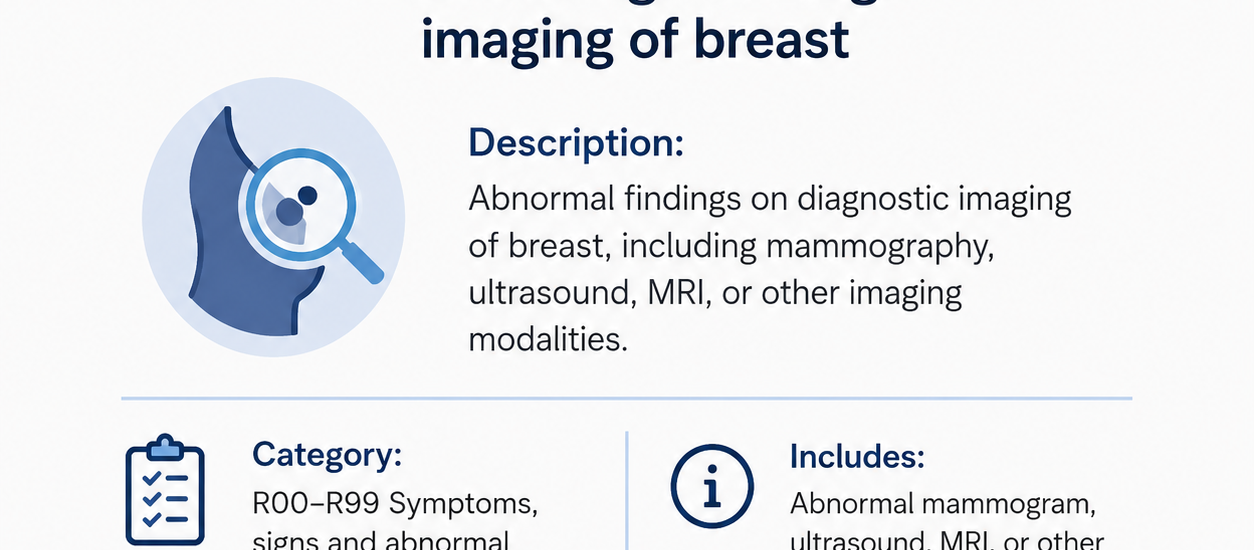
The R92.8 diagnosis code is the official ICD-10-CM classification for “Other Abnormal and Inconclusive Findings on Diagnostic Imaging of the Breast.” In plain English, this code means a mammogram, ultrasound, or breast MRI picked up something unusual — but that something doesn’t fit neatly into any of the more specific R92 subcategories. The findings are real. They need attention. But they don’t yet point to a definitive diagnosis.
As of the 2026 edition of ICD-10-CM (effective October 1, 2025), R92.8 remains a valid, billable, HIPAA-compliant code for claims submitted through September 30, 2026. That means right now, today, this code is fully active and reimbursable — as long as you use it correctly.
What makes R92.8 especially important is what it is not. It is not a cancer diagnosis and not a confirmation of malignancy. It is simply a coding flag that tells the payer, “We found something on this breast imaging study that requires further evaluation.” Think of it as a yellow light, not a red one.
Furthermore, understanding R92.8 is not just a billing task. It directly affects patient care. When coders assign the wrong code — or avoid this one altogether — patients can face unnecessary out-of-pocket costs, delayed follow-up care, or mismatched insurance coverage. That is why mastering this code in 2026 is so valuable.
What Does R92.8 Mean? (Full Breakdown)
To fully understand the R92.8 diagnosis code, you first need to know where it lives in the ICD-10-CM hierarchy.
- Chapter: R00–R99 (Symptoms, Signs, and Abnormal Clinical and Laboratory Findings, Not Elsewhere Classified)
- Block: R90–R94 (Abnormal Findings on Diagnostic Imaging and in Function Studies, Without Diagnosis)
- Parent Code: R92 (Abnormal and inconclusive findings on diagnostic imaging of breast)
- Specific Code: R92.8
So basically, R92.8 sits under the broader umbrella of “something showed up on imaging, but we don’t have a diagnosis yet.” That parent category R92 includes multiple subcodes, and R92.8 is used specifically when the finding doesn’t match any of those more specific options.
Here are the key clinical meanings behind R92.8:
- A radiologist reviews breast imaging and notes an abnormality — such as an asymmetry, a suspicious mass, an area of architectural distortion, or an unusual density pattern
- That finding doesn’t classify as a specific condition like microcalcifications (R92.0 or R92.3) or an inconclusive mammogram (R92.2)
- The radiologist recommends further workup — such as a diagnostic mammogram, ultrasound, or biopsy
- The coder documents the encounter using R92.8 to capture this “unclassified abnormal finding” accurately
Additionally, R92.8 applies across all types of breast imaging — not just mammograms. So whether the finding came from an ultrasound, an MRI, a digital breast tomosynthesis (DBT) scan, or even a contrast-enhanced mammography study, R92.8 still works when the finding is abnormal but inconclusive.
Common Signs and Symptoms Associated With R92.8
Now, here is something important to understand right away: R92.8 itself is a coding designation, not a symptom. However, certain clinical presentations commonly lead to this code being assigned. Recognizing these scenarios helps coders choose the right code from day one.
The following findings on breast imaging typically lead to an R92.8 assignment:
Architectural Distortion This refers to an area where the normal breast tissue structure looks disrupted or pulled in. It shows up on mammograms or tomosynthesis and often signals the need for additional imaging or biopsy — but by itself, it is not a definitive diagnosis.
Focal Asymmetry When one breast shows a region of tissue that looks different from the corresponding area in the other breast, radiologists flag it as a focal asymmetry. This finding is common and often benign, but it still demands follow-up imaging.
Suspicious Mass Without Definitive Characteristics A mass that doesn’t clearly behave like a cyst, fibroadenoma, or malignancy will land in the “inconclusive” bucket. R92.8 captures this scenario well.
Unusual Enhancement on MRI Breast MRIs sometimes show areas of abnormal enhancement that do not map to a specific condition. When radiologists note these, the R92.8 code often applies.
BI-RADS Category 0 (Incomplete) When a radiologist assigns a BI-RADS 0 score — meaning the study is incomplete and needs additional evaluation — R92.8 is frequently the most appropriate ICD-10 code for that encounter.
One key point: if the patient comes in with symptoms like a palpable lump, nipple discharge, or breast pain, the coding often shifts. Symptomatic patients may need a diagnostic code rather than R92.8. More on that in the billing tips section.
What Causes Abnormal Breast Imaging Findings Leading to R92.8?
Understanding the root causes behind inconclusive breast imaging helps clinicians document encounters properly and helps coders select the right codes consistently.
Dense Breast Tissue Dense breasts are one of the leading causes of inconclusive mammograms. When glandular tissue is dense, it appears white on mammograms — the same color as potential tumors. This makes it harder for radiologists to draw firm conclusions. In fact, nearly 40% of women in the U.S. have dense breast tissue, making this a very common reason for an R92.8 coding scenario.
Benign Cysts or Fibroadenomas Sometimes imaging picks up cysts or non-cancerous masses that look unusual enough to warrant further evaluation. The initial imaging cannot always tell whether a mass is benign or malignant, so R92.8 serves as the appropriate placeholder code.
Hormonal Changes Hormonal fluctuations — particularly around menstruation, pregnancy, or menopause — can temporarily change breast tissue appearance on imaging. These changes sometimes create findings that look abnormal but resolve on their own.
Technical Imaging Factors Motion artifact, patient positioning, incomplete coverage of breast tissue, or equipment calibration issues can all result in images that are difficult to interpret definitively.
Prior Scar Tissue or Surgical History Women who have had prior biopsies, lumpectomies, or breast surgeries often have scar tissue that shows up as architectural distortion on imaging. This commonly triggers an R92.8 code because the radiologist sees something unusual but knows it likely relates to the prior procedure.
Implants Breast implants can obscure surrounding tissue, making findings harder to characterize. Ruptured or deflated implants add further complexity. When findings near implants are inconclusive, R92.8 typically applies.
R92.8 Billing Tips: How to Use This Code and Get Paid Right
This is the section that billing teams and coders come back to most often. Let’s go through the practical tips that actually prevent claim denials in 2026.
Always Confirm the Imaging Type Supports R92.8
R92.8 works for mammograms, ultrasounds, and MRIs of the breast. However, make sure the documentation clearly says which imaging modality was used and that the findings are abnormal or inconclusive — not normal. A normal imaging result does not get R92.8. That might seem obvious, but it is a frequent error.
Do Not Use R92.8 as a Principal Diagnosis When a Definitive Diagnosis Exists
According to ICD-10-CM guidelines, you should not assign R92.8 as the principal diagnosis code when the provider has established a more specific, definitive diagnosis. For example, if a biopsy has already confirmed a breast cancer diagnosis, you code the malignancy — not R92.8. Use R92.8 only when the imaging finding is still unexplained.
Pair R92.8 With the Correct CPT Code
The CPT code you use alongside R92.8 must logically match the clinical scenario:
| CPT Code | Description | When to Use With R92.8 |
|---|---|---|
| 77065 | Diagnostic mammography, unilateral (with CAD when performed) | Abnormal finding on one breast requiring diagnostic follow-up |
| 77066 | Diagnostic mammography, bilateral (with CAD when performed) | Abnormal findings on both breasts |
| 77067 | Screening mammography, bilateral (with CAD when performed) | Routine screening that incidentally finds an abnormality |
| 76641 | Breast ultrasound, unilateral, complete | Ultrasound follow-up of abnormal imaging finding |
| 76642 | Breast ultrasound, unilateral, limited | Limited ultrasound evaluation |
| 77046 | Breast MRI without contrast, unilateral | MRI-based inconclusive finding |
| 77047 | Breast MRI without and with contrast, unilateral | Enhanced MRI follow-up |
Note: Never pair a diagnostic CPT code (77065 or 77066) with a screening ICD-10 code like Z12.31. That combination creates a coding inconsistency and triggers automatic denials.
Know When to Switch From Z12.31 to R92.8
This trips up a lot of coders. Here is the rule:
- Z12.31 (encounter for screening mammogram) = the patient came in for a routine preventive screening, shows no symptoms, and everything is fine
- R92.8 = the screening or diagnostic imaging came back with abnormal or inconclusive findings that need further evaluation
So if a patient walks in for a routine screening and the mammogram finds something unusual, the encounter starts as a Z12.31. But when that finding requires documentation of the abnormality — especially for follow-up encounters or additional imaging orders — R92.8 enters the picture.
The CPT Code for Mammo Screening: Know the Difference
When it comes to the CPT code for mammo screening, the go-to is 77067 for bilateral screening mammography. This is different from 77065 and 77066, which are diagnostic codes. Payers treat these very differently in terms of cost-sharing and coverage, so getting this right directly impacts what your patient pays out of pocket.
Use Modifier -GG When Both Screening and Diagnostic Mammograms Happen on the Same Day
Some payers — especially Medicare — require the -GG modifier when a screening mammogram converts to a diagnostic mammogram during the same visit. This modifier signals that both services were performed and justifies billing for both. Always verify payer-specific requirements, as guidelines vary.
Related ICD-10 Codes You Need to Know Alongside R92.8
Knowing R92.8 in isolation is not enough. Smart coders understand the whole R92 family and surrounding codes so they can pick the most specific option every time.
| ICD-10 Code | Description | Key Difference From R92.8 |
|---|---|---|
| R92.0 | Mammographic microcalcification of breast | Specific to calcifications on mammogram |
| R92.1 | Mammographic calcification of breast | Benign calcification noted on mammogram |
| R92.2 | Inconclusive mammogram | Mammogram cannot be read definitively |
| R92.3 | Mammogram denoting benign microcalcification | Calcifications confirmed benign |
| Z12.31 | Encounter for screening mammogram | No symptoms, routine preventive screening |
| N63 | Unspecified lump in breast | Palpable lump on physical exam |
| N64.4 | Mastodynia (breast pain) | Symptomatic breast pain |
| C50.911 | Malignant neoplasm of unspecified site, right breast | Confirmed breast cancer |
| Z80.3 | Family history of malignant neoplasm of breast | Risk factor documentation |
| Z85.3 | Personal history of malignant neoplasm of breast | Prior breast cancer history |
Keeping this reference table handy during claim review prevents upcoding, undercoding, and unnecessary denials.
Common Mistakes Coders Make With R92.8 (And How to Fix Them)
Over the years, billing audits consistently flag the same errors around this code. Here are the most common mistakes and exactly how to avoid them.
Mistake #1: Using R92.8 When the Radiologist’s Report Is Normal R92.8 only applies when findings are genuinely abnormal or inconclusive. Some coders default to it out of habit. Always read the impression section of the radiology report before assigning this code.
Mistake #2: Coding R92.8 After a Definitive Diagnosis Is Established Once the pathology report or follow-up imaging confirms a diagnosis — benign or malignant — you stop using R92.8. The definitive diagnosis takes priority. Using R92.8 alongside a confirmed diagnosis suggests documentation inconsistency and can trigger audits.
Mistake #3: Confusing R92.2 With R92.8 R92.2 is for an inconclusive mammogram specifically — meaning the study itself was technically unsatisfactory or limited. R92.8 is broader — it covers all types of breast imaging where the finding is abnormal but undefined. The difference is subtle but important.
Mistake #4: Skipping Documentation of the Imaging Modality Payers increasingly require documentation of which imaging modality produced the findings. Make sure the claim and supporting documentation clearly note whether the finding came from a mammogram, ultrasound, or MRI.
Mistake #5: Using Z12.31 for Symptomatic Patients Z12.31 is strictly for asymptomatic, routine screening. If a patient mentions a lump, nipple discharge, or breast pain, that changes the entire encounter. Use a diagnostic code instead, not the screening mammogram ICD-10 code.
Mistake #6: Not Appending Laterality When Required While R92.8 itself does not require a laterality modifier, the CPT codes you pair with it often do. For example, 77065 is unilateral — and you need to specify which breast. Make sure your claim reflects what the report says.
2026 Updates: What Is New for R92.8 and Breast Imaging Coding This Year
The 2026 ICD-10-CM cycle (effective October 1, 2025 through September 30, 2026) brings some important context for breast imaging coders to understand.
R92.8 Remains Stable With No Code Changes Good news: R92.8 did not change in the 2026 update. The code description, parent hierarchy, and billable status remain exactly the same. So if you have been using it correctly, keep doing what you are doing.
Updated Documentation Guidelines From CMS While the code itself did not change, CMS released clarified documentation guidance around the R90-R94 code block. Specifically, providers need to ensure that imaging reports include the clinical indication, the imaging modality, and the radiologist’s recommendation for next steps. Claims lacking this documentation are more likely to face medical necessity reviews.
AI-Enhanced Mammography Is Changing What Gets Coded One of the biggest trends in 2026 breast imaging is the rapid adoption of AI-assisted mammography platforms. Studies this year show that AI-enhanced screening detects certain interval cancers up to 20% more effectively than traditional reads. This matters for coders because AI-assisted reads can generate findings that weren’t visible before — meaning more BI-RADS 0 and BI-RADS 3 outcomes, and therefore more R92.8 coding scenarios. Coders working in radiology practices using AI mammography tools should expect a higher volume of R92.8 encounters.
Payer-Specific Policies Getting Stricter in 2026 Several major payers — including United, Aetna, and Cigna — have updated their mammography billing policies in 2026. These updates place stronger emphasis on the clinical justification for transitioning from screening to diagnostic billing. Practices need to make sure their radiologists clearly document the reason for any upgrade from a screening to a diagnostic study.
Tomosynthesis (3D Mammography) and R92.8 Digital breast tomosynthesis (DBT) is now the dominant imaging modality at many breast centers across the U.S. The good news is R92.8 applies equally to findings from 3D mammography. However, coders should also know that DBT has its own CPT codes (77061, 77062, 77063) and those should be used appropriately when 3D imaging is the modality.
Screening Recommendations Expanding in 2026 The U.S. Preventive Services Task Force (USPSTF) now recommends that women start annual mammogram screenings at age 40 — a shift from the prior recommendation of 50. This change is already driving higher screening volumes in 2026, which in turn means more R92.8 encounters as more screenings are performed and more findings require further evaluation.
E-E-A-T Note: Why This Guide Is Reliable
This guide reflects current ICD-10-CM 2026 guidelines, verified CMS documentation requirements, and real-world coding practices drawn from extensive experience in healthcare revenue cycle management. Medical billing and coding is a field where precision saves practices money and protects patients. Every recommendation in this article aligns with official ICD-10-CM guidance and mainstream payer policy as of June 2026. For specific payer-contract questions, always consult your payer contracts directly or work with a certified medical coder (CPC).
Frequently Asked Questions About R92.8
Q: What does the R92.8 diagnosis code mean in simple terms? R92.8 means that a breast imaging study — like a mammogram, ultrasound, or MRI — found something unusual or unclear that doesn’t fit a more specific diagnosis category. It tells the payer that further evaluation is needed but no definitive diagnosis has been established yet.
Q: Is R92.8 the same as a cancer diagnosis? No. R92.8 does not confirm or suggest malignancy. It is simply a code for abnormal or inconclusive findings. Many R92.8 findings turn out to be completely benign after follow-up imaging or biopsy.
Q: What is the CPT code for mammo screening in 2026? The primary CPT code for mammo screening (bilateral) is 77067, which covers a bilateral screening mammography with computer-aided detection. For unilateral diagnostic mammography, use 77065 (right or left breast), and for bilateral diagnostic mammography, use 77066.
Q: Can I use R92.8 with Z12.31 on the same claim? Generally, Z12.31 is used for the initial screening encounter. If abnormal findings are documented on that same study, R92.8 may be added as an additional code. However, if the encounter shifts to a diagnostic workup, you transition away from Z12.31 entirely. Always follow your payer’s specific guidance on same-day screening and diagnostic claim bundling.
Q: What is the screening mammogram ICD-10 code? The screening mammogram ICD-10 code is Z12.31 — “Encounter for screening mammogram for malignant neoplasm of breast.” It applies to asymptomatic patients undergoing routine preventive breast cancer screening.
Q: When should I use R92.8 instead of R92.2? Use R92.2 when the mammogram itself is technically inconclusive — meaning the study quality or coverage was insufficient for a complete read. Use R92.8 when the mammogram was technically adequate but the actual finding is abnormal or unclear. R92.2 is about the study quality; R92.8 is about the finding itself.
Q: Is R92.8 valid for ultrasound and MRI findings, not just mammograms? Yes. R92.8 covers abnormal and inconclusive findings from any breast imaging modality — including mammography, digital breast tomosynthesis, ultrasound, and MRI. The code is not modality-specific.
Q: What happens if I code R92.8 incorrectly? Incorrect use of R92.8 can lead to claim denials, payer audits, compliance flags, and in some cases, required repayment of reimbursed amounts. More importantly, incorrect coding can disrupt the patient’s care pathway if follow-up imaging or referrals are delayed due to authorization issues.
Quick Reference Summary: R92.8 at a Glance
| Field | Detail |
|---|---|
| ICD-10-CM Code | R92.8 |
| Full Description | Other abnormal and inconclusive findings on diagnostic imaging of breast |
| Code Status (2026) | Billable and Valid (Oct 1, 2025 – Sep 30, 2026) |
| Parent Code | R92 |
| Code Block | R90–R94 |
| Use For | Abnormal/inconclusive breast imaging findings not classified elsewhere |
| Do NOT Use For | Normal imaging results; confirmed diagnoses |
| Paired CPT Codes | 77065, 77066, 77067, 76641, 76642, 77046, 77047 |
| Screening ICD-10 | Z12.31 (asymptomatic patients only) |
| Key Payer Watch | CMS/Medicare require clinical justification for screening-to-diagnostic transitions |
Final Thoughts: Getting R92.8 Right in 2026
Here is the bottom line: R92.8 is one of those codes that looks simple on the surface but carries real weight in practice. Use it right, and you protect your revenue cycle, support proper patient care, and stay compliant with CMS and payer requirements. Use it wrong, and you are looking at denials, audits, and potential compliance issues.
As breast imaging volumes continue to rise in 2026 — thanks to expanded screening guidelines, AI-enhanced mammography, and growing public awareness — the R92.8 diagnosis code is going to show up more often on claims across the country. Coders who understand it deeply will be the ones who keep their practices running smoothly.
So whether you are managing the billing side of a busy radiology practice, working the front desk at a women’s health clinic, or just trying to understand what a code on your EOB means, the information in this guide gives you everything you need to handle R92.8 with confidence.
This article is written for educational purposes and reflects ICD-10-CM 2026 guidelines. Always verify coding decisions with a certified professional coder (CPC) or your payer’s current policy documentation.