

If you searched for the icd 10 code for rhabdomyolysis, here’s your answer right away: it’s M62.82. That’s the billable code coders and providers use for nontraumatic rhabdomyolysis, and it’s still active and current in the 2026 edition of ICD-10-CM. But the code itself is just the starting point. Coders, nurses, and billing teams also need to know the related codes, the documentation rules, and the mistakes that lead to denied claims. So, let’s get into all of it, step by step, in plain language that actually makes sense.
What Does Rhabdomyolysis Mean
Rhabdomyolysis means the rapid breakdown of skeletal muscle tissue. When muscle cells get damaged, they leak their contents straight into the bloodstream. This includes myoglobin, creatine kinase (CK), potassium, and other electrolytes. Once these substances flood the blood, they can travel to the kidneys and cause real trouble, including acute kidney injury.
In ICD-10-CM terms, M62.82 sits inside the M62 category, which covers other disorders of muscle. The official short description reads as necrosis or disintegration of skeletal muscle, often followed by myoglobinuria, which is the medical term for myoglobin showing up in urine. Because this is a billable and specific code, providers can use it directly on a claim without adding extra digits.
That said, this code only applies to nontraumatic rhabdomyolysis. If trauma caused the muscle breakdown, a different code comes into play, and we’ll cover that shortly.
Symptoms of Rhabdomyolysis
Here’s something that surprises a lot of new coders and even some clinicians: the classic textbook triad of muscle pain, weakness, and dark tea-colored urine actually shows up in fewer than one in five patients. Most cases look far less dramatic on the surface, which is exactly why lab work matters so much for confirming the diagnosis.
Early and Mild Symptoms
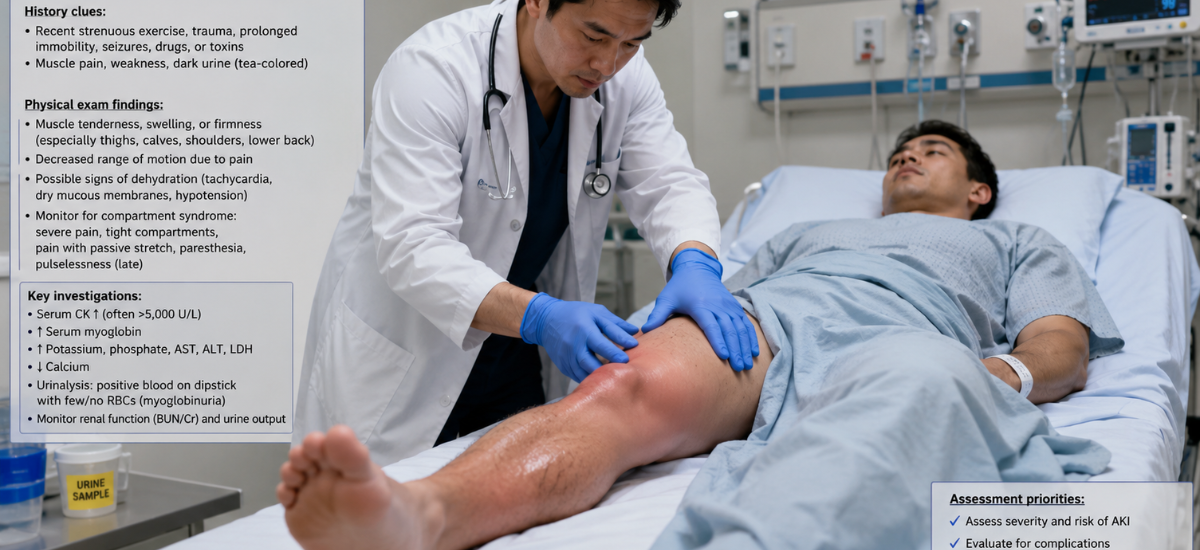
In the early stages, patients usually notice muscle soreness, stiffness, or tenderness, often in the thighs, shoulders, or lower back. Mild swelling and a general sense of fatigue tend to show up too. Some people barely notice anything beyond feeling unusually wiped out after exercise or an illness.
Moderate to Severe Symptoms
As the condition progresses, symptoms can include dark or reddish-brown urine caused by myoglobinuria, significant muscle weakness, nausea, and confusion from electrolyte shifts. In severe cases, patients may develop compartment syndrome, irregular heart rhythms from high potassium, or signs of kidney failure such as reduced urine output. Consequently, anyone with these red flags needs urgent medical evaluation rather than a wait-and-see approach.
Causes of Rhabdomyolysis
Doctors generally split causes into two big buckets: traumatic and nontraumatic. Understanding which bucket applies matters a lot for accurate coding, since it changes which code you’ll actually use.
Traumatic Causes
Crush injuries, electrical shocks, severe burns, and prolonged immobilization after a fall can all trigger traumatic rhabdomyolysis. Compartment syndrome and direct muscle ischemia from prolonged pressure also fall into this group. When trauma is the clear and documented cause, coders should reach for the traumatic rhabdomyolysis icd 10 code instead of M62.82, since the rules treat these as separate clinical pictures.
Nontraumatic and Exertional Causes
Exertional rhabdomyolysis icd 10 cases usually come from intense or unaccustomed physical activity, especially in hot weather or among people who push past their fitness level too quickly. Marathon runners, new military recruits, and weekend warriors hitting an aggressive workout all show up in this category fairly often.
Drug, Toxin, and Medical Causes
Drug induced rhabdomyolysis icd 10 cases typically involve statins, antipsychotics, certain antibiotics, or illicit substances like cocaine and amphetamines. Statin induced rhabdomyolysis icd 10 situations are well documented in clinical literature, and they tend to involve creatine kinase levels climbing far above normal ranges. Alcohol misuse, viral infections such as influenza, seizures, heat stroke, and inherited metabolic muscle disorders round out the rest of the nontraumatic causes. In every one of these scenarios, since trauma isn’t the trigger, coders should still default to M62.82 once the provider has formally documented the diagnosis.
Quick Facts Table
| Detail | Information |
|---|---|
| Focus code | M62.82 |
| Full description | Rhabdomyolysis (nontraumatic) |
| ICD-10-CM chapter | Diseases of the musculoskeletal system and connective tissue |
| Billable | Yes |
| 2026 edition effective date | October 1, 2025 |
| DRG classification | Recognized as a Complication/Comorbidity (CC) |
| Typical CK threshold | Roughly 5 times the upper limit of normal, often above 1,000 IU/L |
| Common complication | Acute kidney injury, seen in about a third of cases |
Diagnosing Rhabdomyolysis for Coding Purposes
Lab confirmation matters just as much as symptoms here. Physicians typically rely on creatine kinase levels that sit well above normal, often five times higher than the upper limit, alongside myoglobin detection in urine. However, a high CK reading by itself doesn’t automatically justify the rhabdomyolysis diagnosis code. The provider has to connect the dots in the documentation and actually state the diagnosis. Otherwise, coders should default to a symptom code for elevated enzymes rather than jumping straight to M62.82.
Related ICD-10 Codes
Knowing the surrounding codes helps prevent claim denials and keeps documentation airtight. Here’s a breakdown of the codes that frequently pair with or get confused with the main rhabdomyolysis code.
| Code | Description | When to Use |
|---|---|---|
| M62.82 | Rhabdomyolysis (nontraumatic) | Documented rhabdomyolysis from exertion, drugs, toxins, or illness |
| T79.6XXA | Traumatic ischemia of muscle, initial encounter | Rhabdomyolysis tied directly to a traumatic event |
| M62.81 | Muscle weakness, generalized | General weakness without confirmed muscle breakdown |
| R74.8 | Abnormal levels of other serum enzymes | Elevated CK without a formal rhabdomyolysis diagnosis |
| N17.9 | Acute kidney failure, unspecified | Kidney injury secondary to rhabdomyolysis |
| E86.0 | Dehydration | Fluid loss accompanying muscle breakdown |
| E87.5 | Hyperkalemia | Elevated potassium from muscle cell breakdown |
| G72.0 | Drug-induced myopathy | Muscle disease from medication without confirmed rhabdomyolysis |
Note that M62.82 carries Excludes1 notes for conditions like alcoholic myopathy, drug-induced myopathy, cramp and spasm, myalgia, and stiff-man syndrome. This basically means coders shouldn’t report those codes together with M62.82 for the same diagnosis, since the guidelines treat them as mutually exclusive concepts rather than companions.
Billing Tips for Accurate Claims
Getting reimbursement right on the first try saves everyone time, so here are the habits that actually move the needle.
First, always confirm the provider has explicitly documented rhabdomyolysis as a diagnosis rather than just listing lab values. Insurance reviewers look closely for that connection, and skipping it is one of the fastest ways to trigger a denial.
Second, sequence the codes thoughtfully. If rhabdomyolysis drives the bulk of treatment, list M62.82 first and follow it with codes for complications such as acute kidney injury or hyperkalemia. On the other hand, if kidney failure becomes the main focus of care, it may need to move into the principal diagnosis position instead, depending on the clinical picture.
Third, link supporting codes generously. Claims involving ICU monitoring, IV fluids, or dialysis need clear justification, and codes like N17.9, E86.0, and E87.5 help establish medical necessity for those higher-cost services.
Fourth, double check the cause before finalizing the claim. Since M62.82 covers nontraumatic rhabdomyolysis, sending it through for a case rooted in trauma can trigger an audit flag. Meanwhile, rhabdomyolysis due to trauma icd 10 claims need T79.6XXA along with the right seventh character for initial, subsequent, or sequela encounters.
Finally, document CK levels clearly in the chart. This single habit supports both the diagnosis and the DRG weight, since M62.82 functions as a recognized complication or comorbidity that can affect reimbursement.
Common Coding Mistakes to Avoid
Even experienced coders slip up here sometimes, so it helps to keep this list handy.
A frequent mistake involves assigning M62.82 purely from an elevated CK result without a documented physician diagnosis. Another common slip is mixing up M62.81, which covers general muscle weakness, with M62.82, which covers actual muscle breakdown. These two codes look similar on paper but describe very different clinical situations.
Coders also sometimes forget the correct seventh character on T79.6XXA, which changes meaning depending on whether it’s an initial encounter, a follow-up visit, or a late effect. On top of that, billing teams occasionally pair M62.82 with an Excludes1 code like G72.0, which can cause the claim to bounce back for review.
Lastly, many claims miss the secondary codes that justify intensive treatment. Without N17.9, E86.0, or E87.5 attached where appropriate, payers may question why a patient needed ICU-level care or repeated lab monitoring.
2026 Updates for Rhabdomyolysis Coding
The 2026 edition of ICD-10-CM took effect on October 1, 2025, and M62.82 remains fully active, billable, and unchanged in its core definition. The Excludes1 notes carry forward as well, so the documentation rules coders relied on previously still apply this year.
What’s shifted more is the environment around the code rather than the code itself. More health systems are now leaning on AI-assisted clinical documentation improvement tools to flag charts where CK levels appear without a matching diagnosis statement, which directly supports cleaner claims and fewer denials. Payers have also tightened medical necessity reviews for high-cost rhabdomyolysis admissions involving dialysis or ICU stays, so linking complication codes properly carries even more weight than it used to. Telehealth follow-up visits for milder, exertional cases have grown too, which means outpatient coders are seeing more rhabdomyolysis diagnosis code claims tied to sports medicine and urgent care settings rather than just hospital admissions.
Frequently Asked Questions
What is the ICD-10 code for rhabdomyolysis? The code is M62.82, and it applies to nontraumatic rhabdomyolysis. It remains billable and current in the 2026 ICD-10-CM edition.
Is there a separate code for rhabdomyolysis caused by trauma? Yes. Traumatic rhabdomyolysis uses T79.6XXA, with the seventh character changing based on whether it’s an initial encounter, a subsequent encounter, or a sequela.
Can a coder assign M62.82 based only on an elevated CK level? No. Official guidance requires a provider’s documented diagnosis. Without it, coders should use R74.8 for abnormal serum enzyme levels instead.
What code applies to exertional rhabdomyolysis? Exertional rhabdomyolysis icd 10 cases, meaning those triggered by intense physical activity, still use M62.82 once the diagnosis is documented, since this falls under the nontraumatic category.
Does statin induced rhabdomyolysis get its own special code? Not exactly. Statin induced rhabdomyolysis icd 10 cases use M62.82 for the rhabdomyolysis itself, though some practices add a secondary code to flag the causative drug for tracking purposes.
What’s the difference between M62.81 and M62.82? M62.81 covers general muscle weakness, while M62.82 specifically covers confirmed muscle tissue breakdown. They’re not interchangeable.
Did the rhabdomyolysis ICD-10 code change for 2026? No major change occurred. The 2026 edition, effective October 1, 2025, kept M62.82 and its Excludes1 notes the same as the prior year.
What secondary codes commonly accompany M62.82 on a claim? N17.9 for acute kidney failure, E86.0 for dehydration, and E87.5 for hyperkalemia show up most often alongside rhabdomyolysis claims.
Final Thoughts
At the end of the day, getting the icd 10 code for rhabdomyolysis right comes down to three things: solid documentation, correct sequencing, and a clear understanding of which related code actually fits the clinical story. M62.82 covers the nontraumatic cases that make up the bulk of claims, while T79.6XXA handles the traumatic side. Add in the right secondary codes for complications, double check the Excludes1 notes, and keep an eye on CK documentation, and most denial headaches disappear before they start. Whether you’re a coder, a biller, or a nurse trying to make sense of a chart, this combination of accurate diagnosis confirmation and careful sequencing is what keeps claims clean heading into 2026 and beyond.