

Introduction
If you work in medical coding, oncology, or healthcare billing, you already know that getting the right ICD-10 code on the first try saves a ton of headache. So let us talk about one of the most commonly used — and most commonly misused — codes in the breast cancer space: Z85.3, the ICD 10 code for history of breast cancer.
Whether you are a coder, a clinician, a nurse practitioner, or someone who just got handed a claim denial and needs answers fast, this guide covers everything you need to know. We break down the meaning of Z85.3, how it differs from the family history of breast cancer ICD 10 code, how to use it correctly in 2026, and what mistakes you absolutely need to avoid.
Let us get right into it.
What Does Z85.3 Actually Mean?
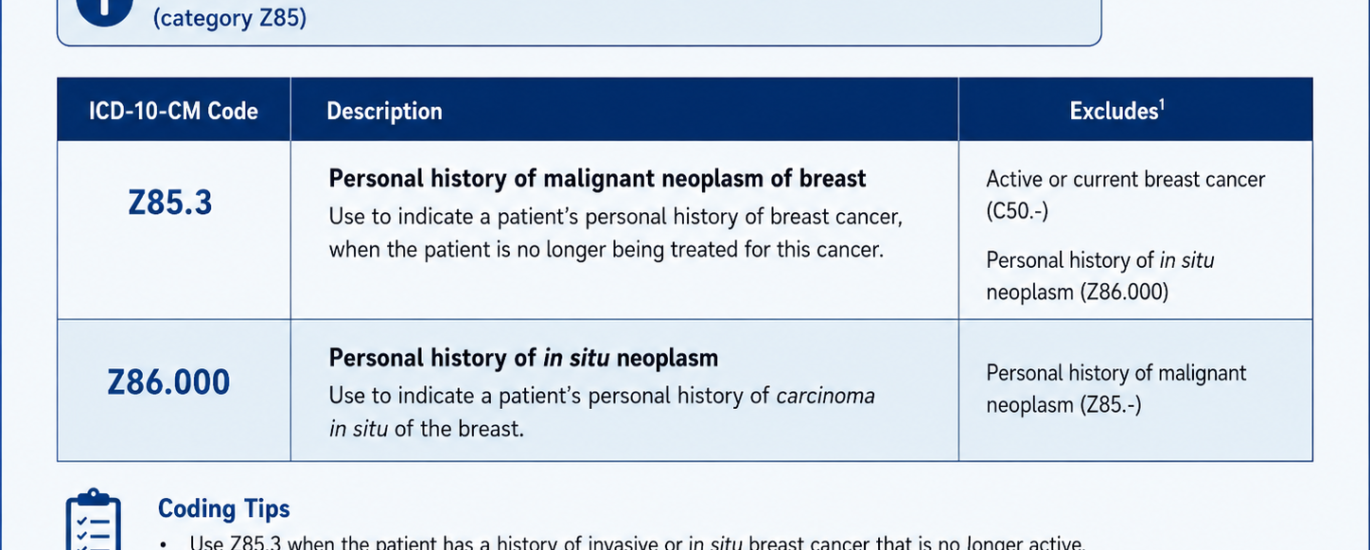
The ICD 10 code Z85.3 stands for “Personal History of Malignant Neoplasm of Breast.” In plain English, that means the patient had breast cancer in the past, completed treatment, and currently has no active disease.
This code lives in the Z80-Z99 chapter of ICD-10-CM, which covers people with potential health hazards related to personal and family history. Specifically, Z85.3 falls under the Z85 category — personal history of malignant neoplasm.
Here is what makes this code so important: it does not describe a current illness. Instead, it tells the story of a patient’s cancer journey. It signals to other providers, insurers, and care teams that this person carries an elevated risk for recurrence, may need altered screening protocols, and likely has long-term complications from prior treatment.
Think of Z85.3 as a clinical flag, not a diagnosis of active disease.
Key Facts at a Glance
| Detail | Information |
|---|---|
| ICD-10 Code | Z85.3 |
| Full Name | Personal History of Malignant Neoplasm of Breast |
| Effective Date (2026) | October 1, 2025 |
| Valid Through | September 30, 2026 |
| Billable? | Yes |
| Principal Diagnosis? | No — unacceptable as principal diagnosis |
| POA Reporting Exempt? | Yes |
| Related Active Code | C50.- (active breast malignancy) |
History of Breast Cancer ICD 10 vs. Family History: Know the Difference
This is where so many coders trip up. There are two separate codes depending on whose breast cancer history you are documenting.
Z85.3 — Personal history of breast cancer ICD 10: Use this when the patient themselves had breast cancer in the past and is now in remission or disease-free.
Z80.3 — Family history of malignant neoplasm of breast: Use this when a blood relative — like a mother, sister, or daughter — has been diagnosed with breast cancer, but the patient in front of you has not.
This distinction matters enormously for billing and clinical documentation. The ICD 10 for family history of breast cancer is Z80.3, and it supports risk assessment, preventive screening, and insurance authorization for high-risk patients. The two codes serve completely different purposes, and you should never mix them up.
Quick Comparison: Z85.3 vs. Z80.3
| Code | Who It Applies To | When To Use |
|---|---|---|
| Z85.3 | The patient (personal history) | Patient had breast cancer, now cancer-free |
| Z80.3 | Patient’s blood relatives (family history) | First-degree relative had breast cancer |
Pro Tip: You can actually use both codes together on the same claim when a patient has both a personal history of breast cancer AND a family history of breast cancer in a close relative. Both are billable and both add clinical context.
Symptoms and Signs That Prompt Z85.3 Use
First, let us clear something up. Z85.3 is not assigned because a patient has symptoms. You assign it because a documented history exists. That said, understanding why patients with a history of breast cancer come in for care helps you code more accurately.
Breast cancer survivors regularly present for follow-up visits due to:
Residual or Late-Onset Effects from Treatment
Patients who completed chemotherapy, radiation, or surgery often deal with ongoing issues. Lymphedema — swelling in the arm from lymph node removal — is extremely common. Code it separately with the appropriate lymphedema code (I89.0) alongside Z85.3.
Surveillance and Screening Encounters
A patient coming in for a follow-up mammogram or imaging scan after completing cancer treatment gets coded with Z08 (encounter for follow-up examination after completed treatment) plus Z85.3. Meanwhile, Z12.31 covers routine screening mammograms for high-risk individuals with a documented history.
Fear of Recurrence
Survivors often present with anxiety around possible recurrence. Do not code active cancer without current diagnostic confirmation. Z85.3 keeps the record accurate.
Hormone Therapy Side Effects
Many survivors remain on hormone-blocking therapies like tamoxifen or aromatase inhibitors for years after remission. Code Z79.810 or Z79.811 for long-term use of selective estrogen receptor modulators or aromatase inhibitors, paired with Z85.3.
Causes: Why Patients Have a History of Breast Cancer
Since Z85.3 documents prior breast cancer, understanding the causes of breast cancer adds clinical depth and helps coders pair secondary codes correctly.
Genetic Factors and BRCA Mutations
BRCA1 and BRCA2 gene mutations significantly raise breast cancer risk. Patients who carry these mutations and have a prior diagnosis should also have Z15.01 (genetic susceptibility to malignant neoplasm of breast) coded when clinically relevant.
Hormonal Influences
Prolonged exposure to estrogen — through late menopause, early menarche, or hormone replacement therapy — contributes to breast cancer risk. Code Z78.0 for postmenopausal status when applicable, and Z17.0 for estrogen receptor positive status if documented.
Family Genetics
A strong family history of breast cancer, especially first-degree relatives, raises lifetime risk dramatically. This is exactly why the family history of breast cancer ICD 10 code Z80.3 exists as a separate billable code.
Lifestyle and Environmental Factors
Obesity, alcohol use, sedentary lifestyle, and prior radiation exposure all contribute to breast cancer development. While these do not directly change the Z85.3 code assignment, they support medical necessity for ongoing monitoring and preventive care.
Billing Tips for Z85.3 in 2026
Getting Z85.3 right on a claim takes more than just knowing the code. Here are the billing practices that actually hold up under payer scrutiny in 2026.
Never Use Z85.3 as a Principal Diagnosis
This is the number one rule. Z85.3 describes a circumstance that influences health status — not a current illness. CMS guidelines explicitly state that Z codes like Z85.3 are unacceptable as the primary reason for an encounter. Pair it with a principal diagnosis that reflects the actual reason for the visit.
Pair Z85.3 With the Right Primary Code
Here is how it works in practice. If a patient comes in for a follow-up exam after completing breast cancer treatment, the principal code is Z08, followed by Z85.3 as a secondary code. If the visit is for a screening mammogram, Z12.31 leads the claim with Z85.3 as supporting documentation.
Document Treatment Completion Clearly
Payers want to see language in the record like “no evidence of disease,” “in remission,” or “history of breast cancer, treatment completed.” Without that documentation, auditors may challenge the code or flag it for medical review.
Avoid Coding Z85.3 Alongside Active Cancer Codes
Do not use Z85.3 and C50.- (active breast malignancy) together on the same claim. They are mutually exclusive. If the cancer is still active, use the appropriate C50 code. Once the patient achieves remission or completes curative treatment, transition to Z85.3.
Add Secondary Codes for Ongoing Treatment Complications
If a survivor still deals with lymphedema, peripheral neuropathy from chemotherapy, or cardiac complications from prior treatment, those need separate codes. Leaving them out leaves money on the table and creates an incomplete clinical picture.
Commonly Paired Codes With Z85.3
| Code | Description | When to Add |
|---|---|---|
| Z08 | Follow-up after completed cancer treatment | Follow-up visits post-treatment |
| Z12.31 | Screening mammogram encounter | Routine mammogram for history patients |
| Z80.3 | Family history of breast cancer | When family members also had breast cancer |
| Z15.01 | Genetic susceptibility to breast cancer (BRCA) | Confirmed BRCA1/BRCA2 mutation |
| I89.0 | Lymphedema | Post-mastectomy lymphedema |
| Z79.810 | Long-term use of tamoxifen | Ongoing hormone suppression therapy |
| Z17.0 | Estrogen receptor positive status | ER+ breast cancer history |
Related ICD-10 Codes You Need to Know
Beyond Z85.3 and Z80.3, a complete picture of breast cancer coding includes several interconnected codes that coders regularly encounter in the same patient encounters.
C50 series (Active Breast Cancer): These codes cover current, active malignant neoplasms of the breast by site and laterality. Never use C50 alongside Z85.3 for the same condition.
Z08: Encounter for follow-up examination after completed treatment for a malignant neoplasm. This is your go-to primary code for survivorship visits.
Z12.31: Screening mammogram for malignant neoplasm of breast. This is appropriate for patients with a personal history who are getting routine imaging as part of surveillance.
Z15.01: Genetic susceptibility to malignant neoplasm of breast. Use this when genetic testing confirms BRCA1 or BRCA2 mutations.
Z80.3: Family history of malignant neoplasm of breast. The essential ICD 10 for family history of breast cancer when blood relatives — not the patient — carry the diagnosis.
Z79.81 (non-billable parent): This refers to long-term use of antiestrogens — reference code family that points back to Z85.3 in the CMS guidelines.
Common Mistakes Coders Make With Z85.3
Even experienced coders make these errors. Here is what to watch for.
Mistake 1: Using Z85.3 for Active Breast Cancer
This is the most common error. If the patient is currently receiving chemotherapy, radiation, or surgery for breast cancer, they have an active malignancy. Code C50.- for active cases. Flip to Z85.3 only after treatment wraps and the provider documents remission or disease-free status.
Mistake 2: Confusing Personal History With Family History
Do not assign Z85.3 when the cancer belongs to a parent or sibling, not the patient. That situation calls for Z80.3, the correct family history of breast cancer ICD 10 code. They are not interchangeable.
Mistake 3: Using Z85.3 as the Principal Diagnosis
Some coders list Z85.3 first on a claim without a qualifying primary diagnosis. This triggers denials. Always position Z85.3 as a secondary or additional code.
Mistake 4: Missing Companion Codes
Coders frequently forget to add codes for treatment-related complications, hormone therapy, or genetic susceptibility. These additional codes support medical necessity and justify services like preventive screenings and specialist referrals.
Mistake 5: Inadequate Documentation
Claims fail when the chart notes do not clearly state that the cancer is resolved. If the provider writes “breast cancer” without specifying “history of” or “in remission,” a coder technically cannot assign Z85.3 without physician clarification. Push for specific documentation language every time.
Mistake 6: Ignoring Laterality When Transitioning From Active Codes
When a patient transitions from active C50 codes (which include laterality — right, left, bilateral) to Z85.3, note that Z85.3 does not have laterality sub-codes. That is fine — but ensure the transition in the record is clearly documented.
2026 Updates to Z85.3 and Related Breast Cancer Coding
The 2026 edition of ICD-10-CM became effective on October 1, 2025 and runs through September 30, 2026. Here is what is relevant for the current fiscal year.
Z85.3 Remains Stable
The code itself carries forward without structural changes from prior editions. It remains a specific, billable code under the Z85 category with no new sub-codes or laterality additions introduced for 2026.
MS-DRG V43.0 Grouping
For fiscal year 2026 (October 1, 2025 through September 30, 2026), Z85.3 appears in updated MS-DRG V43.0 groupings. This matters for inpatient coders managing diagnostic-related group assignments.
POA Exemption Continues
Z85.3 remains exempt from Present on Admission (POA) reporting in inpatient settings, consistent with CMS policy for circumstantial Z codes.
Increased Payer Scrutiny on Z Codes
In 2026, commercial payers and Medicare contractors are paying closer attention to Z code documentation standards. Auditors now more commonly request supporting documentation that explicitly states cancer remission status before approving services tied to Z85.3. Get that documentation language right the first time.
AI-Assisted Coding Tools and Z85.3
A growing number of health systems now use AI-assisted coding platforms that auto-suggest Z85.3 based on clinical notes. While these tools improve efficiency, coders still need to verify that physician documentation supports the code. AI suggestions are only as good as the underlying chart language.
Genetic Testing Integration
In 2026, many survivorship programs now routinely test for BRCA1/BRCA2 variants. When testing confirms susceptibility, coders should add Z15.01 alongside Z85.3. This code pairing supports reimbursement for enhanced surveillance protocols and preventive interventions like prophylactic mastectomy.
Frequently Asked Questions (FAQ)
What is the ICD 10 code for history of breast cancer?
The correct code is Z85.3, which stands for personal history of malignant neoplasm of breast. It applies when a patient previously had breast cancer and is currently free of active disease.
What is the ICD 10 for family history of breast cancer?
The code for family history of breast cancer ICD 10 is Z80.3. This code documents that a blood relative — not the patient — has been diagnosed with breast cancer. Use Z85.3 for the patient’s own history and Z80.3 when the history belongs to a family member.
Can you code Z85.3 and C50 together?
No. These two codes are mutually exclusive for the same condition. C50 applies to active breast cancer. Z85.3 applies to resolved, historical breast cancer. If the cancer is still active, use C50. Once the patient achieves remission, transition to Z85.3.
Is Z85.3 a billable code?
Yes. Z85.3 is a fully billable and specific ICD-10-CM diagnosis code valid for HIPAA-covered transactions from October 1, 2025 through September 30, 2026.
Can Z85.3 be a principal diagnosis?
No. CMS guidelines classify Z85.3 as unacceptable for use as a principal diagnosis. It must accompany a primary diagnosis code that explains the reason for the encounter, such as Z08 for follow-up or Z12.31 for screening.
What documentation do I need to assign Z85.3?
The physician’s notes must clearly state that the patient has a history of breast cancer AND that no active cancer is currently present. Language like “no evidence of disease,” “breast cancer in remission,” or “history of breast cancer, treatment completed” all support accurate code assignment.
Do I need separate codes for lymphedema or hormone therapy in Z85.3 patients?
Yes. Lymphedema and ongoing hormone therapy are separate conditions and treatments. Code lymphedema with I89.0 and add Z79.810 or Z79.811 for ongoing antiestrogen therapy. These companion codes complete the clinical picture and support medical necessity.
Does Z85.3 apply to male breast cancer survivors?
Yes. Z85.3 covers personal history of malignant neoplasm of breast regardless of sex. Male breast cancer is rare but real, and Z85.3 applies equally.
What if a patient has both a personal history and a family history of breast cancer?
Code both Z85.3 and Z80.3. They are distinct codes addressing different clinical facts, and both are billable on the same claim.
Final Thoughts
Accurate coding of Z85.3 — the history of breast cancer ICD 10 code — is not just a billing formality. It shapes how patients get treated after cancer, what screenings they qualify for, and how their long-term risk gets managed. Getting it right matters for the patient, the provider, and the bottom line.
Remember the core rules: Z85.3 is for personal history only, Z80.3 is for family history of breast cancer ICD 10, never use Z85.3 as a principal code, and always back it up with clear provider documentation. In 2026, with increased payer scrutiny and AI-assisted coding tools entering the picture, solid documentation habits and code accuracy matter more than ever.
Stay sharp, code clean, and keep the clinical story accurate.
This article reflects 2026 ICD-10-CM guidelines effective October 1, 2025. Always consult official CMS ICD-10-CM coding guidelines and your payer’s specific policies for final coding decisions.