

What R79.89 Actually Means
R79.89 stands for “Other Specified Abnormal Findings of Blood Chemistry.” The R79.89 diagnosis code sits inside Chapter 18 of ICD-10-CM. That chapter covers symptoms, signs, and abnormal clinical and laboratory findings not classified elsewhere. More specifically, it falls under the R79 category: other abnormal findings of blood chemistry.
Use this code when a blood chemistry test returns an abnormal result. The physician must document and name the finding. And that finding must not fit any more specific ICD-10-CM code within the R70 through R79 range.
Think of R79.89 as a Specific Bucket
R79.89 is not a throwaway code. Coders sometimes grab it when they feel uncertain. That is a fast track to a denial. This code demands real clinical documentation pointing to a real, named abnormality in the blood chemistry panel. Treat it with precision, and it holds up every time.
The Most Common Clinical Scenarios That Use R79.89
Knowing when R79.89 applies keeps claims clean before they leave the billing queue.
Elevated Troponin ICD 10 Without a Confirmed Cardiac Diagnosis
This is the most frequent use case. It also causes the most errors. When a patient arrives with elevated troponin levels and no confirmed acute MI, R79.89 covers that elevated troponin ICD 10 situation correctly.
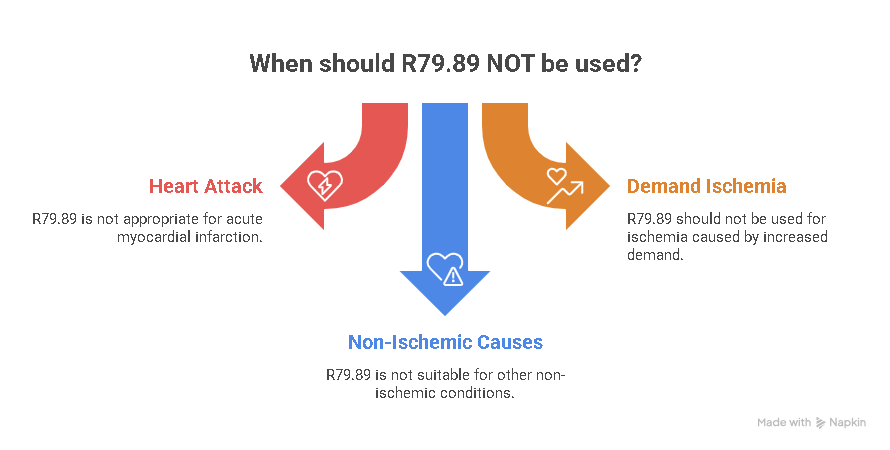
The key phrase here: “without a confirmed diagnosis.” Once the physician documents a definitive cardiac event, drop R79.89. Code the primary diagnosis instead.
What the Troponin Record Must Show
The medical record needs several specific items. Name the troponin type, either troponin I or troponin T. Record the exact numeric value with units. Note the timing of each measurement. Document any ECG correlation. Clearly state whether myocardial infarction is ruled out or still under investigation. Miss any of these, and payers will deny the claim.
Elevated D-Dimer ICD-10 During Workup
Elevated D-dimer ICD 10 situations come up constantly in emergency and hospital settings. When D-dimer comes back elevated and the physician is still investigating a possible pulmonary embolism or DVT, R79.89 captures that abnormal blood chemistry finding correctly.
Once the provider confirms or rules out the underlying condition, the coding changes. Code the confirmed PE or DVT, or shift to the appropriate ruled-out scenario.
Elevated Creatinine ICD-10 Not Yet Attributed to a Condition
Elevated creatinine ICD 10 situations follow the same pattern. The metabolic panel returns a high creatinine. The provider has not yet tied it to chronic kidney disease, acute kidney injury, or another established diagnosis. R79.89 fits here.
If CKD is already the documented diagnosis, the elevated creatinine belongs to that picture. Code CKD. Drop R79.89.
Other Abnormal Labs ICD-10 That Do Not Fit Specific Codes
Abnormal labs ICD 10 situations beyond the three above also land under R79.89 legitimately. Think elevated ferritin, elevated serum chromium, or high creatinine kinase without a confirmed muscle disorder. Unusual enzyme elevations on a CMP or BMP that skip the R70 through R79 specific codes also belong here.
Why Claims Get Denied: The Top Billing Mistakes with R79.89
Let us cut straight to the real reasons denials happen. Knowing them means you can stop them cold.
Pairing R79.89 with an Already Confirmed Diagnosis
This is the number one mistake. Once a physician establishes a definitive diagnosis, drop the sign and finding code entirely. A confirmed acute MI means you stop coding R79.89 for the elevated troponin ICD 10 finding. That pairing is a duplication error. Payers catch it fast.
The ICD-10-CM Official Guidelines make this crystal clear: do not code signs and symptoms when a confirmed diagnosis already explains them.
Using R79.89 When a More Specific Code Exists
R79.89 only applies when the finding does not fit elsewhere. If the abnormal chemistry maps to a specific code, use that code. R79.0 covers abnormal blood mineral levels. R79.83 covers amino acid abnormalities. Bypassing those in favor of R79.89 triggers a denial for incorrect specificity. It also raises an audit flag.
Vague or Missing Documentation
Payers need the specific analyte named in the record. “Abnormal lab panel” does not support R79.89. The physician note must name exactly what is elevated, state the value, and describe the clinical plan. Without that detail, the claim fails.
Using R79.89 as the Principal Diagnosis Incorrectly
ICD-10-CM guidelines say R79.89 should not serve as the principal diagnosis when a confirmed related diagnosis already exists. It works well as a secondary code. However, coders sometimes push it into the primary slot when a more specific primary diagnosis sits right there in the record.
Documentation Best Practices That Kill Denials Before They Start
Great documentation is the whole game. Coders can only work with what the physician writes down. Building precise documentation habits on the clinical side pays off directly on the billing side.
The Six Items Every R79.89 Record Needs
Strong documentation for R79.89 follows a clear checklist. Make sure the medical record includes all six of these items.
1. The specific lab test name. Name the exact test that returned the abnormal result.
2. The exact value with units. Include the reference range the lab used.
3. The physician’s clinical interpretation. A note from the ordering or treating physician matters here.
4. Workup status. Is further investigation planned? Is it still underway?
5. Confirmation no definitive diagnosis exists yet. The record must show the evaluation phase is active.
6. For elevated troponin ICD 10 cases. Add the troponin type, serial measurement timing, ECG findings, and ischemic symptom documentation. That detail separates a clean claim from a denial.
Build Physician Query Templates
Experienced billing managers build physician query templates for common R79.89 scenarios. A short, structured query takes the provider about 30 seconds to answer. It confirms the specific analyte, the workup status, and whether a definitive diagnosis exists. That small investment can save weeks of appeals.
Track Denial Rates by Payer
Not every payer handles R79.89 identically. Some want extra documentation attachments before processing the claim. Others accept it when the record clearly supports the code.
Track your R79.89 denial rates separately from broader abnormal chemistry claims. If one payer keeps pushing back, investigate their specific requirements. Getting ahead of those requirements stops the revenue drain from repeated appeals.
Related ICD-10 Codes to Know Alongside R79.89
Knowing the code family around R79.89 sharpens accuracy and prevents wrong code selection.
R79.0: Abnormal Blood Mineral Levels
Use R79.0 when a specific mineral drives the documented abnormality. Do not default to R79.89 when this more specific code fits.
R79.1: Abnormal Coagulation Profiles
Elevated D-dimer ICD 10 situations sometimes interact with R79.1. The specific finding determines which code applies.
R79.9: Unspecified Abnormal Blood Chemistry
R79.9 is the unspecified version. Lab companies and payers push back hard on unspecified codes. Only use R79.9 when you genuinely cannot document the specific finding.
R74.8: Other Abnormal Serum Enzyme Levels
R74.8 covers abnormal serum enzyme levels. Coders sometimes confuse this with R79.89. Know the difference before you code enzyme elevations.
R77.9: Troponin Coding Territory
R77.9 shows up near troponin situations as an approximate synonym. Applying it incorrectly in elevated troponin ICD 10 cases invites denials and audit attention.
Stay Current with AHA Coding Clinic Guidance
Coding Clinic publishes official direction on nuanced coding situations. It has addressed elevated troponin scenarios specifically. Those updates sometimes shift which code fits best. Staying current with Coding Clinic is one of the highest-value habits a coder can build. Read every update. Apply it immediately.
Frequently Asked Questions (FAQs)
What does ICD-10 code R79.89 mean exactly?
R79.89 means “Other Specified Abnormal Findings of Blood Chemistry.” The R79.89 diagnosis code applies when a blood chemistry test returns a named, documented abnormal result. That result must not fit any more specific ICD-10-CM code in the R70 through R79 range. It is a billable, specific code valid for HIPAA-covered transactions.
Can I use R79.89 for elevated troponin ICD 10 situations?
Yes, but only before a confirmed cardiac diagnosis exists. Once the physician documents a definitive diagnosis like acute MI, drop R79.89 and code the primary diagnosis. Detailed documentation of troponin type, value, timing, and ECG findings is also required.
What is the correct elevated D-dimer ICD 10 code?
During an active workup where D-dimer is elevated and the cause is still under investigation, R79.89 correctly captures the abnormal blood chemistry finding. Once PE or DVT is confirmed or ruled out, shift to the appropriate code.
How do I code elevated creatinine ICD 10 without a confirmed diagnosis?
When elevated creatinine appears on a metabolic panel and the provider has not yet tied it to CKD, AKI, or another condition, use R79.89. If CKD is already the established diagnosis, code CKD and leave R79.89 off.
What documentation do I need to avoid a denial with R79.89?
Name the specific abnormal analyte. Provide the exact value with units and reference range. Include the physician’s clinical interpretation. Confirm no definitive diagnosis explains the finding yet. Vague notes like “abnormal labs” will not support this code.
Is R79.89 supposed to be the principal diagnosis?
Not when a related confirmed diagnosis already exists. R79.89 works best as a secondary code or as the primary code during the evaluation phase before a diagnosis is confirmed.
Why do payers deny R79.89 claims even when the code is valid?
Payers deny when the code pairs with a confirmed diagnosis that already explains the finding. They also deny when documentation skips naming the specific analyte, when a more specific code was bypassed, or when a payer-specific attachment is missing. Auditing denial patterns by payer pinpoints the exact cause.
What is the difference between R79.89 and R79.9?
R79.89 applies when the specific analyte is known and documented. R79.9 applies when the blood chemistry finding cannot be specified further. Lab companies and payers regularly reject unspecified codes. Always prefer R79.89 when the record names the specific abnormality.
Written by a medical billing and coding professional with over a decade of hands-on experience in ICD-10 coding, claim submission, and denial management across hospital, clinic, and lab billing environments.