

What Is Sleep Apnea ICD-10 Code?
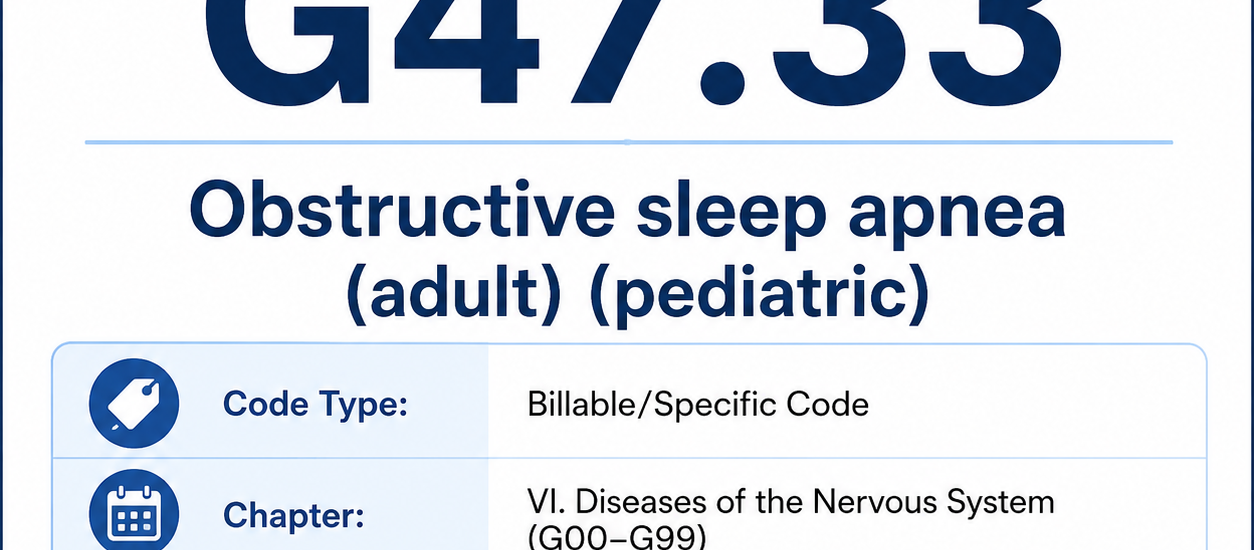
If you work in medical billing, coding, or sleep medicine, you already know how much one wrong code can cost you. So, let us get straight to the point: G47.33 is the official, billable ICD-10-CM diagnosis code for obstructive sleep apnea (OSA) in both adult and pediatric patients. Furthermore, as of 2026, this code stays fully active and valid for all HIPAA-covered transactions running from October 1, 2025 through September 30, 2026.
Now, the Centers for Medicare and Medicaid Services (CMS) places G47.33 under Chapter 6 of ICD-10-CM, which covers Diseases of the Nervous System. That placement makes complete sense when you think about it, because OSA is not just a breathing issue. In fact, it disrupts brain oxygen levels, interferes with the nervous system’s control of sleep, and triggers a chain reaction of health complications that reaches far beyond the bedroom.
As a result, understanding this code deeply is not optional anymore. Instead, it is a requirement for every coder, biller, and clinician who wants accurate reimbursements and clean claims in 2026.
What Does the G47.33 Diagnosis Code Actually Mean?
The code structure tells a clear story. Here is what each part means:
- G = Diseases of the Nervous System (Chapter 6, ICD-10-CM)
- 47 = Sleep disorders
- .33 = Obstructive sleep apnea, adult and pediatric
So, when you write G47.33, you are specifically telling the payer: “This patient has confirmed obstructive sleep apnea — not just snoring, not just fatigue, and not an unspecified sleep issue.” That specificity is exactly what separates a paid claim from a denied one.
Moreover, G47.33 also covers obstructive sleep apnea hypopnea syndrome (OSAHS), which means hypopnea events (shallow breathing, not full apnea) still fall under this single code. Additionally, the ICD-10 system does not break G47.33 down further by severity. Therefore, whether your patient has mild, moderate, or severe OSA, the code stays G47.33. However, severity still gets documented in the clinical notes rather than in a separate sub-code.
Obstructive Sleep Apnea: What It Actually Is
Before diving into the coding side, let us first make sure the clinical picture is crystal clear, because accurate coding always starts with accurate clinical understanding.
Definition
Obstructive sleep apnea is a chronic sleep disorder where the throat muscles relax too much during sleep. When they do, the airway narrows or closes completely. As a result, breathing stops — sometimes for 10 seconds, sometimes for over a minute. Then, the brain senses the drop in oxygen and jolts the body awake just enough to reopen the airway. After that, the entire cycle starts all over again. In fact, this can happen dozens or even hundreds of times per night without the patient ever realizing it.
The AHI Scale: How Severity Gets Measured
Clinicians use the Apnea-Hypopnea Index (AHI) to measure OSA severity. Specifically, the AHI counts how many apnea or hypopnea events occur per hour of sleep. Based on that number, severity falls into three tiers:
| Severity Level | AHI Score |
|---|---|
| Mild OSA | 5 to 14.9 events per hour |
| Moderate OSA | 15 to 29.9 events per hour |
| Severe OSA | 30 or more events per hour |
Even though all three levels map to Sleep Apnea ICD-10 Code, documenting the exact AHI number in your clinical note is non-negotiable for 2026 CPAP authorization and DME coverage. Therefore, never leave severity vague in the chart. We will cover this further in the billing section below.
Symptoms of Obstructive Sleep Apnea (OSA ICD-10: G47.33)
Recognizing the symptoms early is what gets a patient to the sleep lab in the first place. Moreover, as a coder or biller, understanding these symptoms helps you validate the diagnosis before assigning Sleep Apnea ICD-10 Code to a claim.
The most commonly reported symptoms include:
- Loud, chronic snoring that disrupts bed partners (though notably, not all OSA patients snore)
- Witnessed apnea episodes, frequently reported by a spouse or family member
- Gasping or choking sounds during sleep, often followed by brief waking
- Excessive daytime sleepiness (EDS), even after a seemingly full night in bed
- Morning headaches caused by CO2 buildup that occurs overnight
- Difficulty concentrating along with short-term memory problems
- Irritability and mood swings, which are frequently mistaken for anxiety or depression
- Waking up with a dry mouth or sore throat on a regular basis
- Frequent nighttime urination (nocturia), especially in older adults
- Decreased libido in both men and women
Because these symptoms overlap with many other conditions, patients often bounce between specialists before receiving a proper OSA diagnosis. Nevertheless, once a polysomnography (PSG) study or a home sleep apnea test (HSAT) confirms the diagnosis, that is when G47.33 officially locks in as the correct code.
Causes and Risk Factors for OSA
Obstructive sleep apnea does not pick patients randomly. On the contrary, certain physical traits, lifestyle habits, and systemic conditions push the risk significantly higher. Understanding these causes also helps coders confirm the clinical logic behind a G47.33 assignment.
Anatomical Causes
First, anatomy plays a huge role in OSA. The following physical traits directly increase obstruction risk:
- Enlarged tonsils or adenoids, particularly in pediatric patients
- Deviated nasal septum that limits airflow through the nose
- Thick neck circumference (over 17 inches in men, over 16 in women)
- Narrow throat or small jaw structure that reduces airway space
- Enlarged tongue (macroglossia), which can block the airway during sleep
Lifestyle and Systemic Causes
Beyond anatomy, lifestyle choices also contribute heavily to OSA risk:
- Obesity is the single biggest risk factor overall, since excess fatty tissue around the throat directly narrows the airway
- Alcohol and sedative use relax throat muscles further, making collapse more likely
- Smoking inflames and irritates upper airway tissues, worsening obstruction
- Hypothyroidism leads to muscle weakness and tissue swelling that narrows the airway
- Nasal congestion from allergies or chronic sinusitis forces mouth breathing, which increases collapse risk
Demographic Risk Factors
In addition to physical and lifestyle factors, demographics matter as well:
- Men are two to three times more likely to have OSA than premenopausal women
- Risk increases significantly after age 40 in both sexes
- Family history of OSA raises an individual’s risk considerably
- After menopause, women’s OSA risk rises sharply, often equalizing gender differences
Comorbidities That Frequently Appear Alongside G47.33
Payers often look for these comorbidities when they review G47.33 claims, so always code them when present:
- Hypertension (I10)
- Type 2 diabetes (E11.-)
- Obesity (E66.-)
- Atrial fibrillation (I48.-)
- Heart failure (I50.-)
- Metabolic syndrome
When you code G47.33 alongside these comorbidities, you build a much stronger medical necessity case. Consequently, you significantly reduce the risk of a claim denial.
2026 Billing Tips for Sleep Apnea ICD-10 Code
This is where most practices either succeed or bleed money unnecessarily. So, let us walk through the most important billing tips specifically for the 2026 fiscal year.
Tip 1: Always Confirm the Diagnosis With a Sleep Study First
G47.33 is a billable code, but that does not mean you can assign it based on symptoms alone. Specifically, for CPAP and DME coverage, Medicare and most commercial payers require documented proof from a polysomnography (PSG) or a home sleep apnea test (HSAT). Therefore, always attach sleep study results to the claim or keep them in the chart for audit readiness.
Tip 2: Document the Exact AHI in Every Clinical Note
Do not just write “moderate OSA” and move on. Instead, write something like: “OSA confirmed with AHI of 22.4 on PSG dated [date].” That specific number is precisely what payers use to authorize CPAP therapy, DME equipment, and follow-up services. In fact, vague documentation is one of the top reasons G47.33 claims get kicked back in 2026.
Tip 3: Know Your HCPCS Codes for CPAP and DME
Remember that G47.33 is the diagnosis code only. CPAP equipment, however, gets billed separately using HCPCS codes. Here is a quick reference:
| Equipment | HCPCS Code |
|---|---|
| CPAP device | E0601 |
| BiPAP device | E0470 |
| CPAP mask (full face) | A7030 |
| CPAP mask (nasal) | A7034 |
| CPAP supplies and tubing | A7027 |
| Humidifier for CPAP | E0562 |
Most importantly, always link these DME codes directly back to G47.33 in your claim. Missing that linkage is one of the most consistent denial triggers seen in 2026 audits.
Tip 4: Always Code Comorbidities Alongside G47.33
Do not let a visit slip by without coding the relevant comorbidities. For example, if your patient has both hypertension and OSA, code both I10 and G47.33 together. Not only does this tell the full clinical story, but it also supports medical necessity for ongoing treatment. Furthermore, insurance reviewers and auditors specifically look for this completeness.
Tip 5: Follow-Up Visits Require CPAP Compliance Data
After the initial diagnosis, every follow-up note needs to include CPAP compliance data (typically pulled from the device’s SD card or cloud report), symptom updates, and any treatment adjustments. Otherwise, submitting G47.33 on follow-up visits without compliance documentation is a fast track to a denial in 2026.
Related ICD-10 Codes You Need to Know
When you work with the Sleep Apnea ICD-10 Code family, G47.33 never operates in isolation. Therefore, here are the codes that most frequently appear alongside it, or that you need to clearly differentiate from it:
| Code | Description | When to Use |
|---|---|---|
| G47.33 | Obstructive sleep apnea (adult/pediatric) | Confirmed OSA by sleep study or clinical diagnosis |
| G47.30 | Sleep apnea, unspecified | Only when the type cannot be determined; avoid if at all possible |
| G47.31 | Primary central sleep apnea | Brain fails to signal breathing muscles; no physical obstruction |
| G47.32 | High-altitude periodic breathing | Altitude-related breathing disruption; typically temporary |
| G47.34 | Idiopathic nonobstructive alveolar hypoventilation | Rare; involves no airway obstruction |
| G47.39 | Other sleep apnea | Mixed or complex sleep apnea presentations |
| P28.3 | Obstructive sleep apnea of newborn | Use instead of G47.33 for all newborn cases |
| R06.81 | Apnea, NOS | Symptom code only; do not use when OSA is confirmed |
| R06.83 | Snoring | Never use as primary code after OSA is diagnosed |
| E66.- | Obesity | Extremely common comorbidity; always code alongside G47.33 when present |
| I10 | Hypertension | The most common comorbidity paired with G47.33 |
Common Mistakes Coders Make With Sleep Apnea ICD-10 Code
Even experienced coders slip up on this code from time to time. So, let us go through the most common mistakes showing up in 2026 audits, along with exactly how to avoid them.
Mistake 1: Using G47.30 Instead of G47.33
Without a doubt, this is the single most expensive mistake coders make. G47.30 is “sleep apnea, unspecified.” However, if the documentation clearly states “obstructive sleep apnea,” there is absolutely no reason to use G47.30. Payers treat G47.30 as a documentation failure, and as a result, they downgrade or outright deny those claims.
Mistake 2: Applying G47.33 to Newborn Patients
The ICD-10-CM places a Type 1 Excludes note directly on G47.33 for newborns. Specifically, if a newborn has obstructive sleep apnea, the correct code is P28.3, not G47.33. These two codes must never appear together on the same claim under any circumstances.
Mistake 3: Breaking the Link Between G47.33 and CPAP/DME Codes
Coding G47.33 correctly on the problem list but then failing to link it to the CPAP equipment codes on the same claim creates a disconnect. Consequently, automated payer systems flag that gap immediately and deny the DME portion of the claim.
Mistake 4: Skipping AHI Documentation
Listing G47.33 without documenting the AHI score in the assessment section leaves your claim vulnerable. This is especially true when the patient requests CPAP authorization for the first time. Therefore, always include the AHI number in the assessment, not just in the sleep study attachment.
Mistake 5: Still Using R06.83 (Snoring) as the Primary Code
Once OSA is diagnosed, snoring becomes a symptom rather than a diagnosis. Nevertheless, some coders continue billing R06.83 as the primary code even after a confirmed OSA diagnosis. Not only is this clinically inaccurate, but it also represents a clear compliance risk that auditors will catch.
Mistake 6: Ignoring Extra Documentation Requirements for Pediatric Claims
Although Sleep Apnea ICD-10 Code applies to both adult and pediatric patients equally, pediatric OSA claims often require additional supporting documentation. In particular, enlarged tonsils and adenoids are the most common anatomical cause in children, and your notes should clearly reflect that. Also, always confirm that the newborn exclusion does not apply before assigning G47.33 to any young patient.
2026 Updates: What Has Changed for G47.33 and OSA Coding
The ICD-10-CM code G47.33 itself has not changed for fiscal year 2026. However, the billing and documentation landscape around it has shifted considerably. As a result, every coder and biller needs to understand these changes before submitting claims this year.
Home Sleep Testing Is Now More Widely Accepted
As of 2026, both Medicare and major commercial payers have further expanded their acceptance of home sleep apnea tests (HSATs) as qualifying diagnostic studies for G47.33. Consequently, a full in-lab polysomnography is no longer always required for initial CPAP authorization. That said, documentation requirements remain strict: the HSAT report must include clear AHI data and must be interpreted and signed by a qualified physician.
Telehealth OSA Follow-Ups Are Now Considered Standard Practice
Following the extension of telehealth flexibilities into 2026, follow-up visits for Sleep Apnea ICD-10 Code can now happen via telehealth without requiring an in-person component for most payers. Additionally, CPAP compliance reports can be shared digitally through patient portals, and the visit can be billed using standard E/M codes paired directly with G47.33.
AI-Assisted Sleep Scoring Has Entered the Mainstream
Several sleep centers now use FDA-cleared AI tools to score polysomnography and HSAT data. In 2026, documentation generated by these tools is considered acceptable as long as a qualified physician reviews and formally signs off on the final report. Therefore, coders should always look for physician attestation in the clinical note, even when AI-assisted scoring was used for the study.
Pre-Authorization Requirements Have Grown More Specific
Despite broader HSAT acceptance, pre-authorization for CPAP DME has actually become more granular with several major payers, including Blue Cross, United, and Aetna plans, in 2026. As a result, coders need to verify payer-specific criteria before submitting and should always attach the full sleep study summary, documented AHI value, and treatment plan to every prior auth request.
Frequently Asked Questions About G47.33
Q: What does G47.33 stand for in medical billing? G47.33 is the ICD-10-CM diagnosis code for obstructive sleep apnea in adult and pediatric patients. Specifically, it is the code you use when OSA is confirmed through sleep study results or strong clinical documentation. Furthermore, it sits within Chapter 6 of ICD-10-CM, which covers diseases of the nervous system.
Q: Is G47.33 the same as the ICD-10 code for obstructive sleep apnea? Yes, exactly. G47.33 is the ICD-10 code for obstructive sleep apnea, and the two terms are completely interchangeable. So, whenever a provider, coder, or biller says “OSA ICD-10,” they are always referring to G47.33.
Q: Can I use G47.33 for mild OSA? Absolutely. G47.33 covers all severity levels of obstructive sleep apnea, whether mild (AHI 5 to 14.9), moderate (AHI 15 to 29.9), or severe (AHI 30 and above). Since ICD-10-CM does not provide separate sub-codes for OSA severity, the code stays G47.33 regardless. However, you must still document the specific severity level in the clinical note itself.
Q: What is the difference between G47.33 and G47.30? G47.30 is “sleep apnea, unspecified,” and you should only use it when the type of sleep apnea cannot be determined from available documentation. In contrast, if OSA is confirmed, always use G47.33 instead. Moreover, using G47.30 when documentation clearly supports G47.33 is a coding error that frequently leads to claim denials and compliance findings.
Q: Can G47.33 be used for pediatric patients? Yes, and this often surprises newer coders. The full official description of G47.33 reads “Obstructive sleep apnea (adult) (pediatric),” so it clearly applies to children and adolescents. However, it does NOT apply to newborns. Therefore, for any newborn with obstructive sleep apnea, always use P28.3 instead.
Q: Do I need a sleep study to bill G47.33? For initial symptom-based diagnostic visits, clinical suspicion may be sufficient. However, for CPAP authorization and DME coverage, Medicare and most commercial payers require an objective sleep study (PSG or HSAT) with clearly documented AHI results. Without that documentation, CPAP-related claims will almost certainly face denial.
Q: What CPT codes pair with G47.33 for sleep studies? The most common pairings include CPT 95810 for in-lab full polysomnography (age 6 and older) and CPT 95800 for home sleep apnea testing. For CPAP titration studies specifically, CPT 95811 is the standard. In all cases, always link these procedure codes back to G47.33 on the claim.
Q: Is G47.33 valid for the 2026 fiscal year? Yes, G47.33 is fully valid and billable for fiscal year 2026, covering all HIPAA transactions from October 1, 2025 through September 30, 2026. Additionally, no changes to the code itself were made during the 2026 ICD-10-CM update cycle, so coders can use it with full confidence.
Expert Takeaway: Get G47.33 Right the First Time
After more than a decade working in healthcare content alongside certified medical coding professionals, one truth consistently stands out above everything else: most Sleep Apnea ICD-10 Code claim denials are completely preventable. In nearly every case, they trace back to documentation gaps, wrong code selection between G47.33 and G47.30, or a broken link between the diagnosis code and CPAP equipment billing.
The Sleep Apnea ICD-10 Code landscape in 2026 rewards specificity above all else. The more precisely you document, the more efficiently your claims move through the system. Specifically, that means capturing exact AHI values, linking all comorbidities, using the correct HCPCS codes, and staying current on payer-specific pre-auth requirements.
Ultimately, G47.33 is not just a number on a form. Rather, it is the clinical and financial foundation of every OSA patient’s care journey. Get it right, and everything downstream — from CPAP coverage to follow-up care — flows smoothly. Get it wrong, however, and you spend valuable time chasing denials that should never have happened in the first place.
This article is for informational purposes only and reflects ICD-10-CM guidelines and the payer landscape as of June 2026. Always verify current coding guidance with official CMS resources and your organization’s compliance team.


Интересная статья, спасибо за информацию!