

Meaning and Definition of CPT Code 99214
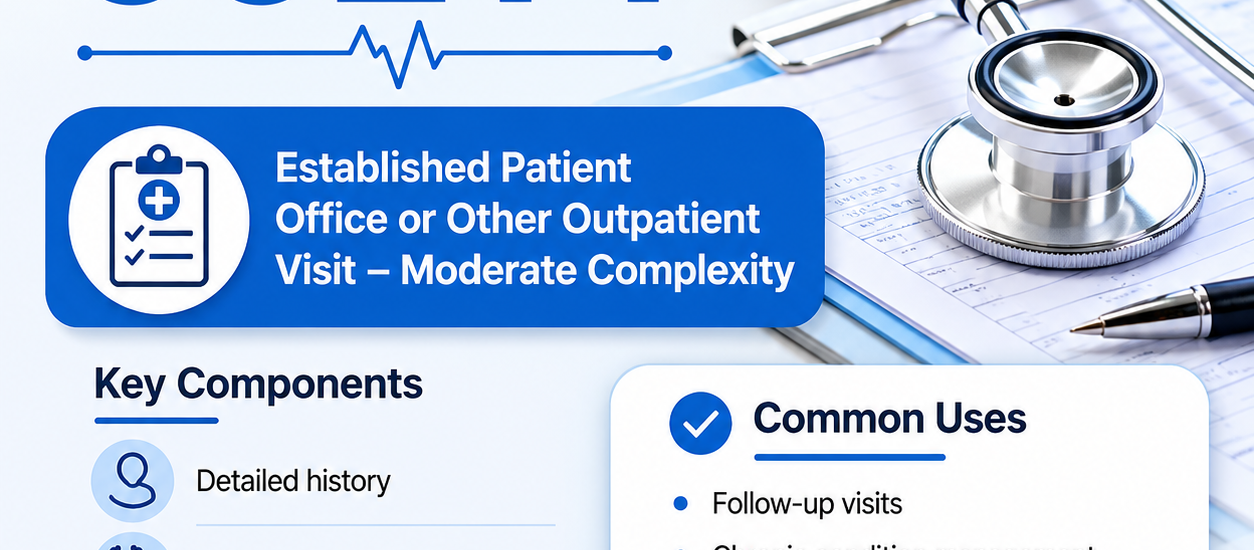
The 99214 cpt code represents something crucial in modern healthcare billing. Specifically, it’s an Evaluation and Management (E/M) code designed for established patients during office or outpatient visits that require moderate medical decision-making or a total provider time commitment of 30 to 39 minutes.
Understanding the 99214 cpt code description matters tremendously in billing operations. Think of it as the middle ground between routine follow-ups and highly complex patient encounters. When a patient walks into your clinic with multiple concerns, or when you’re managing several chronic conditions simultaneously, the 99214 cpt code captures that moderate-complexity level of care perfectly.
From the American Medical Association’s perspective, this cpt code 99214 marks the level that distinguishes visits involving more sophisticated clinical thinking from straightforward appointments. Unlike its lower-tier cousin (99213) or more intensive counterpart (99215), the 99214 strikes a balance between complexity and routine management.
Why This Matters in 2026: Importantly, the coding landscape has shifted significantly. Insurance companies now scrutinize E/M coding far more intensely than before. Furthermore, understanding the precise definition helps you avoid undercoding, which costs your practice thousands annually, while dodging overcoding that invites audits and recoupments.
Core Components of CPT Code 99214 Requirements
Essentially, the 99214 cpt code description hinges on meeting one of two distinct pathways:
Pathway One: Medical Decision-Making (MDM) Based
Moderate medical decision-making requires you to meet two of three elements:
- Diagnosis and Management Options – You’re wrestling with multiple diagnoses or evaluating several management alternatives. For instance, a patient with diabetes showing complications while also managing hypertension and early neuropathy involves reviewing multiple treatment paths.
- Data Review – You’re pulling from multiple sources: lab results, imaging reports, specialist notes, medication histories. You’re synthesizing complex clinical information to form your assessment.
- Risk Assessment – Your management decisions carry moderate consequences. The stakes are higher than routine visits. You’re managing complications, adjusting medications with moderate risk implications, or addressing acute conditions with potential complications.
Pathway Two: Time-Based Billing
Total provider time of 30 to 39 minutes on the date of service. Here’s the critical part: this includes every minute of clinical work, not just face-to-face encounters. It encompasses:
- Chart review before the appointment
- Patient examination and discussion
- Documentation and decision-making
- Care coordination with specialists
- Phone calls to other providers
- Post-visit care planning
Symptoms and Clinical Scenarios That Support 99214 Billing
When do you actually use the 99214 cpt code? Let’s break down real-world situations where this code makes perfect sense.
Multiple Chronic Conditions Scenario
A 62-year-old patient arrives with poorly controlled Type 2 diabetes, Stage 2 hypertension, and newly diagnosed hyperlipidemia. You’re adjusting insulin dosing, changing blood pressure medications due to side effects, starting a statin, and coordinating follow-up labs. This visit justifiably uses the 99214 cpt code because managing multiple chronic diseases with medication adjustments requires moderate MDM.
Acute Problem with Chronic Disease Management
Your long-term patient with COPD comes in with increased shortness of breath. While you address the acute exacerbation with new medications, you’re simultaneously reviewing their chronic disease management, adjusting their home oxygen prescription, and ensuring their inhaler technique is correct. The 99214 cpt code description perfectly fits this scenario.
New Symptom Investigation
A patient reports chest discomfort, and you must differentiate cardiac causes from musculoskeletal pain. You review EKG results, order cardiac enzymes, discuss risk factors, and establish a management plan. The complexity of ruling out serious conditions while managing their existing hypertension supports 99214 billing.
Medication Adjustment and Monitoring
Starting antidepressant therapy requires reviewing the patient’s psychiatric history, discussing side effects, coordinating with psychiatry notes, and establishing follow-up parameters. This administrative complexity, combined with the clinical decision-making involved, generates appropriate 99214 work.
Complex Family History and Risk Stratification
Patients with significant family histories of cancer, heart disease, or genetic conditions require extensive counseling about screening, risk modification, and potential genetic testing. This educational and decision-making complexity triggers appropriate 99214 coding.
Root Causes of Undercoding and Overcoding Mistakes
Notably, the 99214 cpt code creates confusion in many practices, and here’s why most struggle with it.
Why Undercoding Happens
Typically, providers chronically underbill because they fear audits. They assume auditors target higher-value codes. However, in reality, they target incorrect codes. The hesitation costs practices legitimate revenue. When a visit genuinely involves moderate MDM or exceeds 30 minutes, billing anything lower than 99214 represents lost money on your highest-volume service line.
Why Overcoding Happens
Conversely, some practices inflate complexity estimates without robust documentation. They bill 99214 when the visit actually supports only 99213-level care. As a result, this triggers audits faster than you’d think. Payers maintain statistical profiles. When your 99214 usage significantly exceeds peer averages, investigations inevitably follow.
The Documentation Gap
Generally, most undercoding stems from poor documentation. Providers perform complex work but fail to document it clearly. They skip describing the management options considered, omit data sources reviewed, or forget to mention time spent on various clinical tasks. Ultimately, the work happens; the documentation doesn’t capture it.
Copy-Paste Problems
Regrettably, electronic health records enable lazy documentation. Previous visit notes get carried forward without updating for today’s encounter. You write assessment/plan for today but timestamp it from yesterday. Consequently, this documentation flaw makes auditors suspicious regardless of the actual complexity.
Billing Tips for Maximum Accuracy and Compliance
Getting 99214 cpt code billing right requires systematic approaches that your team can implement immediately.
Implement Documentation Standards
Create templated reminders within your EHR that prompt providers to document:
- Multiple diagnoses being managed
- Clinical data reviewed (lab values, imaging, specialist notes)
- Management options considered
- Time statement (“Total time: 35 minutes on date of service”)
- Risk factors influencing decision-making
Don’t make templates too rigid, but guide clinicians toward capturing essential MDM elements without extra work.
Choose Your Billing Pathway Deliberately
Decide whether to bill based on MDM or time for each visit type. Train staff to recognize which pathway better fits your practice pattern. If you specialize in managing complex medication regimens, MDM-based billing might suit you better. If your visits involve extensive counseling, time-based billing could be your advantage.
Document Time Inclusively
Start counting total time when you first touch the patient’s chart that morning, not when they sit in the exam room. Include everything: reviewing yesterday’s lab work, charting after they leave, calling the pharmacy for insurance authorization. Just ensure the total time span represents work on that specific patient that specific day.
Link Diagnoses Appropriately
Match documented diagnoses to the CPT code selected. If you bill 99214 for moderate complexity, make sure your assessment reflects moderate-complexity conditions. Don’t code a simple URI visit as 99214. Insurance companies detect mismatches instantly.
Use Modifiers When Necessary
Modifier 25 signals that you performed a separately identifiable E/M service on a patient who also received a procedure that day. It also indicates telemedicine video visits. Modifier 59 distinguishes distinct procedural services. Using appropriate modifiers prevents claim rejection.
Train Staff on Compliance
Quarterly coding education covering MDM elements, time calculations, and common error patterns keeps everyone aligned. When staff understand why 99214 requirements exist, they document more carefully and code more accurately.
Conduct Internal Audits
Review your own claims before payers do. Analyze your highest-volume providers’ documentation. Identify patterns of undercoding or overcoding. Address problems internally through coaching rather than waiting for external audits.
Related Evaluation and Management Codes for Comparison
Importantly, the 99214 cpt code sits within a hierarchy of established patient E/M codes. Understanding where it fits prevents misuse.
99213: Routine Follow-Up Visits
Primarily, this represents low-complexity care or 20 to 29 minutes of total time. Use it for:
- Single chronic disease monitoring (diabetes check, blood pressure follow-up)
- Minor acute problems (simple cold, mild sprain)
- Medication refills without significant changes
- Routine preventive counseling
Medicare typically reimburses 99213 at approximately $85-95, while 99214 commands $125-130. Moreover, the $35-45 difference across your annual patient population becomes substantial revenue.
99215: Highly Complex Visits
In contrast, this highest established-patient level requires either high-complexity MDM or 40 to 59 minutes of total time. Reserve it for:
- Multiple serious conditions with serious consequences
- Extensive medication regimen adjustments with drug interactions
- Complex diagnostic workups for unclear presentations
- Cases involving significant risk of complications or mortality
99212: Minimal Problem-Focused Visits
The entry-level established patient code for 10 to 19 minutes or minimal-complexity problems. Use sparingly; most practices underutilize it.
99211: Nurse or Staff Visit
For encounters not requiring physician presence, handled by clinical staff under standing orders.
New Patient Codes: 99201-99205
These operate on identical complexity/time frameworks as established patients but start at slightly lower baseline due to extended history-taking requirements with unfamiliar patients.
Common Documentation Mistakes That Trigger Denials
Understanding what auditors flag helps you prevent those flags entirely.
Missing Time Statements
Simply failing to document total time costs hundreds of claims annually. Auditors cannot approve time-based billing without clear documentation: “Total time spent on date of service: 34 minutes.” Without it, payers downgrade to 99213 automatically.
Vague Assessments and Plans
Writing “Patient doing okay, continue current treatment” doesn’t document complexity. Robust assessment/plan documentation explains: “Patient’s diabetes remains suboptimally controlled on current metformin dose given recent A1C results. Increasing to extended-release formulation given side effects from immediate-release. Also noted medication adherence challenges secondary to cost; discussed generic alternatives and authorized social work consult for assistance programs.”
Failing to Update Previous Records
Carrying forward old assessment/plan notes from previous visits without modification suggests you didn’t actually evaluate the patient today. Auditors hate this pattern. Update all clinical sections to reflect today’s encounter.
Inadequate Documentation of Data Review
Simply checking boxes for “reviewed labs” without specifying which labs and what they showed misses an MDM element. Write: “Reviewed most recent chemistry panel showing potassium 5.2 (borderline elevated), creatinine 1.1 (stable), BUN 18. Also reviewed urine microalbumin results showing 2+ proteinuria, indicating advancing nephropathy.”
Omitting Management Decisions
Not documenting your clinical reasoning invites audit challenges. Example of weak documentation: “Patient has pain. Starting hydrocodone.” Stronger documentation: “Patient reporting sharp low back pain radiating to right leg. Given severity and functional impairment, tried oral NSAIDs previously without relief. Concern for possible radiculopathy. Imaging ordered to rule out structural problem. Starting short-acting opioid for pain control while awaiting imaging and planning physical therapy referral.”
Ignoring Payer-Specific Rules
Each insurance company maintains slightly different documentation requirements. Some demand specific templates. Others want narrative notes. Some require diagnoses coded differently. Review your major payers’ guidelines quarterly.
Medication Errors in Documentation
Documenting medication changes without dosages, frequency, or clinical reasoning weakens your case. Write: “Atorvastatin increased from 20 mg daily to 40 mg daily given recent lipid panel showing LDL 145 despite compliance. Patient tolerating current dose without myalgias.”
CPT Code 99214 in the 2026 Billing Environment
The 2026 healthcare landscape introduces specific challenges for 99214 billing that didn’t exist previously.
Medicare Payment Adjustments
The 2026 Medicare fee schedule included modest conversion factor increases, but overall payment pressures persist. The reimbursement for 99214 remains relatively stable, but the bar for documentation has risen. Medicare contractors increasingly deny claims that lack explicit complexity documentation.
Commercial Payer Tightening
Major commercial insurance companies (UnitedHealth, Anthem, Cigna, Aetna) now audit established patient E/M codes at 2-3 times the rate of previous years. They’re specifically targeting the 99213 to 99214 boundary, challenging claims where documentation could support lower codes.
Telehealth Parity Requirements
Medicare now requires identical documentation standards for telehealth 99214 codes as in-person visits. Many commercial payers follow this standard. You cannot substitute visual assessment for hands-on examination; documentation must explain how telemedicine met the visit’s clinical requirements.
AI-Powered Audit Programs
Payers increasingly deploy machine learning systems that analyze coding patterns across your entire practice. These algorithms detect statistical outliers: “This orthopedic surgeon bills 99215 in 48% of cases while peer average is 12%.” Once flagged, human auditors initiate reviews.
Increased Prior Authorization Scrutiny
More payers require pre-visit authorization for 99214 codes when seeing specific patient populations. Getting authorization and then submitting claims that don’t match the authorized complexity creates denial patterns.
Stricter Time Documentation Rules
Auditors now question time-based 99214 claims more thoroughly. Vague documentation like “approximately 35 minutes” creates problems. They want precise numbers. Some practices now use EHR timestamps documenting when chart review started and when documentation finished.
E/M Code Updates Specific to 2026
The American Medical Association released updated guidelines affecting 99214 coding specific to 2026.
Expanded Definition of “Time”
AMA guidance now explicitly includes administration of vaccines, injections, wound care, and other procedural activities in time tallying when performed during the E/M visit. Previously, some payers excluded these. In 2026, if you administer a flu shot during a 99214 visit, that injection time legitimately counts toward your 30-39 minute threshold.
Enhanced Care Coordination Documentation
New guidelines specify that documentation of time spent on care coordination (calling specialists, arranging referrals, discussing cases with other providers) requires explicit notation. Rather than just documenting the outcome, include: “Spent 8 minutes on phone with patient’s cardiologist reviewing current medications and coordinating medication adjustments to prevent interactions with newly started antidepressant.”
Telehealth Complexity Clarifications
The 2026 updates specify that moderate-complexity determination for telehealth should weight counseling and decision-making more heavily than physical examination. If your telehealth visit involves extensive medication counseling and management of multiple conditions, documentation emphasizing these elements strengthens your 99214 claim despite limited physical examination.
Documentation Completeness Standards
New AMA guidance establishes that documentation must address all three MDM elements when billing under MDM pathway: problem list, data review, and risk assessment. Omitting even one element technically disqualifies 99214 billing under the MDM pathway, forcing auditors to examine time documentation instead.
Established Patient Redefinition
Clarifications specify that “established patient” means any patient with an existing relationship with your provider or group, regardless of when the last visit occurred. Previously, some practices questioned whether a patient seen 2 years ago still qualified. In 2026, the definition is clearer: established patient status doesn’t expire through time lapse alone.
Frequently Asked Questions About CPT Code 99214
Q: Can I bill 99214 for a telehealth visit?
Absolutely. In fact, telehealth 99214 codes are billable when the visit meets identical complexity or time requirements as in-person encounters. Use modifier 95 for real-time audio-video visits. Conversely, audio-only telephone visits have stricter requirements; most payers don’t reimburse 99214 for phone-only encounters. Ultimately, document clearly how the telehealth format met complexity requirements—for instance, describing extensive medication counseling visible on video, clear clinical assessment despite lack of hands-on examination, and management decisions supported by detailed historical and clinical data review.
Q: How often can I bill 99214 for the same patient?
As often as medically necessary. For example, if the patient visits your clinic multiple times monthly, and each visit involves moderate complexity or exceeds 30 minutes, then each visit generates appropriate 99214 billing. However, payers notice patterns. Notably, if you bill 99214 for every single patient visit when peer averages show much lower frequency, statistical analysis triggers audits. Therefore, ensure documentation actually supports complexity at each visit.
Q: Does time-based billing require me to break down how time was spent?
No. When billing based on time, you need the total time statement and a description of activities performed, but you don’t need to allocate specific minutes to specific tasks. You don’t write “10 minutes history, 8 minutes exam, 17 minutes counseling.” Simply state: “Total time: 35 minutes on date of service. Time included reviewing patient’s chart, comprehensive examination, extensive counseling on medication side effects and compliance strategies, and coordination with patient’s psychiatrist regarding recent medication changes.”
Q: What if my documentation supports both MDM and time pathways?
Use whichever best represents the visit. If your documentation clearly demonstrates moderate MDM, bill on that pathway. If time is your stronger evidence, use that. You don’t need to list both. In fact, auditors view claiming both as attempt to double-strengthen a claim, sometimes triggering closer scrutiny. Pick your strongest pathway per visit.
Q: How do I calculate time for shared visits?
When multiple providers see a patient on the same day (patient sees physician, then nurse practitioner for additional counseling), tally only your time. The nurse practitioner bills separately based on their time. Time isn’t pooled. If the physician spends 20 minutes and the NP spends 12 minutes, the physician bills based on 20 minutes (probably 99213) and the NP bills based on 12 minutes (probably 99212).
Q: Does copy-paste in EHR disqualify my 99214 claim?
Copy-pasting outdated information automatically disqualifies legitimate claims. Auditors flag notes where assessment/plan clearly originates from previous visits but carries the current date. Update all sections. If you copy a previous note as template, extensively modify and personalize it for today’s patient. Better practice: use templates that remind you what to document without populating outdated information.
Q: Can I bill 99214 when I’m only seeing the patient for one specific problem?
Depends on problem complexity and time spent. A 35-minute visit managing a complex new-onset migraine headache with extensive workup, multiple management options evaluated, and medication prescribing might justify 99214 based on time even for a single problem. A simple acute condition resolved in 15 minutes wouldn’t. It’s entirely legitimate to bill 99214 for focused single-problem visits if complexity or time requirements are met; you don’t need multiple problems.
Q: What happens if my documentation gets audited and audit findings show problems?
Payers issue audit reports detailing claims with documentation deficiencies. You receive notification of proposed payment adjustments. You have opportunity to rebut with additional documentation. If you can’t provide supporting documentation, you potentially owe money back. Persistent patterns trigger overpayment investigations. Establishing strong compliance processes prevents this scenario.
Q: Are there differences in 99214 requirements between Medicare and commercial insurance?
Medicare requirements are standardized across all Medicare Administrative Contractors (MACs). However, commercial insurance varies by carrier. Some commercial carriers maintain more stringent documentation requirements. Maintain a comparison chart of your top 10 payers’ specific standards. Train billing staff on payer-specific variations.
Q: What documentation should I keep to defend a 99214 claim in audit?
Keep everything: the complete clinical note with time statement, progress notes from previous visits showing disease progression (establishing context for complexity), lab results reviewed during the visit, consultant reports, prescription records, and EHR timestamps if available. Also keep documentation of your standard coding practices—charts showing how you select between 99213 and 99214, staff training records, and internal audit procedures. This comprehensive documentation demonstrates systematic, compliant coding practices.
Conclusion: Mastering 99214 for Practice Success in 2026
Undoubtedly, the 99214 cpt code represents genuine opportunity for appropriate revenue capture when documented correctly. Most practices leave thousands annually on the table through undercoding. Additionally, overcoding without documentation support invites audits that exceed the revenue benefit.
Notably, the 2026 billing environment demands precision. Insurance companies scrutinize coding more thoroughly than ever before. Furthermore, artificial intelligence systems detect coding anomalies automatically. Documentation standards continue rising. However, opportunities exist for practices willing to invest in compliance systems.
To begin, start by auditing your current coding patterns. Compare your 99214 usage frequency against peer benchmarks. Subsequently, review a sample of 99214 claims for documentation completeness against the standards outlined here. Identify specific gaps: Are you omitting time statements? Failing to document data sources? Carrying forward outdated information?
Importantly, implement systematic solutions. Update your EHR templates. Train providers on MDM elements and time documentation. Conduct quarterly internal audits before payers audit you. Most significantly, foster a culture where compliant, accurate coding is valued equally with clinical care quality.
In summary, the 99214 cpt code description is straightforward: moderate complexity or 30 to 39 minutes. Ultimately, the complexity lies in documentation and consistency. Get those right, and you’ve positioned your practice for compliance, appropriate reimbursement, and sustainable revenue growth.
Billing Tips Checklist for 99214 Compliance
- Implement templated documentation reminders in EHR
- Choose MDM vs. time billing pathway deliberately
- Document total time inclusively (pre-visit through post-visit)
- Match diagnoses to complexity level selected
- Use modifiers appropriately (25, 95, 59)
- Conduct quarterly staff coding education
- Review sample of claims monthly before payer submission
- Update assessment/plan sections for today’s visit
- Document data sources specifically (which labs, imaging, notes)
- Maintain management decisions with clinical reasoning
- Train all providers on MDM three-element framework
- Create payer-specific documentation guidance documents
- Track 99214 usage rates against peer benchmarks
- Establish clear protocols for time calculation
- Document care coordination activities explicitly
Key Takeaways
- 99214 cpt code applies to established patients with moderate complexity care or 30-39 minutes of total provider time
- Moderate MDM requires documentation of two of three elements: multiple diagnoses/options, data review, and risk assessment
- Time-based billing includes all clinical work that day, not just face-to-face encounter time
- Documentation standards in 2026 are stricter; vague notes create audit risk
- Telehealth 99214 codes are legitimate when complexity requirements are met and documented clearly
- Common mistakes—missing time statements, vague assessments, copy-paste errors, incomplete MDM documentation—trigger denials
- Compliance pays: appropriate documentation protects revenue and prevents audits
- Training matters: provider education on 99214 criteria improves coding accuracy significantly
- Internal audits should precede external audits; catch problems before payers do
- 2026 updates emphasize time documentation inclusivity, care coordination notation, and established patient clarity