

Let’s be real — medical codes can feel like a foreign language. If you’ve spotted diagnosis code I48.0 on a patient chart, an insurance claim, or your own medical paperwork and wondered what it actually means, you’ve landed in the right place. This guide breaks it all down in plain, everyday American English. No fluff, no runaround, just the facts you need — whether you’re a patient, a medical coder, a biller, or a provider trying to stay ahead of the 2026 ICD-10-CM updates.
So let’s get into it.
What Is Diagnosis Code I48.0?
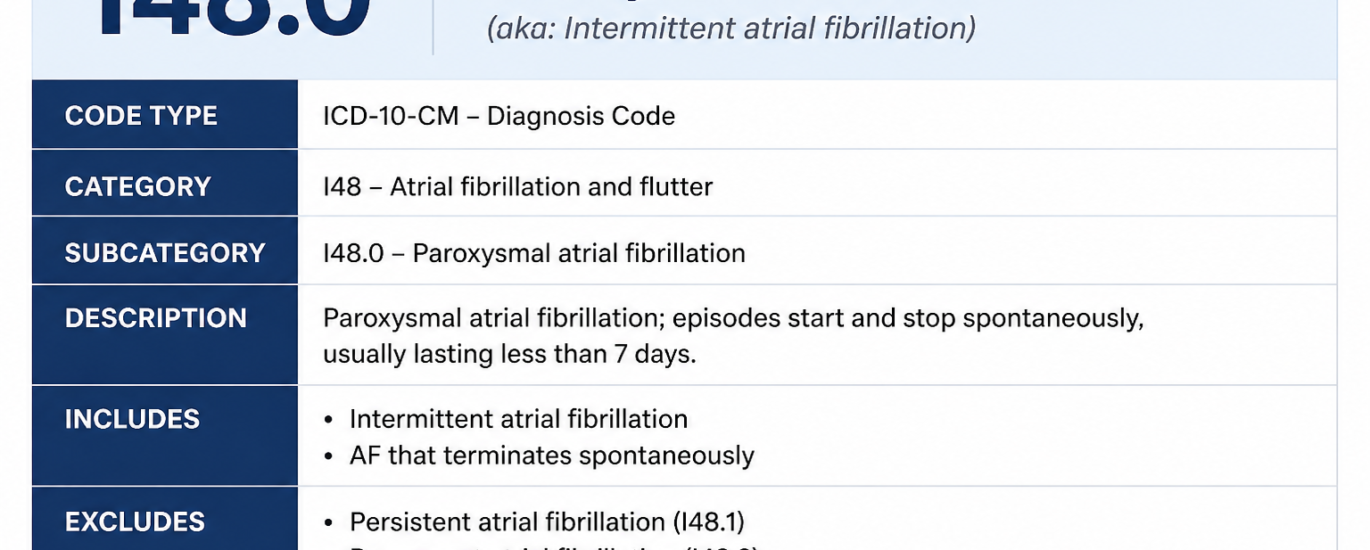
Simply put, what is diagnosis code I48.0? It is the ICD-10-CM code for Paroxysmal Atrial Fibrillation — often shortened to paroxysmal AFib or PAF. The word “paroxysmal” is the key piece here. It comes from the Greek word paroxysmos, meaning a sudden attack or intensification. In clinical terms, it describes a type of atrial fibrillation that starts suddenly, runs its course, and then stops on its own — usually within 7 days, and most commonly within 24 to 48 hours.
Atrial fibrillation itself is one of the most common cardiac arrhythmias in the country. It happens when the heart’s upper chambers, called the atria, start firing electrical signals in a chaotic, disorganized way instead of the smooth, rhythmic pattern a healthy heart follows. The result is a rapid, irregular heartbeat that can affect blood flow throughout the entire body.
What separates I48.0 from other AFib codes is specifically that episodic, self-terminating nature. The heart goes into AFib, and then — with or without medical intervention — it converts back to a normal sinus rhythm on its own. That’s the defining clinical feature that earns this code.
Where I48.0 Sits in the ICD-10-CM Structure
The I48.0 diagnosis code sits within a very logical hierarchy inside the ICD-10-CM system:
- Chapter 9 — Diseases of the Circulatory System (I00–I99)
- Block I30–I5A — Other Forms of Heart Disease
- Category I48 — Atrial Fibrillation and Flutter
- Code I48.0 — Paroxysmal Atrial Fibrillation
This code is maintained by the Centers for Medicare and Medicaid Services (CMS) and the National Center for Health Statistics (NCHS). It became effective October 1, 2015 and remains fully active and unchanged in the FY2026 ICD-10-CM code set, valid for all HIPAA-covered transactions from October 1, 2025 through September 30, 2026.
Additionally, I48.0 is grouped under MS-DRG v43.0 within three Diagnostic Related Groups for inpatient hospital billing:
- DRG 308 — Cardiac Arrhythmia and Conduction Disorders with MCC
- DRG 309 — Cardiac Arrhythmia and Conduction Disorders with CC
- DRG 310 — Cardiac Arrhythmia and Conduction Disorders without CC/MCC
Which DRG gets assigned depends on the presence of major or minor complications and comorbidities. This directly impacts inpatient reimbursement, so documenting those secondary conditions accurately is critical.
Symptoms of Paroxysmal Atrial Fibrillation (I48.0)
Because I48.0 represents an episodic condition, the symptoms come and go. Many patients describe the onset as sudden and sometimes frightening — especially when it happens for the first time. Here’s what providers typically document and what patients commonly report:
Heart-Related Symptoms
- Palpitations — the most classic symptom; patients describe it as their heart “fluttering,” “racing,” “flopping,” or “skipping beats”
- Rapid heart rate — the heart can beat anywhere from 100 to 175 beats per minute during an episode
- Irregular heartbeat — the rhythm feels chaotic rather than steady, which is what distinguishes it from simple sinus tachycardia
Systemic and Neurological Symptoms
- Dizziness or lightheadedness — often because the heart isn’t pumping blood as efficiently during AFib
- Shortness of breath — particularly during physical activity or even at rest during an active episode
- Fatigue — the body works harder to compensate for the irregular rhythm
- Chest discomfort or pressure — not always present, but common enough to warrant documentation when it occurs
- Weakness — a generalized sense of not feeling right, especially during or right after an episode
Asymptomatic Presentation
Here’s something that surprises a lot of patients: some people with paroxysmal AFib have absolutely zero noticeable symptoms. Their AFib gets picked up on an ECG during a routine checkup or on a Holter monitor worn for 24 to 48 hours. This is called silent AFib, and it’s more common than most people think. Even without symptoms, the stroke risk is still real — which is exactly why proper documentation and coding of I48.0 matters so much clinically.
What Causes Paroxysmal Atrial Fibrillation?
Understanding the causes behind the I48.0 diagnosis code helps both clinicians document the full clinical picture and coders identify any secondary codes that might apply. Paroxysmal AFib rarely appears in a vacuum. Most of the time, there’s an underlying trigger or contributing condition.
Cardiovascular Causes
- Hypertension (high blood pressure) — the single most common cardiovascular risk factor for AFib; the increased pressure stretches the atrial walls over time, disrupting electrical conduction
- Coronary artery disease — reduced blood supply to the heart muscle affects its electrical system
- Heart failure — both systolic and diastolic heart failure are strongly linked to AFib development
- Valvular heart disease — particularly mitral valve stenosis or regurgitation, which puts stress directly on the left atrium
- Pericarditis — inflammation of the sac surrounding the heart can trigger arrhythmias
Non-Cardiac Triggers
- Hyperthyroidism — an overactive thyroid speeds up the heart and can directly trigger AFib episodes
- Electrolyte imbalances — low potassium or magnesium levels disrupt the electrical environment in the heart
- Obstructive sleep apnea (OSA) — repeated drops in oxygen during sleep stress the heart and are a major but underrecognized AFib trigger
- Excessive alcohol consumption — “holiday heart syndrome” is a real phenomenon where binge drinking triggers AFib episodes in otherwise healthy people
- Stimulant use — high caffeine intake, certain decongestants, and illicit stimulants can all provoke episodes
- Acute illness or infection — pneumonia, sepsis, and post-surgical states commonly trigger new-onset AFib
Idiopathic or Lone AFib
In a subset of patients — particularly younger, otherwise healthy individuals — no clear structural or metabolic cause gets identified even after a thorough workup. This is sometimes called “lone AFib.” It’s less common but definitely real, and it’s still correctly coded as I48.0 as long as the episodes are paroxysmal in nature.
I48.0 Billing Tips: Getting It Right in 2026
Accurate billing for the I48.0 diagnosis code can make or break reimbursement for cardiology, internal medicine, family practice, and emergency medicine practices. Here’s what you need to know right now.
When to Use I48.0
Use I48.0 when:
- The documentation clearly states “paroxysmal atrial fibrillation” or “paroxysmal AFib”
- The AFib episodes terminate spontaneously within 7 days, with or without cardioversion
- An ECG confirms the irregular rhythm during or shortly after an episode
- The provider documents a history of recurring, self-terminating AFib episodes
When I48.0 Is NOT the Right Code
This is where a lot of coders trip up. If the documentation says anything other than “paroxysmal,” you need a different I48 subcategory code:
- If AFib is persistent (lasting more than 7 days, or requiring cardioversion) — use I48.11 or I48.19
- If AFib is chronic/permanent (ongoing, accepted, not being actively converted) — use I48.20 or I48.21
- If the type of AFib is simply not documented — use I48.91 (but query the provider first)
- If the parent code I48 appears without a subcode — it is NOT billable; I48.0 is the correct specific code
CPT Codes Commonly Paired With I48.0
Pairing the wrong procedure code with I48.0 is one of the fastest ways to trigger a denial. Here are the most common and defensible CPT pairings:
- 93000 — 12-lead ECG with interpretation (standard first-line diagnostic tool)
- 93224–93227 — Holter monitor interpretations for 24–48 hour cardiac monitoring
- 93241–93248 — Extended cardiac event monitoring beyond 48 hours
- 93656 — Comprehensive electrophysiologic evaluation with radiofrequency ablation by pulmonary vein isolation (for AFib ablation procedures)
- 93657 — Additional linear or focal ablation during the same ablation session as 93656
- 99202–99215 — Evaluation and management office visits (new and established patients)
- 92960 — Cardioversion, elective, electrical (external)
Always ensure that every CPT code you pair with I48.0 has clear medical necessity documentation in the chart. For high-dollar procedures like ablation, payers want to see a documented history of AFib episodes, prior medication trials, and rationale for why ablation is appropriate.
Secondary Codes That Strengthen I48.0 Claims
Coding I48.0 alone often misses the full clinical story. Adding appropriate secondary codes not only reflects the patient’s true condition but also supports medical necessity and can affect DRG assignment for inpatient claims. Consider adding:
- I10 — Essential hypertension (if present and documented)
- E11.xx — Type 2 diabetes mellitus (if present)
- I50.xx — Heart failure (if documented)
- G47.33 — Obstructive sleep apnea (if documented and relevant to AFib)
- Z79.01 — Long-term use of anticoagulants (if patient is on blood thinners for stroke prevention)
- I63.xx — Cerebral infarction (if stroke history exists)
Documenting the CHA2DS2-VASc score in the clinical note also strengthens the claim when anticoagulation therapy is being billed, as it clearly justifies the treatment decision.
Related ICD-10-CM Codes You Need to Know
Understanding where I48.0 sits among its close relatives prevents one of the most common coding errors in cardiology billing.
| Code | Description | Key Distinguishing Feature |
|---|---|---|
| I48.0 | Paroxysmal atrial fibrillation | Episodes self-terminate within 7 days |
| I48.11 | Longstanding persistent AFib | Duration over 12 months |
| I48.19 | Other persistent AFib | Lasts over 7 days but under 12 months |
| I48.20 | Chronic AFib, unspecified | Permanent, no longer being converted |
| I48.21 | Permanent AFib | Provider and patient agreed not to restore sinus rhythm |
| I48.3 | Typical atrial flutter | Organized macro-reentrant atrial tachycardia |
| I48.4 | Atypical atrial flutter | Non-isthmus-dependent flutter |
| I48.91 | Unspecified AFib | Type not documented (use rarely, query first) |
| I49.3 | Ventricular premature depolarization | Different arrhythmia, sometimes confused |
The most important distinction to master is I48.0 vs. I48.11/I48.19 — the entire difference comes down to episode duration and whether the rhythm self-terminates or requires intervention to convert.
Common Coding Mistakes With I48.0
After years of working in medical coding and revenue cycle management, the same errors keep showing up in AFib claims. Here’s what to watch out for:
Mistake 1: Using I48.91 as a Default
Too many coders reach for I48.91 (unspecified AFib) simply because it’s easier than figuring out which subtype is documented. If the chart has any language about episode duration, frequency, or whether the rhythm converted spontaneously, that’s enough to code more specifically. Query the provider rather than defaulting to unspecified.
Mistake 2: Coding I48 Without a Subcode
The parent code I48 is not billable. Using it on a claim guarantees an automatic rejection. Always code to the highest level of specificity — which means I48.0, I48.11, I48.19, and so on.
Mistake 3: Missing Secondary Comorbidities
Submitting I48.0 as the only code on a claim when the patient also has documented hypertension, diabetes, heart failure, or sleep apnea leaves money on the table. Worse, it may not accurately reflect disease complexity in a risk-adjusted environment like Medicare Advantage or value-based care contracts.
Mistake 4: Not Documenting Episode Duration
The clinical distinction between paroxysmal, persistent, and permanent AFib hinges almost entirely on how long episodes last. If the provider’s note doesn’t mention duration, coders can’t confidently assign I48.0. This is a documentation education issue, not just a coding issue — and it needs to be fixed upstream.
Mistake 5: Incorrect CPT Pairing for Ablation
Billing 93656 (AFib ablation) against I48.0 without documentation of a failed medication trial and a clear statement of medical necessity is one of the most common reasons ablation claims get denied by Medicare. Payers want to see that conservative therapy was tried first.
Mistake 6: Ignoring the CHA2DS2-VASc Score in the Note
For anticoagulation claims tied to I48.0, the absence of stroke risk stratification documentation is a red flag during audits. Documenting the CHA2DS2-VASc score and the rationale for anticoagulation is not just good clinical practice — it’s a billing protection strategy.
2026 Updates: What’s New for I48.0 and AFib Coding
The FY2026 ICD-10-CM code set became effective October 1, 2025. Here’s what matters most for I48.0 and atrial fibrillation coding right now in 2026:
I48.0 Itself: Stable and Unchanged
The I48.0 diagnosis code carries the same description, billable status, and applicable-to notes in FY2026 as it has since its introduction. No new excludes notes, no additional subcode requirements, and no changes to its DRG grouping. If you know how to use it correctly, nothing about FY2026 disrupts your workflow for this specific code.
Payers Are Getting Stricter on AFib Subtype Documentation
Across the board in 2026, both Medicare and commercial payers are ramping up scrutiny on atrial fibrillation claims. The trend is clear: payers want to see documentation that supports the specific AFib subtype being coded. Practices that consistently submit I48.91 (unspecified) are getting flagged for documentation deficiency reviews. If you’re in a cardiology or internal medicine practice, now is the time to audit your AFib claim mix and push for better provider documentation habits.
Watchman Device Coverage and I48.0
The Watchman left atrial appendage closure device continues to be a hot topic in 2026 AFib billing. Medicare coverage for the Watchman procedure requires specific AFib diagnosis codes paired with documentation of nonvalvular AFib and a CHA2DS2-VASc score of 2 or higher. I48.0 is among the accepted supporting diagnosis codes. However, payers are increasingly requiring detailed clinical justification and prior authorization. Coders and billers working in structural heart programs need to stay current on their specific MAC’s LCD for LAA closure.
Risk-Adjusted Payment Models and AFib HCC Mapping
In Medicare Advantage and ACO-based models, accurate AFib coding has direct dollar implications beyond the individual claim. AFib maps to HCC 9 (Specified Cardiac Arrhythmias) in the CMS-HCC risk adjustment model. Ensuring that paroxysmal AFib is coded every year it is actively managed, not just at the time of diagnosis, is essential for accurate risk score capture. Many practices are leaving significant risk-adjustment revenue uncaptured simply because they don’t re-document chronic conditions like AFib at every qualifying encounter.
Telehealth and Remote Cardiac Monitoring Documentation
Remote cardiac monitoring has exploded since 2020 and continues to grow in 2026. Extended cardiac event monitors (CPT codes 93241–93248) are commonly ordered for patients with suspected paroxysmal AFib who have symptoms but haven’t been caught on a standard ECG. When remote monitoring captures an I48.0 episode, documentation from the monitoring report should be incorporated into the patient’s chart and clearly referenced in the visit note. Payers are starting to request this supporting documentation more frequently when auditing monitoring claims tied to arrhythmia diagnosis codes.
Frequently Asked Questions About I48.0
What is diagnosis code I48.0?
I48.0 is the ICD-10-CM diagnosis code for Paroxysmal Atrial Fibrillation — a type of irregular heart rhythm that starts suddenly and stops on its own within 7 days, most often within 24 to 48 hours.
What is paroxysmal atrial fibrillation in plain English?
It means your heart occasionally goes into a chaotic, fast, irregular rhythm and then returns to normal on its own. Think of it as the heart’s electrical system having brief episodes of short-circuiting and then resetting itself.
How is I48.0 different from I48.91?
I48.0 specifies that the AFib is paroxysmal — meaning self-terminating and episodic. I48.91 is used when the type of AFib is not documented in the chart. Always try to code more specifically before reaching for the unspecified option.
Is I48.0 valid in 2026?
Yes, absolutely. I48.0 is fully active in the FY2026 ICD-10-CM code set, valid for HIPAA-covered transactions from October 1, 2025 through September 30, 2026, with no modifications from prior years.
Does Medicare cover treatment for I48.0?
Yes. Medicare covers evaluation, cardiac monitoring, rate and rhythm control medications, cardioversion, catheter ablation, and other appropriate treatments tied to I48.0, provided medical necessity is properly documented. For high-cost procedures like ablation, prior authorization is commonly required.
What CPT codes pair most commonly with I48.0?
The most common pairings include ECG codes (93000), Holter and event monitor codes (93224–93248), E/M codes (99202–99215), cardioversion (92960), and catheter ablation (93656, 93657) for appropriate candidates.
Can I48.0 be the primary diagnosis on a claim?
Yes. When paroxysmal atrial fibrillation is the primary reason for the encounter, I48.0 serves as the principal diagnosis. If it’s a secondary finding during a visit for another condition, it gets listed as an additional diagnosis.
What happens if I code I48 instead of I48.0?
The claim will be rejected. I48 is the parent category code and is not billable. You must always use the full subcode — I48.0, I48.11, I48.19, I48.20, I48.21, or another specific code depending on documentation.
What specialists commonly use I48.0?
Cardiologists and electrophysiologists use it most frequently, but it also appears heavily in family practice, internal medicine, and emergency medicine encounters. It’s one of the top 10 most commonly billed cardiac diagnosis codes in the United States.
The Bottom Line on Diagnosis Code I48.0
The I48.0 diagnosis code for paroxysmal atrial fibrillation is one of the most clinically and financially significant cardiac codes in the ICD-10-CM system. Getting it right matters — for patients, because accurate coding guides their treatment and risk stratification; for providers, because proper documentation supports appropriate reimbursement; and for coders and billers, because one wrong code choice in the I48 family can mean a denied claim or a compliance audit.
The key takeaways going into the rest of 2026 are clear. Document episode duration every single time. Code to the most specific subtype the chart supports. Don’t default to I48.91 when a provider query can get you to I48.0. Layer in the secondary conditions that tell the full clinical story. And stay alert to the growing payer scrutiny around AFib subcategory specificity, Watchman claims, and HCC risk-adjustment capture.
AFib affects millions of Americans. Coding it right is how the healthcare system tracks it, treats it, and gets paid for treating it properly.