

If you work in a medical office, run a billing department, or handle clinical documentation, you have probably dealt with the I10 diagnosis code more than just about any other code in the entire ICD-10 system. And that makes total sense — hypertension ranks among the most common chronic conditions providers treat every single day across America. But despite how familiar the code looks on paper, a surprising number of coders and clinicians still misuse it, skip important add-on codes, or confuse it with related diagnoses. So let’s fix that right now, all in one place.
What Is the I10 Diagnosis Code?
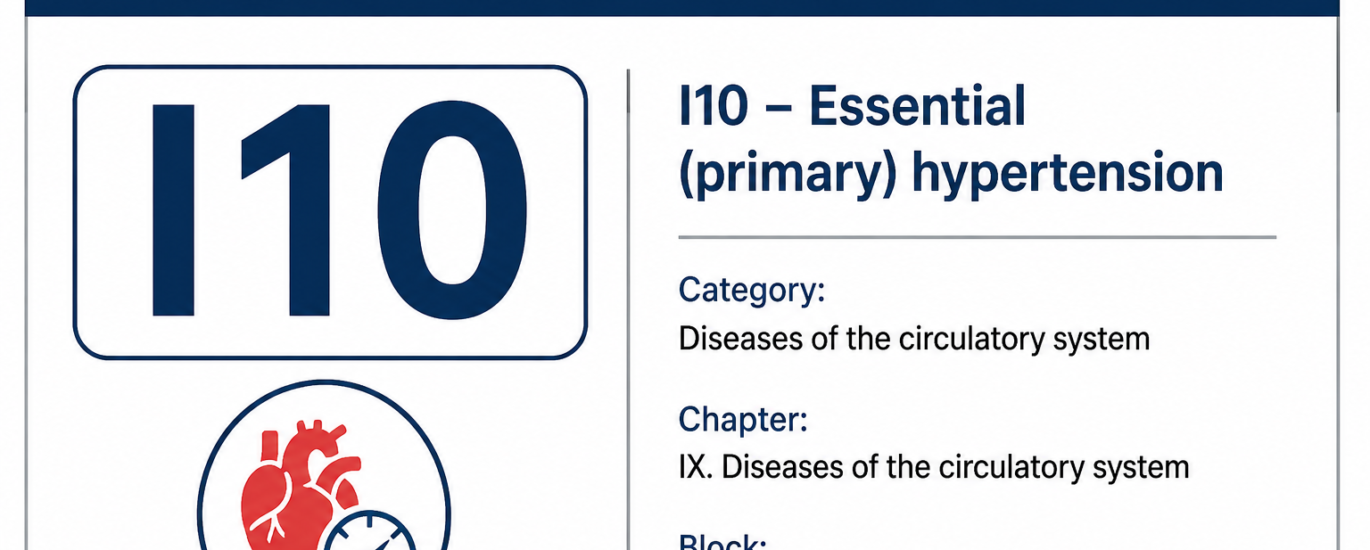
The I10 diagnosis code is the ICD-10-CM billable code for essential (primary) hypertension. Providers use it when a patient’s blood pressure consistently reads at 140/90 mmHg or higher on multiple separate occasions, and no identifiable secondary cause drives that elevation. In plain terms, the patient’s body simply produces high blood pressure on its own, without another underlying disease calling the shots.
This code lives in Chapter 9 of the ICD-10-CM classification system, which covers diseases of the circulatory system (I00-I99). More specifically, it falls within the I10-I1A subgroup dedicated entirely to hypertensive diseases.
Here is exactly where I10 sits in the hierarchy:
- I00-I99 — Diseases of the circulatory system
- I10-I1A — Hypertensive diseases
- I10 — Essential (primary) hypertension (billable)
The I10 icd 10 code also carries an important note: it covers “high blood pressure” as an included term, but it does not include elevated blood pressure without a formal hypertension diagnosis. That distinction matters a lot, and we will cover it shortly.
Essential Hypertension ICD-10: What “Essential” Actually Means
A lot of people see the word “essential” in essential hypertension ICD-10 and wonder what it even means. In medical language, “essential” does not mean important or critical — it means the hypertension exists on its own, without a known root cause. Think of it as primary, idiopathic, or standalone high blood pressure.
Essential hypertension covers the vast majority of hypertension cases that providers diagnose every year. In contrast, secondary hypertension occurs when another condition — such as a kidney tumor, renal artery stenosis, or thyroid disorder — directly drives the elevated blood pressure. Secondary hypertension gets different codes entirely, starting with I15 (Secondary hypertension).
So, when a provider documents “hypertension” without specifying a secondary cause, and the patient does not have associated heart disease or kidney disease, I10 is the correct and only code you need.
ICD 10 Code for Hypertension: Understanding the Full Landscape
Before zeroing in on I10, it helps to see the full ICD 10 code for hypertension landscape. The I10-I1A range covers several distinct scenarios, and picking the wrong one creates billing errors fast:
I10 — Essential (Primary) Hypertension This covers standalone high blood pressure in patients without comorbid heart disease or chronic kidney disease directly linked to hypertension. This is your everyday, go-to hypertension code.
I11 — Hypertensive Heart Disease When hypertension and heart disease coexist, ICD-10-CM presumes a causal link between them unless the provider explicitly documents otherwise. So if a patient carries both a hypertension diagnosis and heart failure, you move from I10 to the I11 category. I11.0 covers hypertensive heart disease with heart failure, while I11.9 covers it without.
I12 — Hypertensive Chronic Kidney Disease Similarly, ICD-10-CM presumes a causal relationship between hypertension and chronic kidney disease (CKD). When a patient has both conditions, use I12 — not I10. The specific code depends on the CKD stage, and you must also add the appropriate N18 code to identify that stage.
I13 — Hypertensive Heart and Chronic Kidney Disease When all three conditions — hypertension, heart disease, and CKD — appear together, I13 takes over. This category gets more complex and requires multiple codes to capture the full clinical picture.
I15 — Secondary Hypertension Use this category only when the provider specifically identifies an underlying condition as the direct cause of the elevated blood pressure.
Understanding this structure makes it much easier to apply the I10 diagnosis code accurately and avoid upcoding or downcoding errors.
Elevated Blood Pressure ICD-10: Do Not Confuse It With I10
One of the most common coding mistakes providers make involves mixing up the elevated blood pressure ICD-10 code with I10, and this confusion costs practices money.
When a patient shows a single elevated blood pressure reading — or even a few readings — without a formal diagnosis of hypertension, you do not use I10. Instead, the correct code is R03.0 (Elevated blood-pressure reading, without diagnosis of hypertension). R03.0 applies when the provider observes high readings but has not yet established a formal hypertension diagnosis.
Coders should look for clear documentation that the provider has reviewed multiple readings across separate visits and formally diagnosed the patient with hypertension before assigning I10 icd 10. A single mildly elevated reading at one visit does not justify I10. Once the provider documents the progression from elevated readings to a confirmed diagnosis, then I10 becomes the correct code going forward.
This distinction protects your claims and ensures your clinical data tells an accurate story about the patient’s condition.
Uncontrolled Hypertension ICD-10: A Common Misconception
Here is something that trips up even seasoned coders: ICD-10-CM does not have a separate code specifically for uncontrolled hypertension ICD-10. Many providers and coders expect to find a distinct code for a patient whose blood pressure stays high despite treatment, but that code simply does not exist in the current ICD-10-CM system.
Instead, when a provider documents uncontrolled hypertension, you still report I10 as the diagnosis code. The “uncontrolled” language in the provider’s notes supports the medical necessity of ongoing treatment and monitoring, but it does not require a different code. Some practices add a note in the encounter documentation to clarify the management challenge, and that absolutely helps from a clinical standpoint — it just does not change the code itself.
Similarly, the old ICD-9 distinction between malignant, benign, and unspecified hypertension no longer applies. ICD-10 consolidates all of those into a single I10 code, which makes coding simpler but also means coders must rely entirely on the provider’s documentation about associated conditions to choose the right category.
When to Use I10 and When to Upgrade to a Combination Code
Getting this decision right saves your practice from denied claims and audit headaches. Use the I10 diagnosis code when the patient meets all of these conditions:
- The provider has diagnosed hypertension (not just elevated readings)
- No heart disease causally related to hypertension appears in the documentation
- No chronic kidney disease causally related to hypertension appears in the documentation
- The hypertension has no documented secondary cause
The moment any of those conditions change, you need to evaluate whether a combination code better fits the situation. Here is a quick decision guide:
- Hypertension only → I10
- Hypertension + heart disease (with causal link) → I11.x + I50.x (if heart failure present)
- Hypertension + CKD (with causal link) → I12.x + N18.x
- Hypertension + heart disease + CKD → I13.x + appropriate add-on codes
- Hypertension caused by another condition → I15.x
A critical point: ICD-10-CM presumes a causal relationship between hypertension and heart or kidney disease unless the provider explicitly states the conditions are unrelated. So if both appear in the record, do not default to I10 without checking the provider’s notes carefully.
Documentation Best Practices to Support the I10 Diagnosis Code
Strong documentation forms the foundation of accurate hypertension coding. When providers build their notes correctly, coders can assign the I10 diagnosis code with confidence and move claims through payers without friction. Here is what the notes should capture:
- Confirmation of hypertension based on multiple blood pressure readings on separate visits
- Explicit statement that no secondary cause drives the hypertension (or the opposite, if applicable)
- Any associated diagnoses — heart disease, CKD, diabetes — and whether the provider considers them causally related
- Current medication and management plan
- Blood pressure readings at the current visit
- Patient compliance and lifestyle factors if relevant
Providers who include these elements give coders everything they need to make the right call between I10 and the combination codes.
Common Coding Errors With the I10 Diagnosis Code
Let’s talk about the mistakes that show up most often in hypertension coding, so you can avoid them:
Using I10 when a combination code applies. When hypertension and heart failure both appear in a record, and the provider has not documented that they are unrelated, ICD-10-CM presumes a connection. Coders who default to I10 in that scenario miss the combination code and create an incomplete claim.
Using I10 for secondary hypertension. When a provider documents that a specific condition — like primary aldosteronism or renovascular disease — causes the patient’s hypertension, I15 takes over. I10 covers primary, not secondary, causes.
Skipping the R03.0 stage. When a patient presents with elevated readings for the first time and the provider documents “elevated blood pressure” without confirming a hypertension diagnosis, R03.0 is the right code. Jumping straight to I10 before the formal diagnosis documentation exists creates a compliance risk.
Forgetting to add the heart failure code. When you correctly upgrade from I10 to I11.0 for hypertensive heart disease with heart failure, ICD-10-CM also requires a code from the I50 series to specify the type of heart failure. Leaving that out makes the claim incomplete.
I10 and DRG Assignment
From a reimbursement standpoint, the I10 diagnosis code falls within the MS-DRG system under:
- DRG 304 — Hypertension with MCC (Major Complicating Condition)
- DRG 305 — Hypertension without MCC
Documenting any major complicating conditions alongside hypertension shifts the DRG assignment and changes what your facility collects. Accurate, complete documentation of comorbidities supports the higher DRG when the clinical picture actually warrants it.
Quick Reference: Hypertension ICD-10 Code Comparison
| ICD-10 Code | Condition | Key Distinction |
|---|---|---|
| R03.0 | Elevated blood pressure, no hypertension diagnosis | No formal diagnosis yet |
| I10 | Essential (primary) hypertension | Standalone, no heart or kidney involvement |
| I11.0 | Hypertensive heart disease with heart failure | Presumed causal link to heart failure |
| I11.9 | Hypertensive heart disease without heart failure | Presumed causal link to heart disease |
| I12.9 | Hypertensive CKD, stage 1-4 or unspecified | Presumed causal link to kidney disease |
| I15.x | Secondary hypertension | Another condition directly causes the high BP |
Frequently Asked Questions
What does the I10 diagnosis code represent?
The I10 diagnosis code identifies essential (primary) hypertension in ICD-10-CM. Providers and coders use it when a patient’s blood pressure consistently reads 140/90 mmHg or higher across multiple visits, and no secondary condition causes the elevation. It covers standalone hypertension without associated heart or kidney disease.
Is there a separate ICD-10 code for uncontrolled hypertension?
No. ICD-10-CM does not offer a distinct code for uncontrolled hypertension. Coders still report I10 even when the provider’s notes describe the hypertension as uncontrolled or poorly managed. The provider’s documentation of uncontrolled status supports medical necessity for treatment but does not require a different code.
What is the difference between I10 and R03.0?
I10 applies when the provider has formally diagnosed hypertension based on multiple elevated readings. R03.0 applies when blood pressure readings come back elevated but the provider has not yet established a formal hypertension diagnosis. Never use I10 for a single high reading without a confirmed diagnosis in the documentation.
When should a coder use I11 instead of I10?
Use I11 instead of I10 when the patient has both hypertension and heart disease, and the provider has not specifically documented that the two conditions are unrelated. ICD-10-CM presumes a causal relationship between them, which means I11 becomes the correct starting point for the claim.
Can I10 and I12 appear on the same claim?
No. When hypertension and chronic kidney disease coexist and carry a causal relationship, I12 replaces I10 — not supplements it. I12 handles the combination, and coders must also add the appropriate N18 code to specify the CKD stage.
What is the ICD-10 code for elevated blood pressure without a hypertension diagnosis?
R03.0 covers elevated blood pressure readings when the provider has not yet formally diagnosed hypertension. This code works as a temporary designation until the provider confirms the diagnosis across multiple visits and documents hypertension in the assessment.
Does I10 apply to both primary and secondary hypertension?
No. I10 covers only essential (primary) hypertension, meaning high blood pressure without an identifiable secondary cause. When another condition directly causes the hypertension — like renovascular disease or primary aldosteronism — the correct code comes from the I15 category for secondary hypertension.
This article targets medical coders, billing specialists, healthcare providers, and clinical documentation professionals. Always consult the official ICD-10-CM coding guidelines and a certified professional coder for case-specific decisions.