

Back pain walks into clinics every single day. It ranks as one of the most commonly billed diagnoses in the entire U.S. healthcare system. Yet despite how frequently providers treat it, the icd 10 code for back pain still trips people up — especially when it involves the thoracic spine. That is exactly where M54.6 comes in.
Whether you work as a medical coder hunting for accuracy, a provider trying to keep claims clean, or a patient trying to understand that alphanumeric code on your paperwork — this guide covers it all. We break down M54.6 from every possible angle, updated for 2026, and keep it real the whole way through.
What Is M54.6? Understanding the Meaning
The Official Code Definition
M54.6 is the ICD-10-CM diagnosis code for Pain in the Thoracic Spine. In plain terms, it tells an insurance company or a healthcare system that a patient carries mid or upper back pain specifically in the thoracic region — not in the neck (cervical) or lower back (lumbar) area.
The thoracic spine covers 12 vertebrae, labeled T1 through T12. It starts right below the neck and runs all the way down to the bottom of the ribcage. So when someone walks in complaining about pain between their shoulder blades, tightness across the mid-back, or a dull ache near the upper back that does not involve the neck — that is your M54.6 territory.
Clinicians use the broader term “dorsalgia” to describe back pain in general, and M54.6 sits under that umbrella within ICD-10-CM Chapter 13, which covers Diseases of the Musculoskeletal System and Connective Tissue.
When Does M54.6 Apply?
Here is the key distinction every coder needs to know: M54.6 applies when thoracic pain exists without a clearly identified structural cause like a herniated disc or fracture. The moment imaging confirms a disc problem as the cause, you need to shift to the M51 family instead — more on that below.
As of the 2026 ICD-10-CM cycle (effective October 1, 2025), M54.6 stands as a fully billable and specific code. It covers reimbursement claims on dates of service from October 1, 2025 through September 30, 2026.
Symptoms Associated with M54.6
What Patients Typically Report
Patients presenting with a thoracic spine pain diagnosis typically describe a wide range of symptoms. Recognizing these early helps coders and providers select the right code from the start, rather than going back later to fix claims.
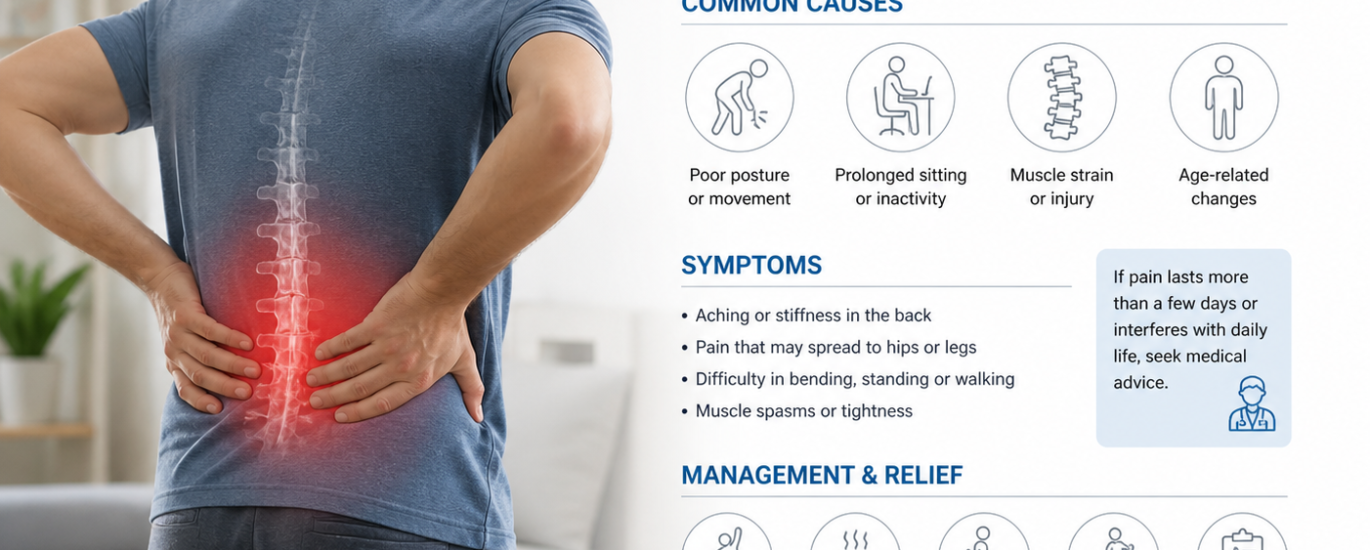
The most common symptoms include a dull or aching pain in the mid-back area, stiffness when rotating or bending the upper body, a sharp or stabbing sensation with deep breathing or sudden movement, muscle tightness and tenderness across the shoulder blades, and in some cases, a radiating discomfort that wraps around the rib cage. Patients also frequently report the pain worsening after prolonged sitting, poor posture, or heavy lifting.
Why Thoracic Pain Is Tricky to Code
What makes thoracic pain unique — and honestly, a challenge to code — is that it can mimic other conditions. Cardiac events, pulmonary issues, and even kidney problems can present with mid-back pain. Providers must rule these out through clinical evaluation before landing on M54.6 as the working diagnosis.
M54.6 specifically fits pain that providers have not yet attributed to a definitive underlying condition. The code suits musculoskeletal pain, postural pain, and overuse-related pain in the thoracic region.
Common Causes of Thoracic Spine Pain (M54.6)
Understanding the “why” behind the pain matters not just clinically — it also guides whether M54.6 is truly the right code, or whether a more specific one applies.
Muscle Strain and Postural Stress
Muscle strain and postural issues top the list of frequent culprits. Long hours hunching over a desk, looking down at a phone, or performing repetitive overhead tasks put enormous strain on the thoracic muscles and joints. This type of pain typically produces no structural finding on imaging, making M54.6 a solid fit.
Degenerative Changes
Degenerative changes in the spine — including early-stage disc degeneration — can contribute to thoracic pain even without nerve involvement. However, once imaging confirms that disc degeneration drives the pain, ICD-10-CM guidelines push you toward the M51 family rather than M54.6.
Trauma and Overuse Injuries
Trauma and overuse injuries from sports, falls, or physically demanding jobs commonly produce thoracic pain. If documentation shows no disc or fracture finding, M54.6 stays appropriate.
Osteoporosis and Myofascial Pain
Osteoporosis-related compression in older adults, especially post-menopausal women, can manifest as mid-back pain. But when imaging confirms a compression fracture, a separate fracture code takes priority over M54.6.
Myofascial pain patterns — meaning pain that originates from trigger points in the thoracic muscle groups — also map to M54.6 when the clinical note supports it.
The bottom line: causes vary widely, but M54.6 applies when the pain is real, localized to T1–T12, and not yet linked to a documented structural pathology.
M54.6 vs. Low Back Pain ICD-10 Codes: Key Differences
Clearing Up the Confusion
A lot of confusion happens when coders mix up thoracic and lumbar spine codes. Let’s clear this up fast.
M54.6 covers pain in the thoracic spine (T1–T12). It ranks among the most-used icd 10 code for back pain options in the mid-back area.
Low back pain ICD-10 codes fall under a completely different category — the M54.5x family:
- M54.50 — Low back pain, unspecified (the catch-all when no specific cause shows up in documentation)
- M54.51 — Vertebrogenic low back pain (requires imaging showing Modic changes at the vertebral endplates)
- M54.59 — Other low back pain (used when a cause appears in documentation but does not fit the vertebrogenic category)
The M54.5 Trap You Must Avoid
The old parent code M54.5 (without the last digit) became non-billable back in 2022. If you still submit M54.5 on claims in 2026, payers reject those automatically. Always use M54.50, M54.51, or M54.59 for low back pain ICD-10 coding.
For icd 10 degenerative disc lumbar specifically, look at the M51.36x codes rather than the M54 family. The M51 series covers intervertebral disc disorders and carries its own documentation requirements around imaging findings.
What About the M549 Diagnosis Code?
The m549 diagnosis code refers to M54.9 — “Dorsalgia, unspecified.” It is valid but broad. Use it only when documentation genuinely omits the specific spinal region. Specificity always wins in medical billing, so M54.6 beats M54.9 every time the clinical note identifies the thoracic spine.
Billing Tips: Getting M54.6 Claims Paid Right
This is where coders and billers invest a lot of mental energy — and for good reason. Inaccurate billing costs practices real money. Here are the most important billing tips for M54.6 in 2026.
Nail the Documentation Language
The provider’s note must clearly state that the pain sits in the thoracic spine. Vague terms like “back pain” fall short. “Thoracic dorsalgia,” “mid-back pain,” “interscapular pain,” and “pain between shoulder blades” all support M54.6 selection when the thoracic region is the documented site.
Respect the Excludes1 Rule — Always
M54.6 carries an Excludes1 instructional note for pain in the thoracic spine that an intervertebral disc disorder causes (M51.-). Excludes1 means “NOT CODED HERE” — you cannot bill M54.6 alongside an M51 code on the same claim. Pick one. If the disc drives the documented cause, go M51. If no structural cause appears, stay with M54.6.
Use G89.29 for Chronic Thoracic Pain
When the patient’s thoracic pain persists beyond three months and documentation labels it chronic, report G89.29 (Other chronic pain) as a secondary code alongside M54.6. This move supports medical necessity for intensive treatment plans, pain management referrals, and physical therapy authorizations.
Avoid Psychogenic Code Conflicts
If the provider documents that the thoracic pain stems solely from psychological factors, the appropriate code becomes F45.41 (Psychogenic dorsalgia). In that case, skip M54.6 entirely. These two codes cannot appear simultaneously on the same claim.
Match CPT Codes to the Diagnosis
Whatever procedure codes you bill — whether that is an evaluation and management visit, a trigger point injection, or a spinal manipulation — M54.6 must clinically justify those services. A mismatch between the diagnosis and the treatment intensity raises a red flag with payers.
Keep Documentation Consistent Across Visits
If the patient returns for a third visit and the clinical note still says “back pain” while the first note said “thoracic pain,” that inconsistency can trigger a denial or an audit. Coders should flag these discrepancies before claims go out the door.
Related ICD-10 Codes You Need to Know
M54.6 does not work in isolation. Understanding the codes around it helps you choose more precisely and avoid costly errors.
M54.2 — Cervicalgia: Covers neck pain. When the patient has both cervical and thoracic pain, you can code both M54.2 and M54.6 — but only when the provider documents both regions as separate clinical findings.
M54.50 / M54.51 / M54.59 — Lumbar Low Back Pain: The M54.5x family covers all low back pain icd 10 scenarios. These codes target a specific region and should never swap with M54.6.
M51.x — Intervertebral Disc Disorders: This family covers disc herniations, disc degeneration, and myelopathy when intervertebral disc pathology drives the pain. M51.34 and M51.35 handle thoracic and thoracolumbar degeneration specifically.
M54.16 — Lumbar Radiculopathy: This code applies when nerve root compression in the lumbar region causes radiating leg pain. It does not equal back pain and requires documented neurological findings.
M47.814 — Spondylosis without myelopathy or radiculopathy, thoracic region: When degenerative joint changes (spondylosis) show up as the documented finding, this code fits better than M54.6.
G89.29 — Other chronic pain: A secondary code that joins M54.6 when chronic thoracic pain appears in documentation.
M54.9 — Dorsalgia, unspecified: The fallback code for back pain when documentation omits the spinal region. This is the m549 diagnosis code that should only land on a claim when region documentation is genuinely absent.
F45.41 — Psychogenic dorsalgia: Exclusively for spinal pain that documented psychological factors drive.
Common Coding Mistakes with M54.6 (And How to Avoid Them)
Even experienced coders stumble here. These are the most common mistakes on M54.6 claims in daily practice.
Mistake 1: Using M54.6 When a Disc Disorder Is Confirmed
This ranks as the number one error. The moment a provider documents that an intervertebral disc problem causes the thoracic pain, M54.6 is off the table. Switch to the M51 family immediately.
Mistake 2: Confusing Thoracic and Lumbar Pain
Some coders see “back pain” and default to low back pain icd 10 codes. Always read the full clinical note to confirm which spinal region the pain involves before selecting a code.
Mistake 3: Choosing M54.9 Over M54.6
When the provider clearly documents that the pain sits in the thoracic area, there is no reason to reach for the unspecified dorsalgia code M54.9. Specificity reduces payer scrutiny and protects against audit risk.
Mistake 4: Submitting M54.6 With M51 Codes Together
The Excludes1 rule prohibits this combination. Payers flag or deny the claim when both codes appear together on the same submission.
Mistake 5: Coding Without Solid Documentation Support
Code what the documentation says, not what you assume. When the chart only says “upper back pain” without further clinical detail, a denial becomes likely because documentation does not clearly support the billed code. Educate your providers on writing thoracic-specific language in every note.
Mistake 6: Missing the Chronic Pain Secondary Code
For patients with ongoing thoracic pain lasting beyond three months, skipping G89.29 misses an opportunity to demonstrate medical necessity for continued treatment. This oversight frequently produces authorization denials for physical therapy or pain management services.
ICD-10-CM Updates Affecting M54.6 and Back Pain Coding
What Changed — and What Stayed the Same
Good news for coders managing thoracic pain: M54.6 itself did not undergo major structural changes in the FY2026 update cycle. The code remains valid, billable, and classified under its existing definition as of October 1, 2025. However, several adjacent updates deserve attention.
The M51.36x and M51.37x Expansion
The M51.36x and M51.37x expansion introduced in FY2025 continues to impact 2026 coding. These sixth-character codes now differentiate icd 10 degenerative disc lumbar conditions by pain presentation — back pain only, leg pain only, combined, or unspecified. Critically, M51.360 carries an Excludes1 relationship with M54.50, meaning you cannot bill both on the same claim for a lumbar disc degeneration case with discogenic back pain. Code carefully when you manage a patient with both thoracic and lumbar conditions.
CMS Acupuncture Coverage Watch
CMS continues to evaluate the chronic low back pain acupuncture NCD (National Coverage Determination). Coders billing Medicare for acupuncture related to back pain should stay current on whether their specific diagnosis codes qualify under the latest LCD-level guidance from their regional Medicare Administrative Contractor.
The M54.A6 Clarification
Some updated coding references mention M54.A6 as an emerging thoracic spine pain code in certain frameworks. As of the official 2026 ICD-10-CM FY update effective October 1, 2025, M54.6 remains the current billable code for pain in the thoracic spine in the American ICD-10-CM system. Always verify against the official CMS code set, as mid-year updates — including the April 1, 2026 mid-year update — may introduce further refinements. For the April 2026 mid-year cycle, no confirmed structural changes to M54.6 appeared, but practitioners should continue monitoring CMS and NCHS announcements throughout the fiscal year.
Frequently Asked Questions (FAQ)
What does M54.6 mean on my medical paperwork? M54.6 is a diagnosis code that tells your insurance company you have pain in the middle or upper part of your back — specifically the thoracic spine, which runs from just below your neck to the bottom of your rib cage. It does not necessarily mean something structural is wrong. Often, the provider documents your pain and has not yet tied it to a specific structural cause like a disc problem.
Is M54.6 the same as low back pain ICD-10?
No. M54.6 covers thoracic (mid-back) pain, while low back pain icd 10 codes fall under the M54.5x family. These two groups target different spinal regions. Low back pain typically involves the lumbar spine (L1–L5), while M54.6 applies to the T1–T12 thoracic vertebrae.
Can I use M54.6 and M54.50 on the same claim?
Yes, you can bill both if the provider documents separate pain sites — one in the thoracic region and one in the lumbar region. Both must independently appear in the clinical note.
Can M54.6 appear with disc disorder codes?
No. When a thoracic intervertebral disc disorder drives the documented pain, the Excludes1 rule blocks M54.6. Use M51 codes instead.
What is the m549 diagnosis code?
The m549 diagnosis code refers to M54.9 — “Dorsalgia, unspecified.” Use it only when the provider’s documentation does not specify which back region hurts. It is a less preferred option compared to M54.6 whenever the thoracic spine clearly appears in the clinical note.
Is M54.6 billable in 2026?
Yes. M54.6 is fully billable in the 2026 ICD-10-CM code set, effective October 1, 2025 through September 30, 2026. It is a specific, valid code that supports reimbursement submissions.
What is the difference between M54.6 and M54.9?
M54.6 targets thoracic spine pain specifically, while M54.9 covers unspecified dorsalgia when no spinal region appears in documentation. Specificity always wins — use M54.6 whenever the thoracic location appears in the clinical note.
Does icd 10 degenerative disc lumbar fall under M54.6?
No. Degenerative disc disease in the lumbar region maps to the M51.36x or M51.37x family, not M54.6. M54.6 is thoracic-specific and does not cover lumbar conditions.
Final Word: Use M54.6 With Confidence — When It Fits
M54.6 is one of those codes that looks simple on the surface but carries real weight in the billing world. Used correctly, it gets claims paid, supports clinical documentation, and keeps your practice compliant. Used carelessly — or swapped in for a more specific code when better options exist — it creates a denial waiting to happen.
The 2026 ICD-10-CM guidelines make the rules clear: code what documentation shows, go specific whenever possible, and respect the Excludes1 rules every single time. Whether you manage low back pain icd 10 claims, handle thoracic dorsalgia, navigate icd 10 degenerative disc lumbar scenarios, or just want to understand what your diagnosis code means at your next appointment — knowing M54.6 inside and out is a real game changer.
Stay updated. Code with precision. And when in doubt, pull the official 2026 CMS ICD-10-CM guidelines before that claim goes out the door.
This article serves educational purposes for medical coders, billers, healthcare providers, and patients. Always verify coding decisions against the official ICD-10-CM FY2026 guidelines and payer-specific policies.