

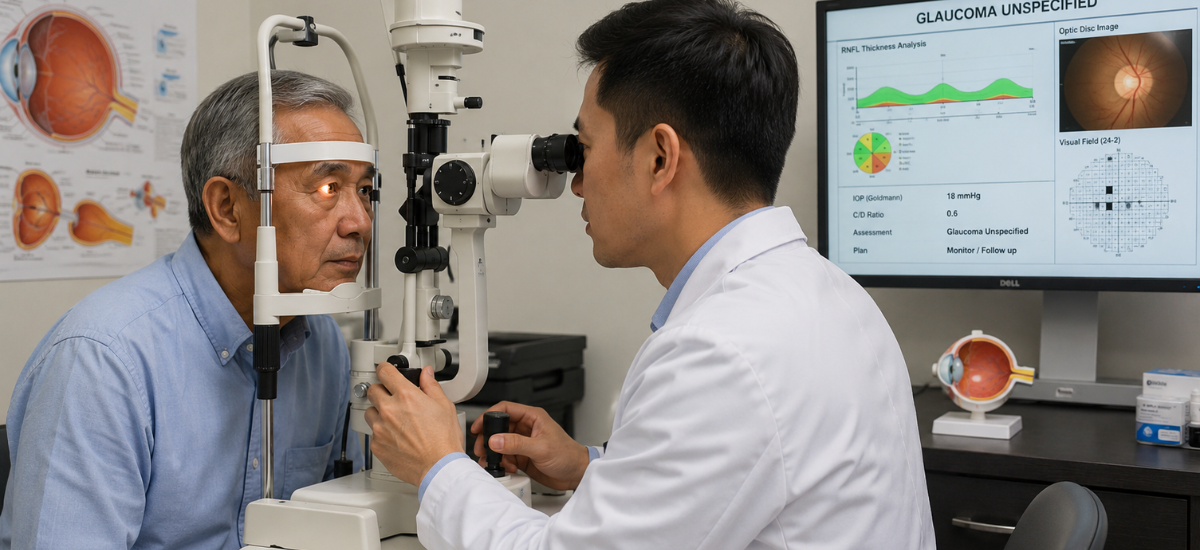
If you work in medical coding, ophthalmology billing, or eye care documentation, you already know how frustrating glaucoma codes can get. There are dozens of sub-codes, laterality requirements, and staging digits that can trip up even experienced coders. So, when the documentation just does not give you enough detail to pick a specific code, that is exactly where the ICD 10 code for glaucoma unspecified, H40.9, comes in.
This guide breaks down everything you need to know about H40.9, including what it means, when to use it, what related codes you should know, the most common billing mistakes, and what changed for 2026. Whether you are a certified medical coder, a billing specialist, or an ophthalmologist trying to make sure your charts hold up to payer scrutiny, this article covers it all.
What Is the ICD-10 Code for Glaucoma Unspecified?
The ICD 10 code for glaucoma unspecified is H40.9. This is a billable, specific ICD-10-CM diagnosis code that falls under Chapter 7 of the ICD-10-CM classification system, which covers diseases of the eye and adnexa (H00 to H59).
Glaucoma itself refers to a group of eye conditions that cause damage to the optic nerve, most often due to abnormally high pressure inside the eye. The fluid inside the eye, called aqueous humor, normally flows in and out. When that outflow gets blocked or restricted, pressure builds up and eventually injures the optic nerve. Left untreated, glaucoma leads to permanent vision loss or blindness.
The code H40.9 sits at the broadest end of the glaucoma coding spectrum. You use it specifically when the type of glaucoma is not clearly documented. In other words, the provider confirms glaucoma exists but does not specify whether it is open-angle, angle-closure, secondary, or any other defined subtype.
How H40.9 Fits in the ICD-10-CM Hierarchy
The parent category is H40, which covers all forms of glaucoma. Here is a quick look at where H40.9 sits:
| Code | Description |
|---|---|
| H40 | Glaucoma (parent category, not billable) |
| H40.0 | Glaucoma suspect / Ocular hypertension |
| H40.1 | Open-angle glaucoma |
| H40.2 | Primary angle-closure glaucoma |
| H40.3 | Glaucoma secondary to eye trauma |
| H40.4 | Glaucoma secondary to eye inflammation |
| H40.5 | Glaucoma secondary to other eye disorders |
| H40.6 | Glaucoma secondary to drugs |
| H40.8 | Other specified glaucoma |
| H40.9 | Unspecified glaucoma (billable) |
Because H40.9 is at the end of the list, it is clearly a last-resort code. You should only reach for it when more specific documentation is completely unavailable.
What Does “Unspecified Glaucoma” Actually Mean?
Here is what trips a lot of coders and providers up: “unspecified” does NOT mean the patient does not have glaucoma. It means the type of glaucoma has not been clearly identified or documented. The diagnosis of glaucoma itself is confirmed. The subtype is what is missing.
For example, suppose a patient comes in with elevated intraocular pressure and optic nerve cupping. The provider documents “glaucoma” but does not specify whether it is open-angle or angle-closure. Furthermore, the provider does not indicate which eye is primarily affected or what stage it is at. In that case, you code it as H40.9.
The ICD-10-CM Official Guidelines state clearly that unspecified codes like H40.9 are acceptable when clinical information is genuinely unknown or unavailable at the time of the encounter. However, they also emphasize that coders should always push for specificity whenever possible. If the documentation supports a more detailed code, use it.
Symptoms and Clinical Presentation of Glaucoma
Understanding the clinical picture helps coders recognize when a provider should be providing more detail rather than defaulting to an unspecified code. Glaucoma presents differently depending on its type, which is precisely why there are so many specific sub-codes.
Common Symptoms Across Glaucoma Types
- Gradual loss of peripheral (side) vision — This is the hallmark of open-angle glaucoma. Patients often do not notice it until significant damage has already occurred.
- Sudden eye pain, nausea, or vomiting — These are more typical of acute angle-closure glaucoma and require emergency coding specificity.
- Blurred vision or halos around lights — Often appear in the earlier or moderate stages.
- Redness of the eye — More common in angle-closure presentations.
- Headaches — Frequently accompany acute pressure spikes.
- Tunnel vision in advanced stages — By this point, the optic nerve damage is severe.
Since open-angle glaucoma progresses silently, many patients get diagnosed during a routine eye exam. That is why specificity in coding is so important. When you can identify the type and stage, you should always code beyond H40.9.
Causes and Risk Factors for Glaucoma
Knowing the causes helps you understand why glaucoma has so many sub-codes. Different causes point directly to different ICD-10 categories.
Primary Causes
- Elevated intraocular pressure (IOP) — The main driver in most forms of glaucoma
- Drainage system dysfunction — The angle where the iris meets the cornea may be too narrow or blocked
- Optic nerve sensitivity — Some people develop glaucoma even with normal IOP (normal-tension glaucoma)
Secondary Causes (These Require More Specific Codes)
- Eye trauma (points to H40.3)
- Eye inflammation such as uveitis (points to H40.4)
- Systemic medications like corticosteroids (points to H40.6)
- Other ocular conditions like cataracts or lens disorders (points to H40.5)
Risk Factors
- Age over 60
- Family history of glaucoma
- African American or Hispanic ethnicity
- Thin central corneal thickness
- High intraocular pressure (IOP above 21 mmHg)
- Prior eye injury or surgery
- Certain medical conditions like diabetes or hypertension
When a patient has a secondary cause clearly documented, do NOT use H40.9. Move to the appropriate secondary glaucoma code instead.
Related ICD-10 Codes You Need to Know
Understanding icd 10 code for glaucoma means knowing the whole family of codes. Here is a breakdown of the most important related codes that coders encounter daily.
H40.05 — Ocular Hypertension ICD 10
Ocular hypertension ICD 10 code H40.05 is used for patients with elevated intraocular pressure who have NOT yet been diagnosed with glaucoma. This is a critical distinction. Ocular hypertension means the pressure is high, but no optic nerve damage has occurred yet.
Subcodes for laterality:
- H40.051 — Ocular hypertension, right eye
- H40.052 — Ocular hypertension, left eye
- H40.053 — Ocular hypertension, bilateral
H40.0 — Glaucoma Suspect ICD 10
Glaucoma suspect ICD 10 code H40.0 is used for patients who show certain risk factors or borderline findings but do not yet have a confirmed diagnosis of glaucoma. H40.0 is a non-billable parent code. You need the more specific subcategories below it.
Key subcategories:
- H40.00 — Preglaucoma, unspecified
- H40.01 — Open angle with borderline findings, low risk
- H40.02 — Open angle with borderline findings, high risk
- H40.03 — Anatomical narrow angle
- H40.04 — Steroid responder
- H40.05 — Ocular hypertension
- H40.06 — Primary angle closure without glaucoma damage
Other Key Glaucoma Codes
| Code | Description |
|---|---|
| H40.10 | Unspecified open-angle glaucoma (needs 7th character for stage) |
| H40.1110 | Primary open-angle glaucoma, right eye, stage unspecified |
| H40.1131 | Primary open-angle glaucoma, both eyes, mild stage |
| H40.20 | Unspecified primary angle-closure glaucoma |
| H40.89 | Other specified glaucoma |
| H44.51 | Absolute glaucoma (excluded from H40.9) |
| Q15.0 | Congenital glaucoma (excluded from H40.9) |
Billing Tips for ICD 10 Code for Glaucoma Unspecified
Now let’s get into the real clinical application. If you want clean claims and fewer denials, you need to nail the billing side of glaucoma ICD 10 coding.
Tip 1: Only Use H40.9 When Specificity Is Truly Unavailable
H40.9 is acceptable under HIPAA-covered transactions valid from October 1, 2025 through September 30, 2026. However, payers increasingly scrutinize unspecified codes. Therefore, always query the provider for additional documentation before defaulting to H40.9.
Tip 2: Always Specify Laterality When Possible
Most open-angle and angle-closure codes require you to indicate the affected eye and the stage. H40.9 is one of the few codes where laterality and stage digits are NOT required. Still, document laterality in the clinical notes for audit protection.
Tip 3: Use H40.9 With Supporting CPT Codes Properly
When billing for glaucoma evaluations alongside H40.9, make sure the CPT code aligns with the level of service and diagnosis. Payers will look at medical necessity. An unspecified diagnosis can sometimes undermine the necessity argument for complex testing or procedures.
Tip 4: Pair H40.9 With Additional Diagnosis Codes
If the patient also has ocular hypertension or a related condition, you can code both. For instance, if the clinical notes mention elevated IOP alongside a diagnosis of glaucoma without further detail, H40.9 plus H40.05x may both be reportable.
Tip 5: Document MS-DRG Grouping
For inpatient claims, H40.9 falls under MS-DRG V43.0, specifically DRG 124 (Other disorders of the eye with MCC or thrombolytic agent). Knowing the DRG grouping helps with expected reimbursement estimates.
Common Mistakes Coders Make With ICD-10 code for glaucoma
Even experienced coders slip up with glaucoma coding. Here are the most frequent errors and how to avoid them.
Mistake 1: Using H40.0 for Billing
H40.0 (Glaucoma suspect) is NOT a billable code. It is a header code. If you submit it on a claim, it will reject. Always drill down to the specific subcategory under H40.0.
Mistake 2: Confusing Ocular Hypertension With Glaucoma
Ocular hypertension ICD 10 (H40.05) and glaucoma are NOT the same thing. Ocular hypertension means elevated IOP without optic nerve damage. Glaucoma means optic nerve damage has occurred. Using H40.9 when only ocular hypertension is documented would be an upcoding error.
Mistake 3: Missing the 7th Character for Staged Codes
For codes like H40.10 (unspecified open-angle glaucoma), the 7th character represents the stage of disease. Forgetting to add it results in a claim rejection or an audit flag. The staging digits are:
- 0 = Stage unspecified
- 1 = Mild stage
- 2 = Moderate stage
- 3 = Severe stage
- 4 = Indeterminate stage
Mistake 4: Using H40.9 When Secondary Glaucoma Is Documented
If the chart shows glaucoma caused by trauma, inflammation, medication, or another eye disorder, you must code it as secondary glaucoma (H40.3 through H40.6). Falling back on H40.9 in those scenarios undercodes the encounter and misrepresents the clinical picture.
Mistake 5: Ignoring Excludes1 Notes
The H40 category has important Excludes1 notes. The following conditions CANNOT be coded alongside H40.9:
- Absolute glaucoma (H44.51)
- Congenital glaucoma (Q15.0)
- Traumatic glaucoma due to birth injury (P15.3)
Using H40.9 alongside these codes triggers a claim rejection.
Mistake 6: Not Querying for Laterality
Even though H40.9 does not require a laterality digit, the clinical documentation absolutely should reflect which eye is affected. When the documentation later supports a more specific code, you will need that laterality detail on record.
2026 Updates for ICD 10 Glaucoma Codes
The 2026 edition of ICD-10-CM became effective on October 1, 2025. Here is what every coder needs to know about the current cycle.
H40.9 Remains Billable Through September 30, 2026
The code H40.9 is valid for all HIPAA-covered claims submitted with dates of service from October 1, 2025 through September 30, 2026. No structural changes were made to H40.9 in this fiscal year update.
MS-DRG V43.0 Now in Effect
The Medicare Severity Diagnosis Related Group (MS-DRG) version V43.0 applies to the current fiscal year. H40.9 groups into DRG 124 when paired with an MCC (major complication or comorbidity). Coders should verify that all comorbidities are captured to ensure accurate DRG assignment.
Increased Payer Scrutiny on Unspecified Codes
Although no formal ICD-10 changes targeted H40.9 in 2026, payers in 2025 and 2026 have continued to tighten their audit policies around unspecified diagnosis codes. Commercial payers and Medicare Administrative Contractors (MACs) increasingly flag claims where unspecified codes appear repeatedly for the same patient. Therefore, if you use H40.9 for a patient visit, document clearly why more specific coding was not possible at that time.
CPT 2026 Changes Relevant to Glaucoma Billing
The 2026 CPT codebook, published by the American Medical Association, includes updated guidance for interventional glaucoma procedures. National average 2026 Medicare rates for glaucoma-related procedures are now in effect, though actual payment reflects sequestration adjustments (2% Medicare payment reduction) and geographic adjustments. Coders pairing glaucoma diagnosis codes with procedural CPT codes should verify current fee schedules.
Documentation Best Practice Push in 2026
The ICD-10-CM Official Guidelines for Coding and Reporting FY 2026 reinforce that providers should avoid unspecified codes wherever clinical information supports specificity. This guideline directly affects how long H40.9 should stay on a patient’s record. If a follow-up visit clarifies the glaucoma type, update the code accordingly.
Quick Reference: Glaucoma ICD-10 Code Summary Table (2026)
| Code | Description | Billable? | Laterality Required? | Stage Required? |
|---|---|---|---|---|
| H40.0 | Glaucoma suspect (parent) | No | Varies | No |
| H40.00 | Preglaucoma, unspecified | Yes | No | No |
| H40.05 | Ocular hypertension | Yes (with laterality) | Yes | No |
| H40.10 | Unspecified open-angle glaucoma | Needs 7th character | No | Yes (7th digit) |
| H40.1110 | Primary open-angle glaucoma, right eye, stage unspecified | Yes | Right eye specified | Yes |
| H40.89 | Other specified glaucoma | Yes | No | No |
| H40.9 | Unspecified glaucoma | Yes | No | No |
FAQ: ICD 10 Code for Glaucoma Unspecified
Q1. What is the ICD 10 code for glaucoma unspecified?
The ICD 10 code for glaucoma unspecified is H40.9. It is a billable ICD-10-CM code valid for fiscal year 2026 (October 1, 2025 through September 30, 2026).
Q2. When should I use H40.9 instead of a more specific glaucoma code?
You should use H40.9 only when the clinical documentation confirms a glaucoma diagnosis but does not specify the type, laterality stage, or other defining characteristics. Always try to use a more specific code first.
Q3. What is the difference between H40.9 and H40.0?
H40.0 is for glaucoma suspect, meaning the patient has NOT been diagnosed with glaucoma yet. H40.9 is for a confirmed glaucoma diagnosis where the type is unspecified. They are clinically and diagnostically distinct situations.
Q4. Can I use H40.9 and H40.05 (ocular hypertension ICD 10) together?
In some cases, yes. If the patient has confirmed glaucoma (H40.9) and also has documented ocular hypertension that is separately managed, both codes may be reported. However, verify with your payer guidelines before doing so.
Q5. Does H40.9 require a stage digit?
No. Unlike many open-angle and angle-closure codes, H40.9 does not require a 7th character for stage. It stands alone as a complete billable code.
Q6. What is the glaucoma suspect ICD 10 code?
The main glaucoma suspect ICD 10 code is H40.0. However, H40.0 itself is not billable. You need to report a subcategory such as H40.01 (low risk), H40.02 (high risk), or H40.05 (ocular hypertension ICD 10) depending on clinical documentation.
Q7. Is H40.9 accepted by Medicare in 2026?
Yes. H40.9 is accepted for Medicare claims in FY2026. However, repeated use without documentation justifying the lack of specificity can trigger audits. Document your reasoning clearly in the chart notes.
Q8. What codes are excluded from H40.9?
The Excludes1 notes for H40.9 prohibit its use alongside absolute glaucoma (H44.51), congenital glaucoma (Q15.0), and traumatic glaucoma due to birth injury (P15.3).
Final Thoughts
Understanding the ICD 10 code for glaucoma unspecified, H40.9, is not just a matter of memorizing a number. It is about understanding the full clinical and billing context around it so you can use it correctly, avoid costly errors, and stay clean during payer audits. The 2026 ICD-10-CM updates confirm that H40.9 remains a valid and billable code, but the pressure to move toward specificity is real and growing.
As a coder or billing professional, your best move is always to push for documentation that tells the full story. When the full story is genuinely unknown, H40.9 is your safety net. Just make sure your notes show exactly why you needed it.
Stay current, code smart, and protect your practice from claim denials by mastering the full glaucoma ICD 10 code family in 2026.