

What Exactly is an ICD-10 Code for History of Falls
When you’re working in healthcare, you’re constantly writing codes to describe your patients’ conditions. However, here’s something crucial that many professionals overlook: not every code describes a disease or an active injury. In fact, some codes tell a completely different story altogether. These particular codes communicate risk factors and historical information that fundamentally shapes how you’ll care for someone moving forward.
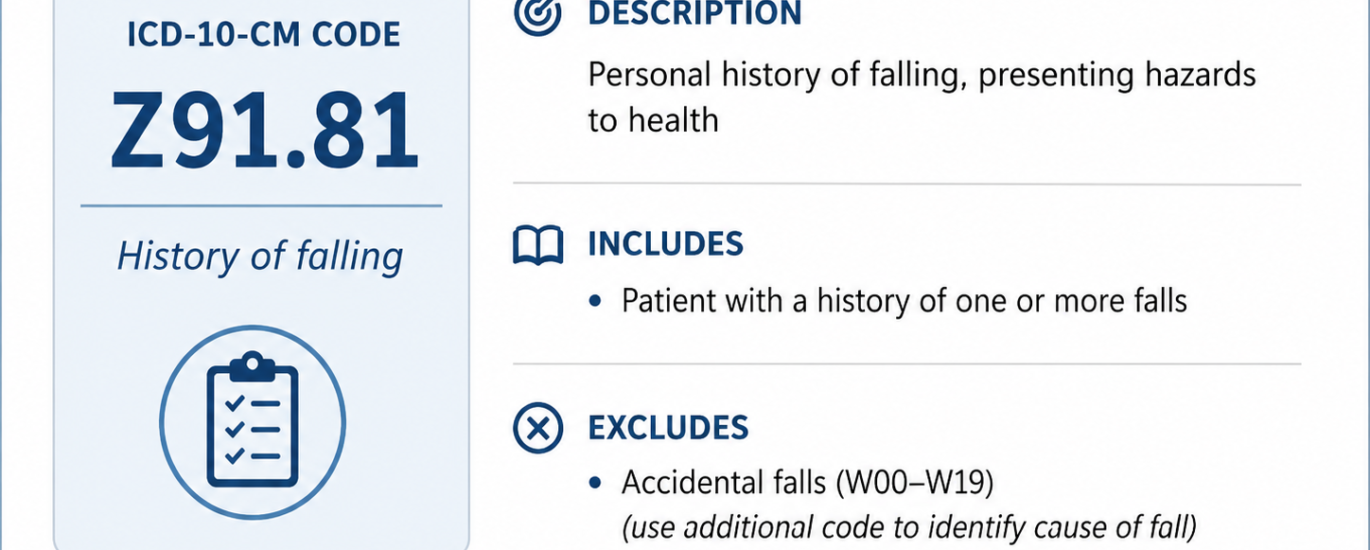
Specifically, the ICD-10 code for history of falls is Z91.81. Furthermore, this single code communicates something remarkably powerful to every provider who reads it: this patient has fallen before, and they’re at a significantly increased risk of falling again.
Now, consider what this means in actual practice. Imagine a patient walks into your office with a new complaint, but their chart shows Z91.81. Immediately, you understand several things. First, you know to ask about their home safety. Additionally, you know to check their medications for dizziness as a potential side effect. Moreover, you know to assess their balance and gait carefully. In essence, this simple code changes your entire approach to care from the moment they arrive.
Importantly, Z91.81 belongs to the broader ICD-10 category of “Z codes,” which are specifically designed to capture factors affecting health that aren’t diseases themselves. Indeed, these codes describe risk factors, preventive care encounters, and historical information that guides clinical decision-making. Therefore, understanding how to use them correctly is essential for proper patient documentation.
Why This Code Matters in 2026
The healthcare landscape has shifted dramatically in recent years. Specifically, with aging populations and an increased focus on preventive medicine, fall risk has become a critical quality metric across all healthcare settings. Notably, Medicare requires fall risk assessment as part of Annual Wellness Visits. Additionally, insurance companies actively track fall-related readmissions. Furthermore, healthcare systems now implement fall prevention protocols based largely on proper coding documentation.
Here’s the thing: when you use Z91.81 correctly, you’re not just filling out paperwork. Rather, you’re triggering a cascade of protective measures throughout the healthcare system. Your documentation triggers care coordination reviews. Subsequently, it informs physical therapy referrals. Moreover, it influences medication reconciliation efforts. Ultimately, it becomes the foundation for evidence-based fall prevention strategies that protect your patients.
What Z91.81 Actually Tells You
The full name of this code is “History of falling.” But what does that really mean? Let me break it down into what coders and clinicians need to understand.
Essentially, Z91.81 indicates that your patient has experienced one or more falls in the past. These falls, crucially, have bearing on the patient’s current health status or treatment plan. The code doesn’t specify whether injuries occurred. Additionally, it doesn’t describe how many times someone fell. Rather, it simply establishes that falling has happened before and continues to present a meaningful risk.
This distinction is fundamental because it differs dramatically from codes in the W00-W19 range, which describe active falls with injuries. Specifically, W codes capture what caused the fall (falling from stairs, tripping on a level surface, etc.) and are used when someone arrives with a recent fall-related injury. In contrast, Z91.81 works backward, documenting the historical pattern.
Here’s a helpful way to think about it: if someone comes to your office because they fell yesterday and broke their wrist, you’d code the wrist fracture as your primary diagnosis and subsequently use a W code to explain how it happened. However, if that same patient returns three months later for a routine visit and mentions they’ve had multiple falls in the past year, then you’d add Z91.81 to their chart to document this risk factor and its relevance to current care.
Why Coders Keep Missing This Distinction
Many billing professionals struggle with proper application of this code. Fundamentally, they see “fall” and automatically use whatever fall-related code comes to mind. As a result, they confuse Z91.81 with R29.6 (repeated falls). Consequently, they use Z91.81 as a primary diagnosis when it should only be secondary. Moreover, they code it when documentation doesn’t explicitly mention a history of falling.
These mistakes don’t just waste time on audits. Rather, they impact quality metrics significantly. Furthermore, they affect reimbursement directly. Additionally, they create incomplete medical records that confuse other providers when reviewing care. Therefore, getting this distinction right is absolutely critical to your coding success.
Symptoms and Risk Factors That Point Toward History of Falls
You won’t see “symptoms” of having a history of falls in the traditional sense. Indeed, there’s no rash, no pain, no fever. Rather, you’ll see the patterns and presentations that indicate someone is likely to fall again.
Physical Signs Present During Examination
When you encounter a patient with Z91.81 in their history, you’ll often notice several physical indicators. Notably, their gait might appear unsteady. Furthermore, they might hold onto furniture or walls while moving. Additionally, their balance on one foot may be noticeably poor. During the Romberg test or functional reach test, consequently, they might demonstrate reduced balance capacity.
Importantly, many patients with a history of falls show increased fall risk markers during assessment. For instance, they walk more slowly than expected for their age. Moreover, they take shorter steps than their peers. Similarly, they may demonstrate decreased ankle flexibility or hip strength. In some cases, they show signs of neuropathy, with notably reduced sensation in their feet.
Behavioral Patterns That Signal Increased Risk
Beyond physical findings, behavioral patterns emerge quite clearly. For example, these patients often move cautiously through their environments. Furthermore, they might refuse certain activities they previously enjoyed due to fear. Additionally, they express anxiety about falling again. Consequently, some become socially isolated because they fear another fall will happen.
Cognitive changes matter too, which is why providers must assess them thoroughly. Specifically, patients with memory problems or dementia show higher fall rates. Similarly, those with depression often have slower movements and reduced balance attention. Moreover, patients taking multiple medications frequently demonstrate drowsiness or vertigo. Therefore, a comprehensive assessment must address all these factors.
Underlying Medical Conditions Driving Falls
Several medical conditions dramatically increase fall risk, and therefore often accompany Z91.81 coding in medical records:
Notably, vestibular disorders interfere with balance and spatial awareness significantly. Similarly, diabetes causes neuropathy that reduces foot sensation considerably. Additionally, cardiovascular conditions lead to dizziness and orthostatic hypotension. Consequently, thyroid disorders, particularly hypothyroidism, slow movements and cognition. Furthermore, neurological conditions like Parkinson’s disease fundamentally compromise balance mechanisms.
Arthritis and musculoskeletal problems reduce strength and flexibility substantially. Moreover, vision problems limit environmental awareness critically. Additionally, inner ear infections create vertigo and disorientation. Similarly, anemia reduces oxygen delivery and causes weakness. Therefore, properly identifying these underlying conditions is essential to effective fall prevention.
Primary Causes: What Makes Falls Happen in the First Place
Understanding why falls occur helps you properly document the need for Z91.81 coding and develop effective prevention strategies.
Intrinsic Causes (What’s Wrong with the Person)
These originate within the patient’s body. Age-related muscle loss accelerates after age 70, reducing strength and power. Poor balance develops from vestibular dysfunction, cerebellar disease, or spinal cord problems. Weakness manifests from various sources: deconditioning, muscle disease, neurological damage.
Dizziness and vertigo stem from inner ear problems, medication side effects, or cardiovascular insufficiency. Vision loss—whether from cataracts, glaucoma, or macular degeneration—eliminates environmental cues necessary for balance. Foot problems including pain, numbness, and structural abnormalities affect proprioception and gait stability.
Medication interactions create a perfect storm. Sedatives slow reaction time. Blood pressure medications cause dizziness. Pain medications impair cognition. Combining multiple drugs multiplies fall risk exponentially.
Cognitive impairment from dementia, delirium, or depression reduces attention and judgment. Psychological factors like anxiety and fear of falling create a vicious cycle. Patients become so afraid they fall, which intensifies their fear.
Extrinsic Causes (What’s in the Environment)
Your surroundings matter enormously to fall prevention outcomes. Indeed, poor lighting hides obstacles and hazards effectively. Furthermore, clutter creates tripping hazards throughout homes. Additionally, stairs without railings eliminate critical safety devices. Consequently, bathroom surfaces become slippery without proper flooring or grab bars in place.
Footwear proves absolutely critical to stability and safety. Specifically, loose shoes, high heels, and worn-out soles dramatically increase fall risk substantially. Moreover, incorrect assistive device use (such as a cane at wrong height or walker misused) provides false security. Additionally, unfamiliar environments create disorientation. Therefore, attention to these details is essential.
Living situations matter significantly, which is why home assessment is important. For instance, aging homes often lack necessary modifications for safety. Similarly, transitions between facilities (hospital to home) disrupt routines and create confusion. Furthermore, crowded spaces limit movement options. Consequently, environmental modification is a key prevention strategy.
Billing Tips and Best Practices for Z91.81 Coding in 2026
Getting your billing right requires understanding both the clinical picture and coding rules thoroughly. Moreover, here’s what separates expert billers from those who create audit problems. Specifically, proper documentation is absolutely essential.
Documentation Requirements That Must Be Present
To begin, never code Z91.81 without explicit documentation of a history of falling. Importantly, the provider must state something like “history of falls,” “patient reports multiple falls,” “high fall risk due to prior falls,” or similar language. Consequently, vague references simply won’t work in your documentation.
Furthermore, ideally documentation includes timing information for each fall. Specifically, when did the most recent fall occur? Additionally, how many falls happened in the past year? Moreover, what were the circumstances surrounding them? Most importantly, did any injuries result from these falls?
Additionally, current prevention strategies matter significantly. Indeed, what’s being done to prevent future falls? For instance, is the patient using assistive devices? Furthermore, are home modifications in place? Similarly, is therapy recommended? Therefore, this context supports medical necessity and strengthens your coding position.
Proper Code Sequencing and Hierarchy
Remember this critical rule: Z91.81 functions as a secondary code, never primary. Additionally, when coding a patient with multiple conditions, the primary diagnosis should be the main reason for the current visit. Consequently, Z91.81 follows as supplementary information about risk factors.
Specifically, if you’re coding a patient coming in for a fall-related injury, code the injury first. Then, use the appropriate W code for the fall mechanism. Finally, add Z91.81 to indicate this represents an ongoing pattern.
Moreover, when a patient has both current repeated falls (R29.6) and a history of falls (Z91.81), sequence R29.6 first as the more acute concern. Subsequently, add Z91.81 to document the historical pattern.
Avoiding Documentation That Triggers Audits
To clarify, don’t assume falls from documentation. Rather, explicitly stated history requires explicit documentation. Importantly, “at risk for falls” alone isn’t enough; you need evidence the patient actually fell previously.
Furthermore, avoid coding Z91.81 if the patient sustained a new fall during this visit. Instead, that’s handled through W codes and injury codes. Significantly, Z91.81 documents past patterns, not current incidents.
Equally important, don’t use this code in isolation without addressing why fall prevention matters for this specific patient encounter. Consequently, the medical necessity must connect to current clinical decisions clearly.
Reimbursement Considerations in Current Billing Climate
Notably, Z91.81 is POA (Present on Admission) exempt, meaning you don’t need to report whether this condition was present when the patient arrived at the hospital. Therefore, this simplifies documentation for inpatient settings considerably.
Insurance companies increasingly scrutinize fall-related coding because it impacts quality metrics. If you’re coding Z91.81, be prepared to support it with solid documentation. Payers want to see that your documentation justifies the risk classification and relates to the current episode of care.
Medicare pays for fall risk assessment as part of Annual Wellness Visits. Proper Z91.81 coding supports medical necessity for this assessment and any interventions that follow.
Related ICD-10 Codes You’ll Encounter Frequently
Understanding how Z91.81 relates to other codes prevents confusion and ensures complete documentation. Additionally, proper knowledge of related codes is essential for correct code selection.
R29.6: Repeated Falls
This code indicates something different from Z91.81. Importantly, it means the patient is currently experiencing multiple falls. Unlike Z91.81, which documents historical pattern, R29.6 means falls are happening now and warrant immediate investigation. Therefore, use R29.6 when you see a patient who’s falling repeatedly during the current episode of care.
The key distinction is critical to understand. Essentially, Z91.81 says “this person fell before and might again.” However, R29.6 says “this person is falling now, repeatedly.” Consequently, you can use both codes together. Specifically, R29.6 functions as the primary code when the patient is currently experiencing multiple falls. Then, Z91.81 serves as secondary to document that this represents an ongoing pattern.
W00-W19: External Cause Codes for Specific Falls
The W00-W19 range covers specific fall circumstances comprehensively. Moreover, these codes are essential when documenting acute fall events. For instance, W06 describes falls from beds. Similarly, W10 covers falls from stairs. Additionally, W18 captures same-level falls and falls from striking objects. Therefore, these codes explain the mechanism of injury.
When you code an acute fall injury, importantly, use the specific W code that matches the fall type first. Then add codes for any injuries sustained. Subsequently, Z91.81 provides context about why this person fell (they have a pattern) but doesn’t replace the specific documentation of how this particular fall happened.
Z91: Personal Risk Factors, Not Elsewhere Classified
Z91.81 is one of several Z91 codes describing personal risk factors. Moreover, these codes follow a similar structure. For example, Z91.82 codes for personal history of anaphylaxis. Similarly, Z91.83 covers allergy status. Therefore, these codes all document risk factors that affect ongoing care.
V00-V89: External Cause Codes
These codes describe transportation accidents. Additionally, they intersect with fall coding when falls occur due to vehicle-related incidents. However, they’re distinct from the W00-W19 fall codes used for simple slips and trips.
S Codes: Injury Codes
When falls result in injuries, importantly, S codes describe the actual damage. For instance, S72.001A codes a specific neck of femur fracture from an initial encounter. Similarly, S82.891A describes other specified fractures of the lower leg. Consequently, these are sequenced as primary diagnoses when the fall caused injury. Then, the fall mechanism gets a W code secondary.
Common Mistakes That Complicate Billing and Audits
Learning from others’ errors keeps you from repeating them. Here are the mistakes I see most frequently.
Mistake #1: Using Z91.81 Without Documented History
Providers sometimes code Z91.81 because a patient “seems like” they might fall. However, seems isn’t documentation. Critically, if there’s no explicit statement about previous falls, the code shouldn’t be there. Moreover, auditors look at this immediately.
Mistake #2: Confusing Z91.81 with R29.6
These codes seem similar but serve vastly different purposes. Frequently, some coders use them interchangeably, which confuses metrics and creates billing problems. Therefore, learn the distinction clearly: Z91.81 is historical and secondary; R29.6 is current and can be primary.
Mistake #3: Using Z91.81 as a Primary Diagnosis
This is clearly invalid coding. Importantly, Z91.81 functions only as a secondary code. Additionally, every claim using Z91.81 must have another primary diagnosis explaining why the patient is seeking care. Furthermore, insurance systems flag these submissions as unbillable immediately.
Mistake #4: Coding Falls That Occurred Years Ago Irrelevantly
Z91.81 documents falls that have clinical relevance to current treatment. For example, a patient who fell once five years ago and has had no falls since might not warrant this code. Moreover, the falls need to be recent enough or frequent enough to influence current clinical decisions. Consequently, timing matters significantly.
Mistake #5: Not Documenting Prevention Strategies
When you code Z91.81, importantly, document what’s being done about it. For instance, are there assistive devices? Furthermore, are home modifications in place? Additionally, is physical therapy recommended? Therefore, this demonstrates medical necessity and supports why this code matters.
Mistake #6: Missing Secondary Codes for Complete Picture
If someone has Z91.81, they likely have contributing conditions—arthritis, diabetes, neuropathy—that also should be coded. Furthermore, incomplete secondary coding makes your documentation insufficient and affects quality reporting. Consequently, comprehensive coding is essential.
2026 Updates: What Changed and What You Need to Know
The 2026 edition of ICD-10-CM became effective October 1, 2025. Although no dramatic changes affected Z91.81 itself, several important shifts in the broader coding landscape matter significantly for your practice.
Emphasis on Fall Prevention Quality Metrics
Healthcare systems increasingly track fall prevention metrics more closely. Furthermore, the focus has shifted dramatically from simply coding falls to demonstrating systematic fall prevention efforts. Therefore, documentation should include risk assessments, preventive measures, and reassessment findings.
Importantly, Medicare’s Quality Reporting System includes fall risk assessment and management in its quality measures. Consequently, proper Z91.81 coding supports these metrics when accompanied by appropriate risk reduction documentation.
Integration with Annual Wellness Visits
The G0402 (Welcome to Medicare) and G0438/G0439 (Initial and Subsequent Annual Wellness Visits) codes now more explicitly require fall risk assessment. Notably, when you’re documenting these visits, Z91.81 becomes more important in demonstrating that fall risk was identified and addressed appropriately.
Expanded Fall Prevention Resources
The CDC’s fall prevention programs and clinical guidelines inform coding best practices currently. Furthermore, while this doesn’t change Z91.81 itself, it influences how your documentation should frame fall risk assessment and prevention strategies moving forward.
Continued Focus on Medication Review
Polypharmacy drives many falls, which is why this issue deserves attention. Increasingly, documentation for Z91.81 should include medication review, specifically noting whether medications contributing to fall risk were identified and addressed. Consequently, this demonstrates comprehensive fall prevention thinking.
Telehealth Considerations
More fall risk assessments happen via telehealth now than ever before. Additionally, documentation must clearly indicate how the provider assessed fall risk remotely and what information supported the fall risk determination. Subsequently, Z91.81 coding then documents this assessment finding appropriately.
Frequently Asked Questions About Z91.81 and Fall Coding
These questions come up repeatedly in billing education and provider conversations. Therefore, I’ve addressed them comprehensively.
Can I Use Z91.81 as a Primary Diagnosis?
No, absolutely not. Z91.81 functions exclusively as a secondary code. Importantly, it documents a risk factor or historical information affecting patient care, not the primary reason for the visit. Furthermore, every claim using Z91.81 must have another diagnosis code that serves as the primary reason for the encounter.
How Far Back Can I Look When Documenting a History of Falls?
ICD-10-CM doesn’t specify rigid timelines, which gives you some flexibility. However, the falls documented should be clinically relevant to the current visit. For instance, falls from several years ago might not warrant Z91.81 if they’re truly historical and no longer influence current care. Ideally, document falls from the past year or more recent timeframe, though the specific date depends on clinical judgment.
Should I Use Z91.81 if the Patient Had Only One Fall?
One fall alone doesn’t typically warrant Z91.81. Importantly, this code implies a pattern or risk that affects ongoing care. For example, a single fall from long ago that had no consequences and hasn’t recurred probably doesn’t justify this code. However, if that one fall resulted in significant injury or changed the patient’s functional capacity, it might warrant coding to document the impact.
Can Both R29.6 and Z91.81 Be Used Together?
Yes, absolutely they can work together effectively. Use R29.6 as the primary code when the patient is currently experiencing repeated falls. Subsequently, add Z91.81 as secondary to document that this represents an ongoing pattern. This combination tells a complete story: the patient is falling now (R29.6) and has a history of falling (Z91.81).
What if the Documentation Says “At Risk for Falls” but No Falls Actually Occurred?
Don’t use Z91.81 in this scenario. Critically, this code documents actual falls that have occurred, not theoretical risk. If someone has risk factors but hasn’t fallen yet, code the risk factors instead (arthritis, peripheral neuropathy, etc.) but don’t code a history of falls that didn’t happen.
How Does Z91.81 Interact with Workers’ Compensation or Personal Injury Claims?
Z91.81 documents a pre-existing history, which is important context. Furthermore, if a worker files a claim for a fall at work, Z91.81 in their chart establishes they had previous falls. Consequently, this becomes relevant in determining whether the work-related fall caused injury or aggravated a pre-existing condition. Therefore, always ensure documentation is clear about timing and causation.
Should Home Health Agencies Use Z91.81?
Home health serves many patients with fall risk actively. Moreover, when a patient has a documented history of falling, Z91.81 becomes appropriate to include in the agency’s coding. Consequently, this supports medical necessity for home safety evaluation, physical therapy, and other fall prevention interventions that your agency provides.
Does Z91.81 Require Any 7th Character Extension?
No, it does not. Unlike W codes that require 7th character extensions (A for initial encounter, D for subsequent, S for sequela), Z91.81 doesn’t need extension characters. Therefore, it’s a complete, valid code as stated.
What’s the Difference Between Z91.81 and Z87 Codes?
Z87 codes describe personal history of diseases and injuries (for instance, Z87.71 is personal history of hypospadias). Meanwhile, Z91.81 is in the Z91 category for personal risk factors not elsewhere classified. Both are “history” codes, but importantly, Z91 codes specifically identify current risk factors affecting present treatment, while Z87 codes generally describe resolved health events with less current clinical relevance.
How Do I Address Documentation Deficiencies Before Coding?
If you receive documentation that suggests fall risk but lacks explicit mention of a history of falls, query the provider directly. Ask specifically: “Does this patient have a documented history of falling that we should capture in coding?” This clarifies the clinical picture and ensures accurate coding ultimately.
Summary: Putting It All Together in 2026
The ICD-10 code for history of falls—Z91.81—serves a truly crucial function in modern healthcare delivery. Furthermore, it communicates risk effectively. Moreover, it triggers prevention efforts systematically. Additionally, it informs clinical decision-making appropriately. Importantly, it supports quality metrics throughout organizations. Finally, it guides reimbursement processes correctly.
But only when used correctly, which is the critical point.
Moving forward through 2026, remember these essentials clearly: First, Z91.81 documents actual patterns of falling, not theoretical risk. Second, it functions only as a secondary code. Third, it requires explicit provider documentation stating a history of falling exists. Fourth, it supports medical necessity for fall risk assessments and prevention strategies.
When you see a patient with this code in their chart, you’re seeing more than just a coding notation. Rather, you’re seeing a flag that changes your entire approach to care. Specifically, you’ll assess their environment carefully. Moreover, you’ll review their medications thoroughly. Furthermore, you’ll ensure they have assistive devices and physical support. Additionally, you’ll coordinate with other providers to reduce their fall risk. Ultimately, you’ll implement systematic strategies to prevent future falls.
That’s the power of proper coding—it’s not just paperwork. Rather, it’s a tool that transforms the quality of care you deliver. When done correctly, Z91.81 supports better patient outcomes and demonstrates your commitment to comprehensive, preventive healthcare.