

What Is the ICD 10 Code for Skin Tag?
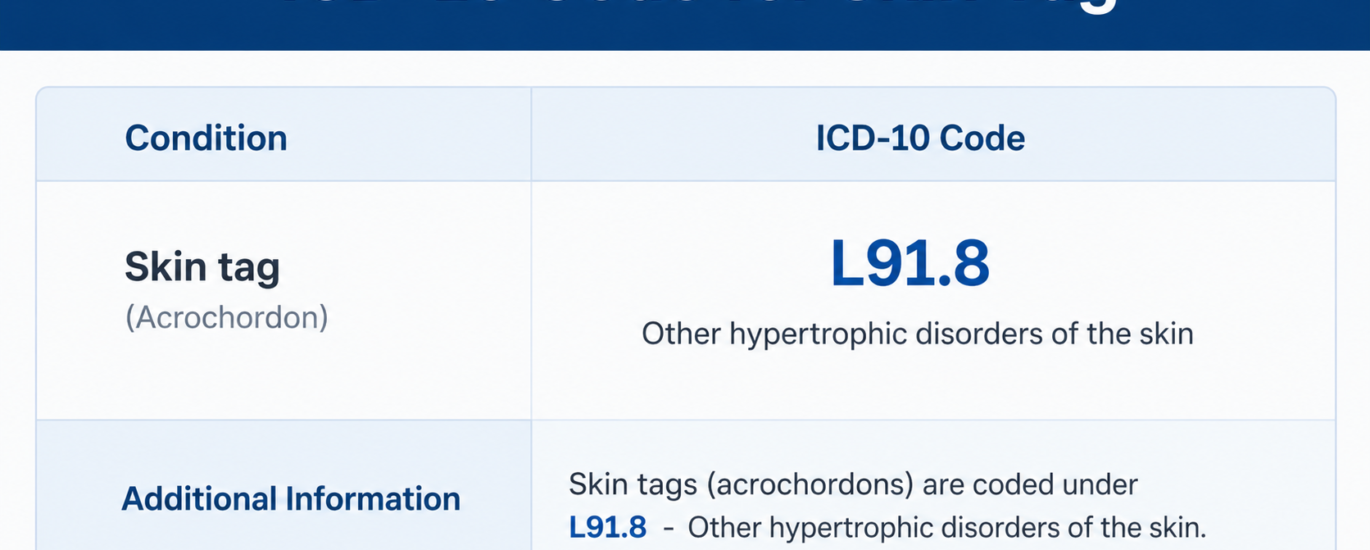
If you want a straight answer, here it is. The primary ICD 10 code for skin tag is L91.8 — Other Hypertrophic Disorders of the Skin. This code is fully billable, accepted by Medicare and most commercial payers, and it remains valid in the current ICD-10-CM edition.
However, L91.8 is not the only code out there. Because the location of the skin tag and the patient’s symptoms both matter, you may need a different or additional code in many cases. Furthermore, understanding when to use which code is exactly what separates clean claims from denied ones.
So, let’s break it all down clearly.
What Is a Skin Tag and Why Does Coding Matter?
Skin tags, medically known as acrochordons or fibroepithelial polyps, are small, soft, benign growths that hang off the skin by a thin stalk. They typically show up where skin rubs against skin or clothing — think the neck, underarms, eyelids, groin, and inner thighs.
Most of the time, they are completely harmless. However, they can become irritated, bleed, or even get infected through friction. And when a patient needs them removed, that is when accurate coding becomes absolutely critical.
Why Insurance Demands the Right Code
Here is the real deal: insurance companies do not just hand out reimbursements. They need a diagnosis code that justifies the procedure. Without the right ICD 10 code for skin tag, your claim lands in the denied pile, even if the removal was completely necessary.
Payers look at two things: the diagnosis code (ICD-10) and the procedure code (CPT). Both need to align perfectly with your clinical documentation. Moreover, the provider notes must support medical necessity before the payer even considers covering the removal.
What Is the ICD 10 Code for Skin Tags? Full Code Breakdown
Primary Code: L91.8 — Other Hypertrophic Disorders of the Skin
L91.8 is the gold standard answer to the question what is the ICD 10 code for skin tags. It covers acrochordons, soft fibromas, and fibroepithelial polyps under the hypertrophic disorders of the skin category. This is the code most payers recognize and accept when skin tag removal is medically necessary.
Additionally, L91.8 is the correct answer when someone asks what is the ICD 10 code for skin tag removal, because it directly identifies the diagnosis behind the procedure. The code applies when:
- The skin tag gets irritated by friction from clothing or jewelry
- The patient reports pain, tenderness, or redness around the growth
- The provider documents visible inflammation or repeated trauma to the lesion
One important thing to remember: Simply writing L91.8 on the claim is never enough. The provider notes must back it up with specific symptoms. Without documented symptoms, payers classify the removal as cosmetic, and cosmetic removals get denied almost every single time.
Location-Specific ICD-10 Codes for Skin Tags
When someone asks what is the ICD 10 code for accessory skin tag at a particular location, the answer gets more nuanced. L91.8 still serves as the primary code in most cases. However, you may need to pair it with secondary, location-specific codes depending on where exactly the tag sits.
Eyelid Skin Tags — D23.9 and H02.89
When a skin tag sits on or near the eyelid and causes visual disturbance or corneal irritation, coders often use D23.9 (Benign Neoplasm of Skin, Unspecified) as a supporting code alongside L91.8. Furthermore, in cases where the lesion actually obstructs a patient’s vision, H02.89 (Other Specified Disorders of Eyelid) provides an even stronger argument for medical necessity. Therefore, always document whether the tag interferes with blinking or visual fields — that documentation carries serious weight with payers.
Perianal and Rectal Skin Tags — K64.4
Skin tags around the rectum or perianal area deserve special attention. Specifically, if the tag is a residual growth left behind after a thrombosed hemorrhoid has resolved, use K64.4 — Residual Hemorrhoidal Skin Tags. Payers recognize this code as medically necessary because these tags associate with hygiene issues, discomfort, and post-hemorrhoidal conditions. However, if the tag is simply a regular acrochordon on the perianal skin with no hemorrhoid history, then L91.8 remains the correct choice.
Inflamed or Bleeding Skin Tags — L98.8
When a skin tag is actively inflamed, bleeding, or shows signs of possible infection, L98.8 — Other Specified Disorders of the Skin and Subcutaneous Tissue offers a more precise option. Consequently, it tells the payer that this is not a routine acrochordon but rather a symptomatic lesion that needs real clinical attention.
Face and Back Skin Tags — D23.9
For skin tags on the face, back, or other unspecified skin areas that providers classify as benign neoplasms, D23.9 works well. It signals to payers that the growth is a benign neoplasm rather than a general skin disorder, and in some payer policies, that distinction actually supports medical necessity more effectively.
Non-Billable Codes to Avoid for Skin Tags
Not every skin condition code works for skin tags, and using the wrong one bounces your claim instantly. So, here are the codes you must stay away from:
- L72.0 — Epidermal cyst (a keratin-filled cyst, not a skin tag)
- L72.3 — Miliaria rubra (heat rash, often mistaken for skin tags)
- L91.0 — Hypertrophic scar (a thickened scar, not a growth on a stalk)
- L57.0 — Actinic keratosis (a pre-cancerous lesion that is an entirely different condition)
Submitting any of these for skin tag removal is a clear miscoding error. Not only does it trigger automatic denial, but it can also raise compliance red flags during a payer audit.
What Is the ICD-10-CM Code for Removal of Skin Tags? CPT Pairing Explained
Here is something important that trips up a lot of coders. The question what is the ICD-10-CM code for removal of skin tags actually has a two-part answer. The ICD-10 code tells the payer what the patient has. The CPT code tells the payer what the provider did. Both must appear on the claim together.
CPT 11200 — First 15 Lesions
CPT 11200 covers the removal of skin tags, multiple fibrocutaneous tags, from any area, up to and including 15 lesions. Importantly, this is a flat-fee code. You bill it once for the first 1 to 15 tags — not once per tag.
CPT 11201 — Each Additional 10 Lesions
CPT 11201 covers each additional group of 10 lesions beyond the first 15. This is always an add-on code, meaning you must bill it alongside 11200. Therefore, if a patient gets 25 skin tags removed in one session, billing looks like this: one unit of 11200 plus one unit of 11201.
A Critical Mistake to Avoid
Never use CPT 17110 (Destruction of Benign Lesions) for skin tags. That code belongs to warts, molluscum, and seborrheic keratoses. Using it for acrochordons is miscoding and can trigger a Recovery Audit Contractor (RAC) audit — which nobody wants anywhere near their practice.
Medical Necessity: The Biggest Reason Claims Get Denied
Here is a number that should make every biller sit up straight: roughly 85% of denied skin tag removal claims come down to one single issue — a lack of documented medical necessity. The procedure might have been completely appropriate. But if the chart note does not explain why the removal was necessary, the payer simply says no.
What Counts as Medical Necessity for Skin Tag Removal
So, what exactly makes skin tag removal medically necessary? Your documentation should clearly describe one or more of the following:
- Irritation from friction — clothing, jewelry, or skin rubbing causes ongoing and documented discomfort
- Bleeding — the tag bleeds spontaneously or repeatedly during normal daily activity
- Infection — the area shows signs of inflammation, redness, or clear infection risk
- Pain — the patient reports localized pain specifically at the lesion site
- Functional impairment — for eyelid tags, any interference with vision or blinking
- Quality-of-life impact — documented in clinical notes when a tag meaningfully affects a patient’s daily life
How the Removal Method Affects Your Code
Interestingly, the removal method itself does not change the CPT code. Whether you use scissors, cryotherapy, electrosurgery, or ligation, the code stays the same. What matters is the lesion count and the documented clinical reason for the procedure.
Documentation Best Practices That Support Your Skin Tag Claims
Getting the code right is step one. But strong documentation is what actually protects you during a payer audit. So, here is what your clinical notes should always include when submitting a claim with the ICD 10 for skin tag:
Record the Exact Lesion Count
Always document the precise number of skin tags you removed. This directly determines whether you bill 11200 alone or add 11201. Vague language like “multiple tags” simply does not cut it with auditors.
Specify the Anatomical Location
Specify where each tag is located. The neck, axilla, groin, eyelid, and perianal region all involve different secondary code considerations. Moreover, location documentation strengthens the argument for medical necessity when the tag sits in a high-friction area.
Use Specific Symptom Language
Use specific, clinical language in your notes. Phrases like “patient reports persistent irritation from collar rubbing against right neck lesion,” or “tag on upper right eyelid obstructs superior visual field during upward gaze” carry real weight with payers. Furthermore, they make the claim nearly impossible to deny on medical necessity grounds.
Document the Removal Method
Always note whether you used scissor excision, cryotherapy, electrosurgery, or another technique. This does not change the CPT code, but it demonstrates procedural completeness and supports clean documentation.
ICD 10 Code for Skin Tag: Quick Reference Table
| Skin Tag Type or Location | ICD-10 Code | Billable? | Notes |
|---|---|---|---|
| General or Irritated Skin Tags | L91.8 | Yes | Most widely used; document symptoms |
| Inflamed or Bleeding Tags | L98.8 | Yes | Use when active inflammation or bleeding present |
| Perianal / Post-Hemorrhoidal | K64.4 | Yes | Only for residual hemorrhoidal skin tags |
| Eyelid Tags (Benign Neoplasm) | D23.9 | Yes | Pair with H02.89 if vision is affected |
| Face or Back Tags | D23.9 | Yes | When classified as a benign neoplasm |
| Heat Rash (Miliaria Rubra) | L72.3 | No | Not a skin tag; do not use for removal |
| Epidermal Cyst | L72.0 | No | This is a cyst, not an acrochordon |
How Payer Type Affects Skin Tag Removal Coverage
Different payer types handle skin tag removal differently, even when the ICD-10 code is identical. So, here is a quick overview to keep in mind:
Medicare generally considers skin tag removal cosmetic and non-covered. However, when removal is medically necessary and providers clearly document symptoms like bleeding, infection, or functional impairment, Medicare may cover it under L91.8 paired with CPT 11200. Always verify with the applicable Local Coverage Determination (LCD) for your specific region.
Commercial payers vary widely. Some follow Medicare guidelines closely, while others carry more flexible policies. Therefore, always check individual payer policies before assuming coverage.
Medicaid operates under state-specific rules. Some state Medicaid programs cover skin tag removal, while many others do not, especially for cosmetic presentations.
Self-pay patients come into play when insurance denies the claim as cosmetic. In these situations, you can bill the patient directly. However, you must have a signed Advance Beneficiary Notice (ABN) or financial agreement in place before the procedure — otherwise, you are doing free work with no legal recourse.
Frequently Asked Questions
What is the ICD 10 code for skin tag?
The primary ICD 10 code for skin tag is L91.8 — Other Hypertrophic Disorders of the Skin. This is the most widely accepted, fully billable code for acrochordons across Medicare and commercial payers.
What is the ICD 10 code for skin tag removal?
There is no separate ICD-10 code for the removal itself. The ICD-10 code (typically L91.8) identifies the diagnosis, while CPT codes 11200 and 11201 capture the removal procedure on the claim.
What is the ICD 10 code for accessory skin tag?
Accessory skin tags fall under L91.8 for general presentations. For eyelid locations, D23.9 or H02.89 may also apply. For perianal residual tags after hemorrhoids, K64.4 is the correct choice.
What is the ICD-10-CM code for removal of skin tags on the eyelid?
Use L91.8 as the primary code paired with D23.9 or H02.89 as secondary codes, depending on whether the tag causes eyelid-specific symptoms like corneal irritation or visual obstruction.
What is the ICD 10 code for skin tags on the neck or groin?
L91.8 applies to skin tags in any high-friction location, including the neck, axilla, and groin. Location-specific secondary codes may strengthen the claim when the tag produces documented local symptoms.
Is skin tag removal covered by insurance?
Coverage depends on the payer and the level of documented medical necessity. When a provider clearly documents irritation, bleeding, infection, or functional impairment, insurance may cover the removal. Cosmetic-only removals, however, get denied by Medicare and most commercial plans.
Can I use CPT 17110 for skin tag removal?
No. CPT 17110 is specifically for warts, molluscum, and seborrheic keratoses. Using it for skin tags is a miscoding error that can trigger a RAC audit. Always use CPT 11200 and 11201 for acrochordon removal.
What is the difference between L91.8 and L98.8 for skin tags?
L91.8 covers general skin tags and irritated acrochordons. L98.8 applies specifically to skin tags showing active inflammation, bleeding, or clinical signs that go beyond simple irritation. So, the severity and nature of the symptoms drives that distinction.
How many skin tags does CPT 11200 cover?
CPT 11200 covers the removal of up to 15 lesions per session. For every additional 10 lesions beyond that, you add one unit of CPT 11201. The removal method has no effect on these codes.
What documentation best supports a skin tag removal claim?
Your clinical notes should always include the exact number of lesions, their anatomical location, the patient’s reported and observed symptoms, the method of removal, and a clear medical necessity statement. Missing or vague documentation is the single biggest cause of claim denials for this procedure.
This article reflects current ICD-10-CM guidelines and AMA CPT coding standards. Payer-specific policies vary by region and plan type. Always verify coverage with individual insurers before submitting claims.MA CPT coding standards. Payer-specific policies vary. Always verify coverage with individual insurers before submitting claims.