
If you are navigating the complex world of medical billing, clinical documentation, or simply trying to decode a recent diagnosis, finding the right ICD-10 code for liver cirrhosis can feel overwhelming. You might be looking at a bill or a chart and seeing codes like K74.60 or K70.30, wondering what they actually mean for the patient’s health.
Liver cirrhosis isn’t just one single condition in the eyes of insurance companies and medical coders. It is a spectrum of diseases, each with specific causes and levels of severity. Using the correct code is critical—not just for reimbursement, but for ensuring accurate medical records. Let’s break down exactly how the coding works, why specificity matters, and which code fits your specific scenario.
What Is the Main ICD-10 Code for Cirrhosis?
The broader category for liver cirrhosis falls under the ICD-10-CM (International Classification of Diseases, 10th Revision, Clinical Modification) range K74, which stands for “Fibrosis and cirrhosis of liver” .
However, in the world of medical coding, the parent code K74 is generally non-billable. This means you cannot use it for an insurance claim because it lacks the detail required by payers. You must drill down into the subcategories to find the specific code that matches the patient’s diagnosis.
The Specific ICD-10 Codes for Liver Cirrhosis (K74 Subcategories)
The K74 category splits cirrhosis into several distinct types based on etiology (cause) and pathology. Here are the primary codes you will encounter:
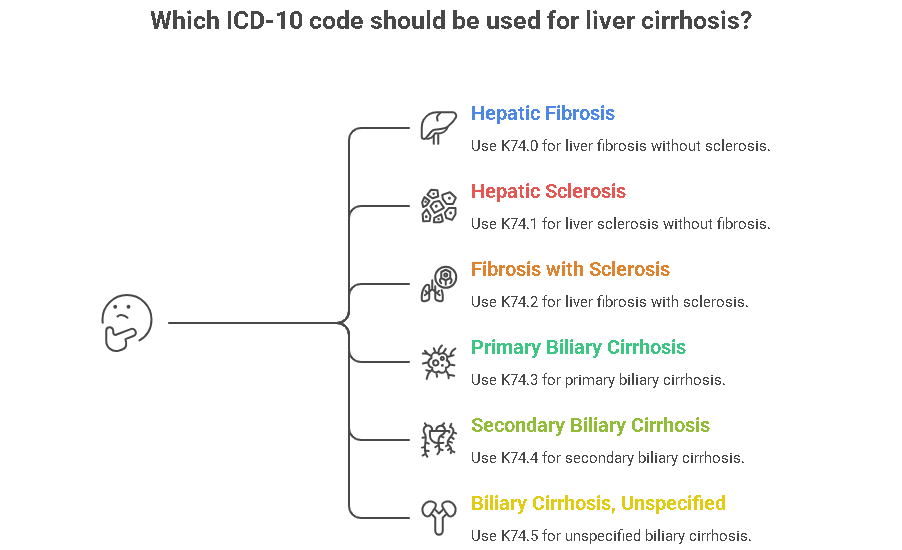
K74.0 – Hepatic Fibrosis
Before cirrhosis develops, there is fibrosis. This code represents the scarring of the liver that hasn’t yet progressed to full cirrhosis. It is further broken down into:
- K74.00: Hepatic fibrosis, unspecified.
- K74.01: Early fibrosis.
- K74.02: Advanced fibrosis.
K74.1 – Hepatic Sclerosis
This refers to the hardening of the liver tissue, often associated with chronic congestion or other underlying liver diseases.
K74.2 – Hepatic Fibrosis with Hepatic Sclerosis
A combination code used when both fibrosis and sclerosis are present, indicating a more complex pathological state.
K74.3 – Primary Biliary Cirrhosis
This is a specific type of cirrhosis caused by damage to the bile ducts in the liver. It is an autoimmune condition where the bile ducts are slowly destroyed, leading to bile buildup and eventually cirrhosis. It is a critical distinction because it is not related to alcohol or viral hepatitis.
K74.4 – Secondary Biliary Cirrhosis
This code is used when cirrhosis results from a prolonged obstruction of the bile ducts, such as from a gallstone, tumor, or stricture, rather than an autoimmune attack.
K74.5 – Biliary Cirrhosis, Unspecified
When documentation indicates biliary cirrhosis but does not specify whether it is primary or secondary, this is the code to use.
K74.6 – Other and Unspecified Cirrhosis of Liver
This is the “catch-all” category, containing the most frequently used codes for general cirrhosis:
- K74.60: Unspecified cirrhosis of liver (Cirrhosis NOS – Not Otherwise Specified). This is often used when the doctor documents “cirrhosis” but hasn’t specified the cause .
- K74.69: Other cirrhosis of liver. This is used for cryptogenic cirrhosis (cirrhosis of unknown cause) or other specific forms not classified elsewhere .
Important Excludes: When Not to Use K74
A common mistake is using K74 when the cirrhosis has a known, specific cause that has its own code category. The ICD-10 guidelines have strict “Excludes1” notes for the K74 category .
If the cirrhosis is due to alcohol, you cannot use K74. Instead, you must use codes from the K70 category:
- K70.2: Alcoholic fibrosis and sclerosis of liver.
- K70.3: Alcoholic cirrhosis of liver.
- K70.30: Alcoholic cirrhosis of liver without ascites.
- K70.31: Alcoholic cirrhosis of liver with ascites .
Additionally, if the cirrhosis is a result of toxic liver disease (caused by drugs or chemicals), you must use K71.7 (Toxic liver disease with fibrosis and cirrhosis of liver) .
Decompensated Cirrhosis and Related Conditions
When a patient with cirrhosis develops complications, the condition is referred to as “decompensated cirrhosis.” In medical coding, you often need to code for the complications separately to capture the full severity of the illness.
Portal Hypertension (K76.6)
Cirrhosis often leads to increased pressure in the portal vein. K76.6 (Portal hypertension) is a crucial code to add when this complication is present .
Esophageal Varices (I85)
When portal hypertension causes veins in the esophagus to swell, it is a serious emergency.
- I85.0: Esophageal varices with bleeding.
- I85.9: Esophageal varices without bleeding .
Hepatorenal Syndrome (K76.7)
This is a specific type of kidney failure that occurs in people with advanced liver disease or cirrhosis. It is coded with K76.7 .
Ascites (R18)
Fluid buildup in the abdomen is a hallmark of decompensation. R18.8 (Other ascites) or R18 (Ascites) is often used as a secondary diagnosis alongside the cirrhosis code .
Hepatic Encephalopathy
While often coded under G93.4 or in the K72 range, hepatic encephalopathy (confusion due to liver failure) is a critical severity indicator. If the liver failure is chronic, you might see K72.1 (Chronic hepatic failure) used .
Coding for Severity: Child-Pugh Score
In clinical documentation, you may see a reference to the Child-Pugh score, which classifies the severity of cirrhosis (A, B, or C). In the ICD-10 system, there are specific codes that allow for this level of granularity.
For example, K74.72 specifically denotes “Cirrhosis of liver, Child-Pugh score C,” indicating the most severe stage where the liver can barely perform its functions . This level of specificity helps payers understand the acuity of the condition.
The Importance of “Code Also”
The ICD-10 system uses a “Code Also” instructional note. For the K74 category, you are instructed to also code for viral hepatitis if it is applicable .
If a patient has Hepatitis C (B18.2) and has developed cirrhosis as a result, you must code both:
- The specific cirrhosis code (e.g., K74.69 for other cirrhosis).
- The chronic viral hepatitis code (B18.2).
This dual coding provides a complete clinical picture, showing the etiology (the hepatitis) and the result (the cirrhosis).
Conclusion
Selecting the correct ICD-10 code for liver cirrhosis requires attention to detail. You must determine if the cause is alcoholic (K70.3), biliary (K74.3-K74.5), or unspecified (K74.60). You must check for exclusions and always remember to add secondary codes for complications like ascites (R18), varices (I85), or portal hypertension (K76.6). By mastering these nuances, you ensure accurate medical records, proper reimbursement, and a clear representation of the patient’s health status.
Frequently Asked Questions (FAQs)
Q1: What is the most commonly used ICD-10 code for liver cirrhosis?
A: The most common billable code is K74.60 (Unspecified cirrhosis of liver). However, K70.30 (Alcoholic cirrhosis of liver without ascites) is also very common if the cause is alcohol-related.
Q2: What is the difference between K74 and K70 codes for cirrhosis?
A: K74 codes are used for non-alcoholic cirrhosis (such as biliary cirrhosis or cryptogenic cirrhosis). K70 codes are specifically reserved for alcoholic liver disease. Using the wrong category can result in denied insurance claims.
Q3: Can I use a cirrhosis code for liver fibrosis?
A: No. Liver fibrosis is coded using K74.0 (Hepatic fibrosis). While fibrosis can lead to cirrhosis, they are pathologically distinct stages. It is important to use the code that matches the documented stage of liver disease.
Q4: What code is used for cirrhosis with ascites?
A: If the cirrhosis is alcoholic, you would use K70.31 (Alcoholic cirrhosis with ascites). If the cirrhosis is non-alcoholic, you would use the specific K74 code for the cirrhosis type (e.g., K74.69) plus a secondary code R18.8 for the ascites.Q5: Is “end-stage liver disease” the same code as cirrhosis?
A: Not exactly. End-stage liver disease (ESLD) is often coded as K72.1 (Chronic hepatic failure) . If a patient has cirrhosis that has progressed to liver failure, you would typically code for both the cirrhosis (etiology) and the chronic hepatic failure (manifestation).