
Introduction:
Let’s be real for a second. Running a small medical practice today isn’t just about patient care; it’s a serious business operation. You didn’t go through years of med school or advanced practice nursing to argue with insurance companies about denied claims, right? Yet, that’s exactly where a lot of small practice owners find their time—and their revenue—draining away.
If you’ve been searching for RCM software solutions for small practices, you already know the struggle. The days of spreadsheets and sticky notes are long gone. In 2026, the right software doesn’t just process payments; it acts like a silent partner that keeps your cash flow healthy. Based on current market leaders and user feedback, we’ve scanned the landscape to bring you the top performers that actually understand the budget and staffing constraints of a small operation.
What to Look for in RCM Software (Before You Buy)
Before we dive into the specific platforms, let’s talk about the non-negotiables. The top-ranking sites all emphasize that small practices need a specific mix of power and simplicity. You don’t need enterprise-level bloatware; you need tools that work out of the box.
Seamless EHR Integration
If your billing software doesn’t talk to your Electronic Health Record (EHR), you’re just creating more manual work. The best revenue cycle management tools sync automatically. When a doctor enters a diagnosis, the billing codes should populate instantly. This single feature cuts down on claim denials caused by mismatched codes.
Denial Management and Claim Scrubbing
This is the big one. You want a system that checks your claims for errors before you send them out (that’s “claim scrubbing”). If the software catches a missing modifier or a coding error, it saves you the 30-to-60-day wait for a denial. Look for platforms that offer intelligent denial management that tells you why it was denied and helps you fix it fast.
Transparent and Fair Pricing
Small practices operate on thin margins. Many of the top solutions now offer transparent, month-to-month pricing rather than locking you into expensive long-term contracts. Some charge a percentage of collections, while others have flat monthly fees.
The Top RCM Software Solutions for Small Practices
After analyzing the market and the current front-runners for 2026, here are the standout RCM software solutions for small practices that consistently deliver results.
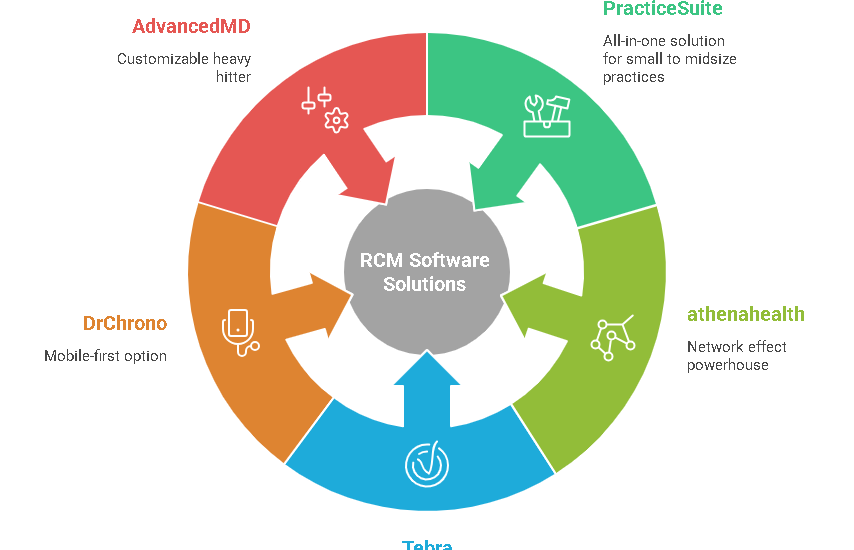
1. PracticeSuite: The Best All-in-One for Small to Midsize Practices
If you look at the landscape of medical billing, PracticeSuite keeps popping up as a favorite for smaller operations. Why? Because they understand that small practices often need to do more with less.
- Why it ranks: PracticeSuite offers a truly comprehensive cloud-based platform that covers over 150 billing specialties. It’s not just a billing add-on; it’s a full RCM service with real-time dashboards.
- Key Features: You get real-time eligibility verification, which means your front desk knows the patient’s co-pay before they even sit down in the waiting room. Their enterprise claims management lets you handle rejections and payment posting from a single screen.
- Best For: Small practices that plan to grow. You can start with just the billing module and scale up to their full EHR suite as you expand.
2. athenahealth: The Network Effect Powerhouse
athenahealth is a giant in the space, but they’ve tailored their athenaOne and athenaIDX solutions to be flexible enough for smaller groups. They operate on a unique model that uses collective data from their massive network to improve your billing.
- Why it ranks: They use AI-enabled automation to handle routine A/R follow-up tasks without you lifting a finger. They also use “gamification” to keep their billing teams sharp, which indirectly benefits your bottom line.
- Key Features: The software excels at automatic waitlist scheduling and denial analysis. If a claim is denied, the system doesn’t just log it; it helps your staff understand the root cause.
- Best For: Practices that want a hands-off approach but still want to maintain control over their financial KPIs through executive dashboards.
3. Tebra (formerly Kareo): The User-Friendly Contender
Tebra has become a household name for independent practices because it prioritizes the user experience. If your staff gets frustrated easily with clunky software, Tebra is usually the safe bet.
- Why it ranks: It’s built for the cloud and designed with a modern interface. It connects clinical workflows directly to financial ones.
- Key Features: Robotic process automation (RPA) handles repetitive billing workflows. They also offer integrated patient scheduling and automated patient statements, which means you get paid faster on the patient responsibility side.
- Best For: Solo practitioners and very small groups who want something that “just works” without a steep learning curve.
4. DrChrono: The Mobile-First Option
We live in a mobile world, and DrChrono has capitalized on that with its award-winning iOS application. For small practices where doctors are always on the move, this is a game-changer.
- Why it ranks: It offers flexibility. You can manage the entire practice from an iPad or iPhone, which is perfect for small clinics that don’t want a front desk full of desktop towers.
- Key Features: The platform includes customizable billing profiles with frequent diagnoses codes, making it faster to chart and bill. Their denial analysis reports are top-notch, giving you a clear picture of where money is leaking.
- Best For: Primary care and specialty practices that are heavily invested in the Apple ecosystem or have remote providers.
5. AdvancedMD: The Customizable Heavy Hitter
AdvancedMD is known for its robust feature set that can be tailored to specific specialties. While they serve large enterprises, their offerings for small practices are comprehensive without being overwhelming.
- Why it ranks: They offer integrated scheduling, telehealth, and billing in one suite. Their reporting and analytics are some of the best in the industry, allowing you to drill down into specific payer performances.
- Key Features: Look for their automated appeal filing for denied claims and their out-of-network billing support. They also provide strong compliance tracking to keep you safe from audits.
- Best For: Specialty small practices (like dermatology or physical therapy) that need specific templates and billing rules.
The Shift to AI-Powered RCM in 2026
The buzzword this year is “Automation,” but specifically, it’s about revenue cycle management tools that use AI to predict denials before they happen. If you look at the newer solutions climbing the ranks, they are incorporating AI agents to handle the grunt work.
Nanonets Health: Front-End Automation
For small practices, the front-end chaos (scheduling, eligibility, pre-auth) is a huge time suck. Nanonets Health specializes in automating these exact tasks. It integrates directly with your EHR to ensure data is consistent from the first phone call. This is a great add-on if your current RCM is weak on the intake side.
Thoughtful AI: The Full-Cycle Guarantee
Some smaller practices are turning to companies like Thoughtful AI, which offer guarantees on financial improvements. They cover the entire cycle, from patient intake to payment posting, using AI “employees” that work alongside your human staff. For a lean team, having an AI that never sleeps chasing down denials can be a huge relief.
Making the Final Decision: Software vs. Service
One of the biggest questions small practices face is whether to buy software or hire a service. As noted in several buyer’s guides, medical billing software gives you control. You hire the staff, you buy the software, and you manage the process. RCM services, on the other hand, mean you outsource the work.
For 2026, the sweet spot for many small practices is a hybrid approach: using robust software like PracticeSuite or athenahealth in-house, but outsourcing specific high-stress tasks like denial management to the vendor’s professional services team. This keeps your overhead lower than hiring a full-time billing specialist, but gives you more transparency than handing over the entire revenue cycle to a black box.
Conclusion: Your Revenue Cycle Deserves Attention
You didn’t open a practice to become a billing expert. However, in the current healthcare economy, ignoring your revenue cycle is the fastest way to close your doors. The top RCM software solutions for small practices listed above are designed to lift that burden. Whether you choose the simplicity of Tebra, the mobile flexibility of DrChrono, or the comprehensive power of PracticeSuite, the key is to implement a solution that scrubs your claims, verifies eligibility in real-time, and gives you clear visibility into your financial health.
Take advantage of free trials and demos. Ask the vendors how they handle integration with your current EHR. The right fit will feel less like a piece of software and more like a partner in your practice’s success.
Frequently Asked Questions (FAQs)
What is the difference between medical billing software and RCM software?
Medical billing software is a subset of RCM. Billing software focuses on the actual task of generating and sending claims. RCM software solutions for small practices cover the entire financial lifecycle, including patient scheduling, eligibility verification, coding, claims submission, denial management, and patient payment collections .
How much does RCM software cost for a small practice?
Pricing varies. Some vendors charge a monthly subscription fee per provider (ranging from $100 to $500 per month), while others charge a percentage of your total collections (usually between 3% and 7%). Be sure to ask about setup fees, clearinghouse fees, and integration costs, as these can add up .
Can RCM software really help reduce claim denials?
Absolutely. Modern revenue cycle management tools use “claim scrubbing” technology to check for errors before the claim is ever sent to the payer. They also flag common denial reasons so your staff can fix recurring issues. This significantly increases your first-pass acceptance rate .
Do I need to buy new hardware to run these solutions?
Not usually. Most modern platforms are cloud-based (SaaS), meaning you just need a decent internet connection and a computer or tablet. You can access them from anywhere without installing bulky servers .
Is it worth getting AI-powered RCM for a very small practice?
Yes, especially if you are a solo practitioner. AI tools handle repetitive tasks like data entry and eligibility checks, effectively acting as a virtual administrative assistant. This frees you up to focus on patients rather than paperwork